

LED linear wall wash lighting transforms ordinary surfaces into stunning visual displays. These versatile fixtures create smooth, even illumination across walls and architectural features.
At PacLights, we see architects and designers struggling with fixture selection daily. The right choice depends on your specific application, technical requirements, and installation environment.
Where Do LED Linear Wall Washers Work Best
Building Facades Showcase Architectural Excellence
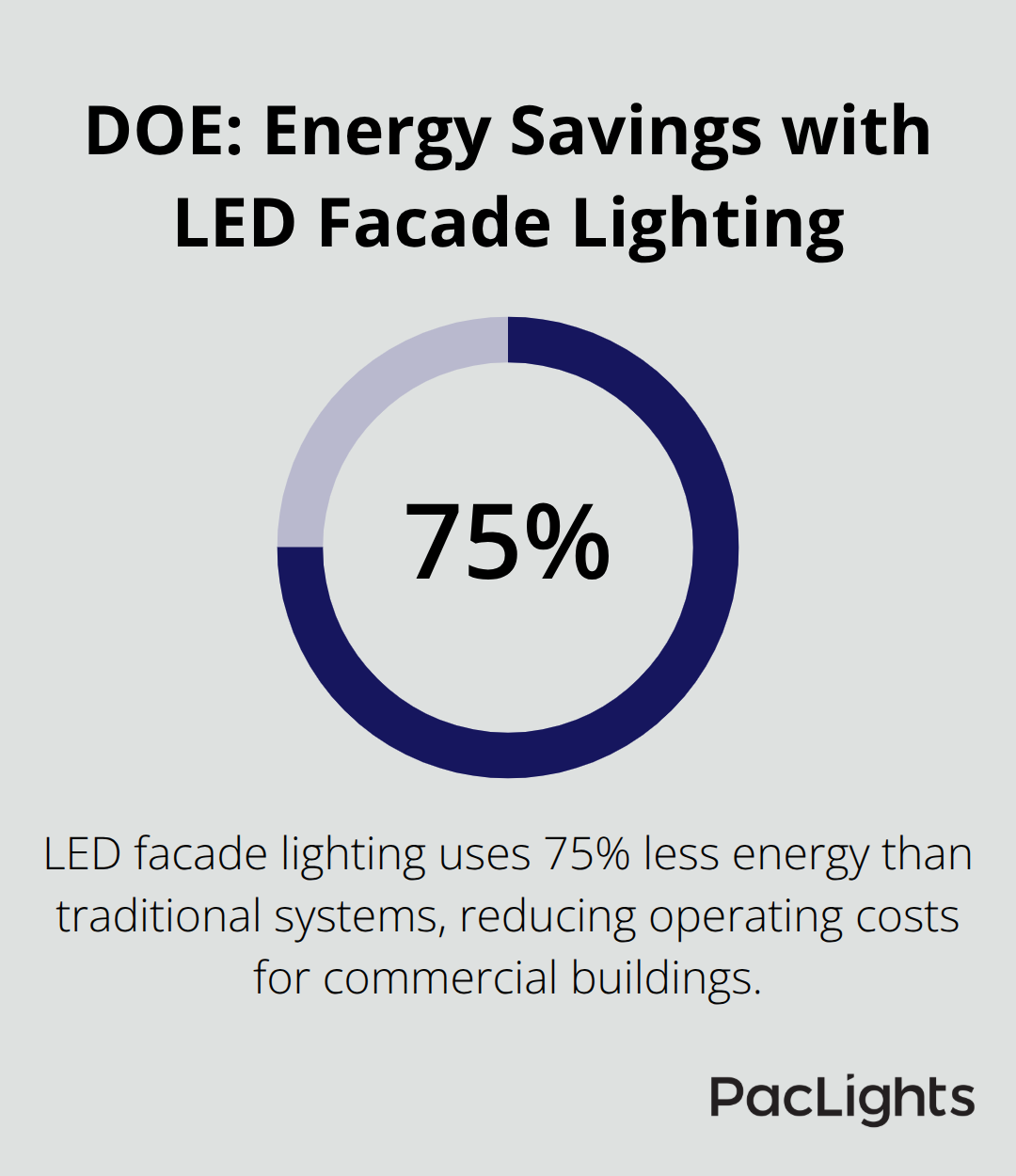
Building facades demand precise illumination to showcase architectural details effectively. LED linear wall washers excel at highlighting textural elements like stone, brick, or metal cladding with uniform light distribution. The U.S. Department of Energy reports that LED facade lighting uses 75% less energy than traditional systems, making these fixtures the smart choice for commercial buildings.
Modern projects require 18W to 36W fixtures spaced 20-60 cm from surfaces to prevent overexposure while maintaining even coverage.
Retail Spaces Transform Customer Experience
Retail environments benefit from wall wash techniques that create inviting atmospheres and highlight merchandise displays. Linear fixtures with 30-degree beam angles work best for product walls, while wider angles suit ambient lighting needs. DMX512 control systems enable dynamic color changes for seasonal promotions and special events. Position fixtures at heights between 3-5 meters for optimal light distribution across merchandise areas. Quality LED chips from manufacturers like Osram provide consistent color rendering with CRI ratings above 90 (which ensures accurate product representation).
Outdoor Applications Demand Weather-Resistant Solutions
Landscape and hardscape lighting demands fixtures with IP67 or higher ratings to withstand environmental conditions. LED linear wall washers illuminate retaining walls, garden features, and outdoor architectural elements effectively. High-power options reach 96W and can illuminate surfaces up to 10 meters away, perfect for large-scale installations. Wireless control systems use Wi-Fi or Zigbee protocols to simplify installation in outdoor environments where control cables prove challenging to run. Temperature-resistant designs maintain performance in extreme weather conditions (from -40°F to 140°F) while reducing maintenance requirements.
Understanding these application requirements helps narrow your fixture selection, but technical specifications determine whether your chosen fixtures will deliver the performance you need.
What Technical Specs Matter Most
Lumen output determines your fixture’s performance more than any marketing claim. Wall wash applications need 200-300 lumens per linear foot for accent lighting, while 400-600 lumens per linear foot work for primary illumination tasks. Beam angles between 20-40 degrees provide optimal wall coverage without light spillage. We recommend 30-degree angles for most installations because they balance coverage width with intensity control.
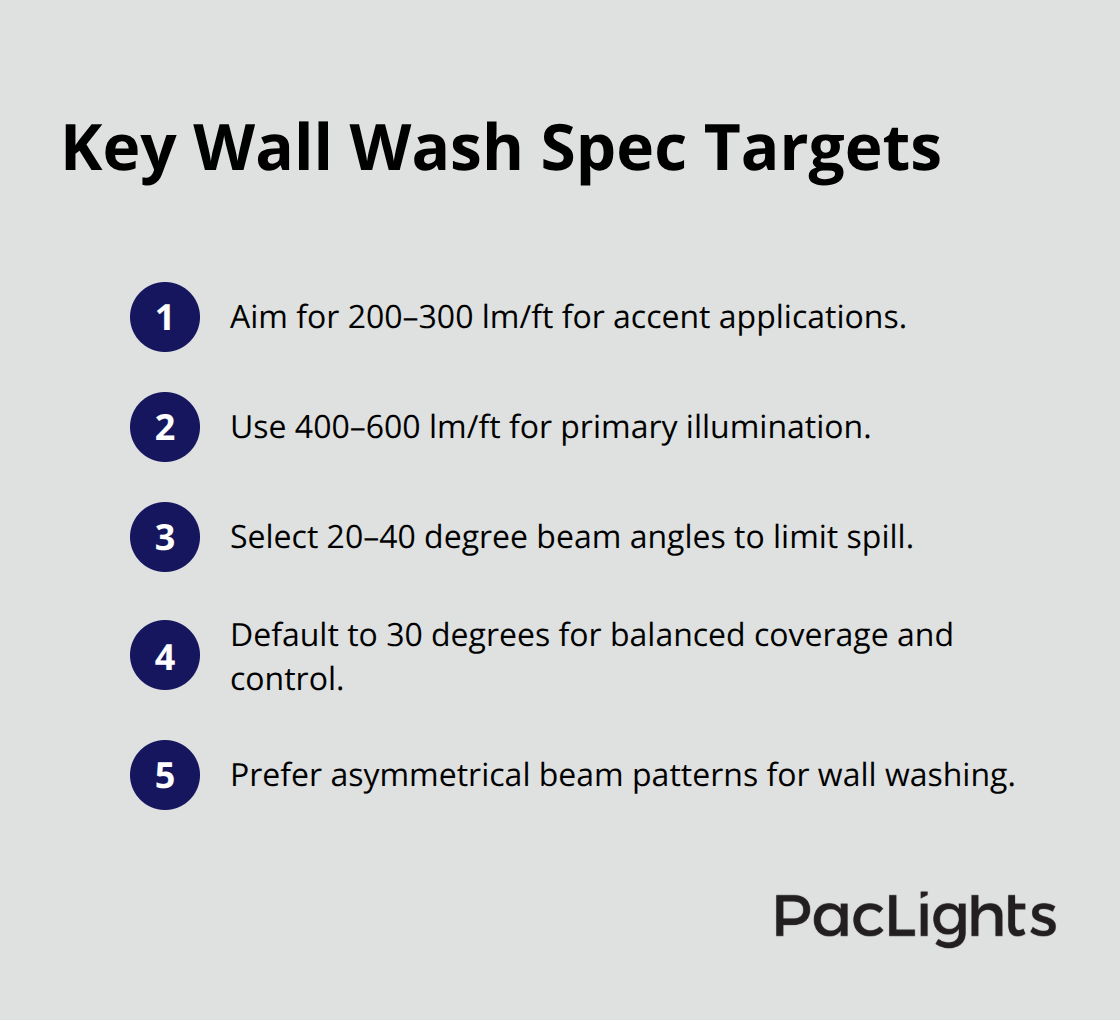
Asymmetrical beam patterns work better than symmetrical ones for wall washing since they direct more light toward the surface rather than into space.
Color Temperature and Color Rendering Drive Visual Impact
Color temperature selection affects perception dramatically. Retail spaces perform best with 3000K for warm, inviting atmospheres, while commercial facades need 4000K for crisp, professional appearance. Never compromise on CRI ratings below 80 for any application. Osram and other premium manufacturers deliver CRI values above 90, which means accurate color representation that cheaper alternatives cannot match. RGB and RGBW chips enable dynamic effects, but single-color fixtures provide better light quality for permanent installations.
Weather Protection Ratings Determine Longevity
IP65 ratings handle most outdoor applications, but IP67 or IP68 ratings are non-negotiable for wet locations and direct weather exposure. Temperature resistance specifications matter more than most designers realize. Quality fixtures operate from -40°F to 140°F without performance degradation (Chinese manufacturers often skimp on thermal management, leading to premature failures in extreme conditions). Proper heat dissipation extends LED life from 25,000 hours to over 50,000 hours, making initial investment worthwhile.
Wattage Selection Affects Performance and Costs
Wattage requirements depend on installation distance and desired light levels. Fixtures positioned 20-60 cm from walls need 18W to 36W for standard applications, while larger buildings may require 96W options for adequate coverage. Higher wattages increase both initial costs and energy consumption (but provide better light distribution for challenging installations). Calculate your specific needs using lighting simulation software like Dialux to avoid over-specification and unnecessary expenses.
These technical specifications form the foundation of fixture selection, but proper installation and design considerations determine whether your chosen fixtures deliver the expected results.
How Do You Install Wall Wash Fixtures Correctly
Mounting Distance and Placement Strategy Matter Most
Installation distance between fixtures and walls directly affects light quality and energy efficiency. Position linear wall washers 20-60 cm from illuminated surfaces to achieve uniform coverage without hotspots or scalloping effects. Closer distances below 20 cm create uneven light patterns, while distances that exceed 60 cm waste energy and reduce illumination effectiveness. Mount fixtures at heights between 3-5 meters for retail applications and up to 10 meters for large architectural installations. Recessed options provide the cleanest appearance for indoor applications, while surface-mounted versions work better for retrofit projects where structural modifications prove costly. Space individual fixtures 1.5-2 meters apart along the wall length to maintain consistent illumination levels across the entire surface.
Power Requirements Determine Circuit Capacity
Electrical plans must account for total wattage loads before installation begins. Linear wall wash fixtures typically draw 18-96W per unit (which means a 10-fixture installation requires 180-960W capacity plus 20% safety margin for circuit protection). Install dedicated circuits for these loads to prevent interference with other electrical systems. Calculate your total power draw early to avoid costly electrical upgrades during installation. Higher wattage fixtures need heavier gauge wiring and may require additional circuit breakers depending on local electrical codes.
Control System Selection Affects Installation Complexity
DMX512 control requires separate low-voltage cables alongside power feeds, while DALI systems need specialized drivers that cost more but offer individual fixture control. Wireless control systems that use Wi-Fi or Zigbee eliminate control cable runs but require network infrastructure and backup power for reliable operation. Forward phase and 0-10V protocols provide the most reliable performance with minimal electromagnetic interference compared to reverse phase systems that cause LED flicker in many installations.
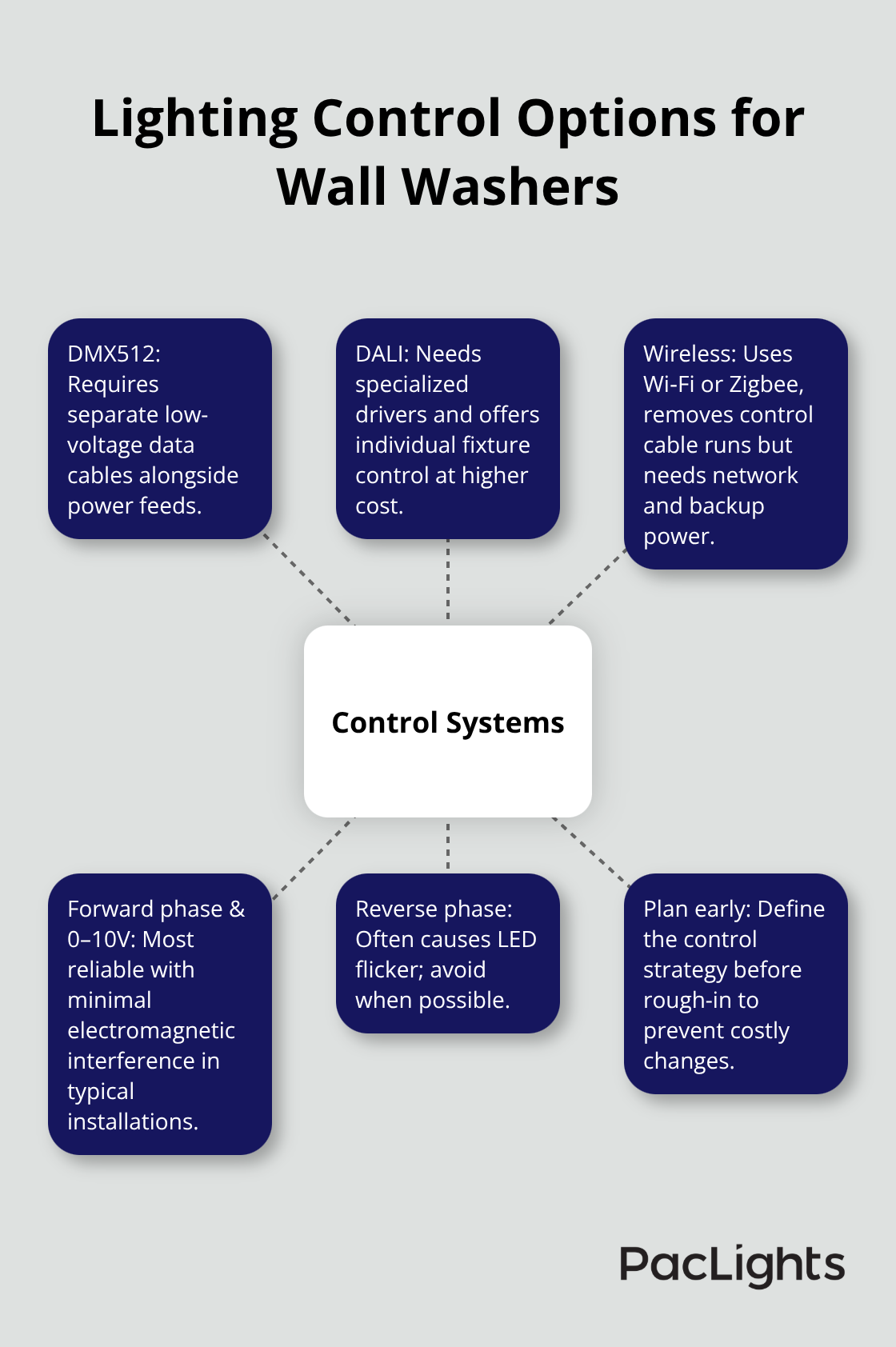
Plan your control strategy before rough-in work begins to avoid expensive modifications later.
Final Thoughts
LED linear wall wash lighting selection demands careful attention to technical specifications and installation requirements. Lumen output between 200-600 lumens per linear foot, beam angles of 20-40 degrees, and CRI ratings above 80 create effective installations. IP67 ratings protect outdoor fixtures while proper distances of 20-60 cm from surfaces prevent hotspots and energy waste.
Energy efficiency benefits make LED wall wash systems smart investments for any project. The U.S. Department of Energy confirms 75% energy savings compared to traditional systems, while quality fixtures deliver 50,000+ hour lifespans that reduce maintenance costs. DMX512 and DALI control systems add operational flexibility for dynamic effects (though wireless options simplify installation in challenging locations).
Installation success requires careful electrical planning and control system selection before work begins. Calculate total wattage loads early to avoid expensive circuit upgrades during construction. We at PacLights help architects and designers navigate these technical decisions with expert guidance tailored to your specific project needs.
Disclaimer: PacLights is not responsible for any actions taken based on the suggestions and information provided in this article, and readers should consult local building and electrical codes for proper guidance.