

Commercial building Christmas lights transform ordinary storefronts and office buildings into festive attractions that draw customers and boost holiday sales. Studies show that well-lit commercial properties see up to 30% more foot traffic during the holiday season.
We at PacLights know that proper installation requires careful planning, safety protocols, and the right equipment. This guide covers everything from initial assessment to maintenance throughout the season.
What Should You Consider Before Installing Commercial Christmas Lights
Assess Your Building’s Electrical Capacity
Building assessment begins with electrical capacity evaluation. Most commercial buildings operate with 200-amp to 800-amp electrical panels, but holiday lights add 20% to 40% to your electrical load. A licensed electrician must perform load calculations before you purchase lights. Buildings constructed before 1990 often need electrical upgrades to handle modern LED displays safely. Check for GFCI protection on outdoor circuits and verify that your building’s electrical system meets current NEC codes.
Choose Commercial-Grade LED Solutions
Standard residential Christmas lights fail within weeks on commercial buildings. Commercial-grade LED strings use 20-gauge wire instead of 22-gauge, which allows connection of up to 960 watts per circuit compared to 210 watts for residential versions. Look for lights with IP44 ratings minimum for outdoor use. C9 LED bulbs consume just 0.96 watts each versus 7 watts for incandescent versions, which reduces energy costs by 86%. Coaxial connectors on commercial strings prevent water intrusion and connection failures. Calculate 1.2 watts per linear foot when you plan electrical requirements.
Plan Your Timeline and Budget
Start your plans 8-12 weeks before installation. Commercial LED light strings cost $0.80 to $2.50 per foot, while professional installation ranges from $8 to $15 per linear foot (depending on building height and complexity). Factor in permit costs that average $150 to $500 for most municipalities. Schedule installations during October or early November when weather conditions remain favorable and installer availability stays higher.
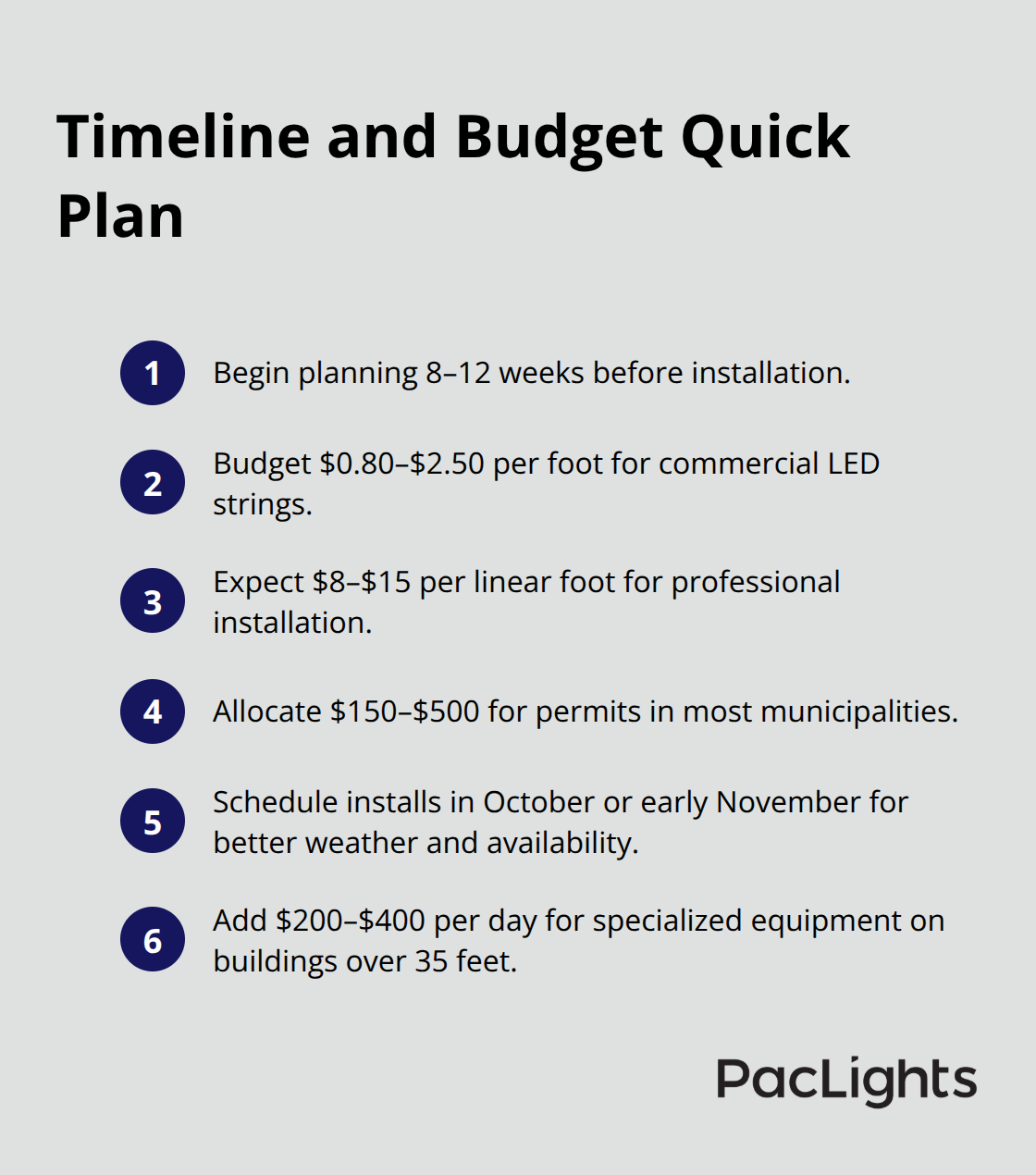
Buildings over 35 feet require specialized equipment that adds $200 to $400 per day to installation costs.
With your foundation plans complete, the next step focuses on the actual installation process and the safety protocols that protect both workers and your property.
How Do You Install Commercial Christmas Lights Safely
Safety Equipment Requirements for Commercial Installations
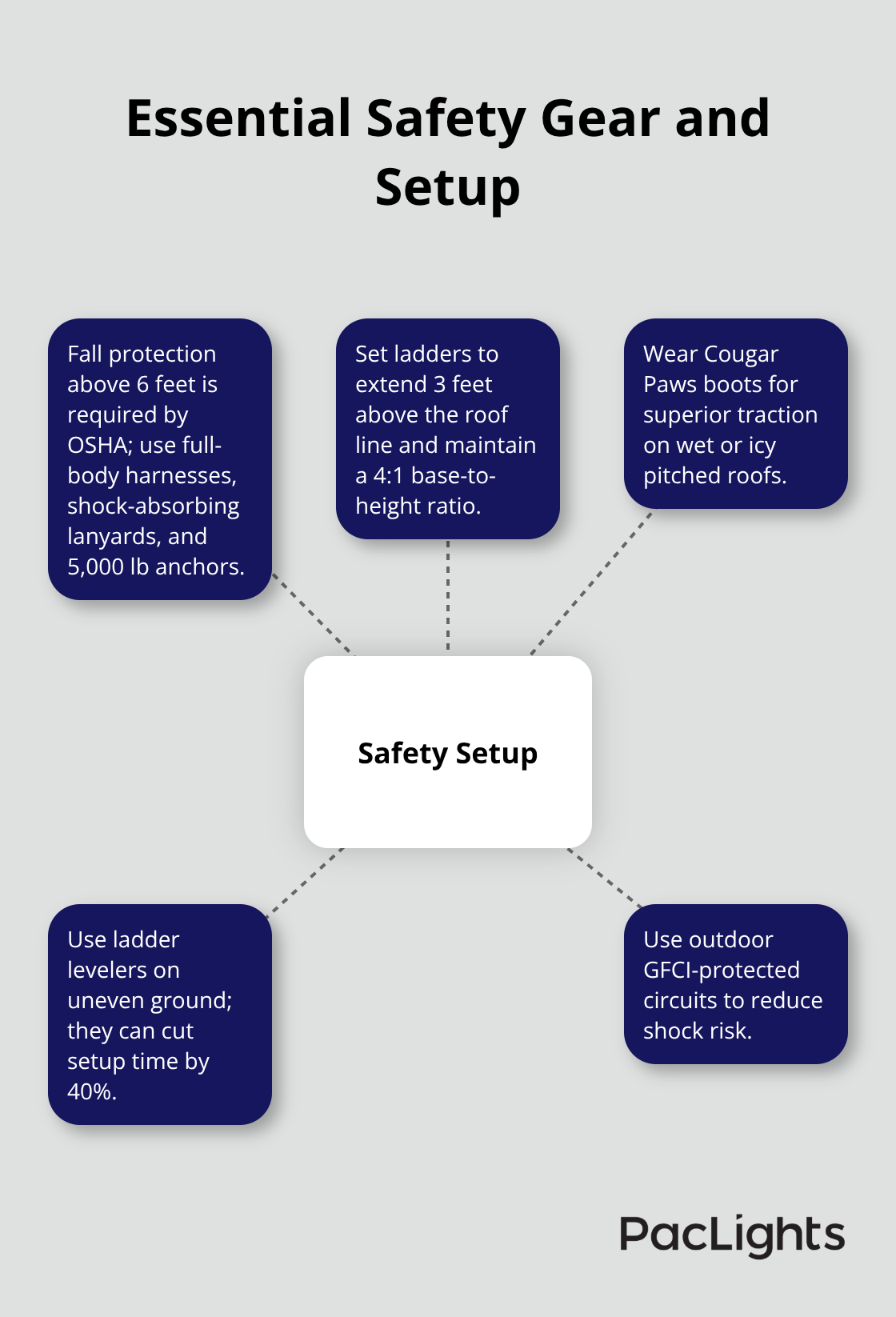
OSHA regulations mandate fall protection systems for any work above 6 feet on commercial buildings. Personal fall arrest systems must include full-body harnesses, shock-absorbing lanyards, and secure anchor points rated for 5,000 pounds per worker. Cougar Paws boots provide essential grip on pitched roofs with their specialized sole design that prevents slips on wet or icy surfaces. Extension ladders must extend 3 feet above the roof line and maintain a 4:1 ratio (for every 4 feet of height, position the base 1 foot from the building). Ladder levelers compensate for uneven ground and reduce setup time by 40% compared to manual positioning methods.
Installation Techniques for Different Building Structures
Single-story retail buildings allow ground-level installation with 16-foot extension poles for most roofline work. Multi-story office buildings require 32-foot or 40-foot dual extension ladders and two-person installation teams for safety compliance. Flat commercial roofs need temporary anchor systems installed every 30 feet along the perimeter for worker safety lines. Brick buildings work best with magnetic clips that support up to 10 pounds per attachment point, while metal siding requires specialized clips that distribute weight across multiple mounting points. Install lights from left to right in 100-foot sections to maintain consistent spacing and prevent wire tangling during the process.
Power Distribution and Electrical Connections
Commercial installations require dedicated 20-amp GFCI circuits to handle LED loads safely. Each 20-amp circuit supports up to 1,920 watts of LED lighting, which equals approximately 2,000 linear feet of commercial-grade strings. Install weatherproof junction boxes every 200 feet to create service loops for maintenance access. Coaxial connectors on commercial strings require hand-tightening to finger-tight plus one-quarter turn to prevent over-tightening damage. Test each 100-foot section with a multimeter before you connect to the main power source to identify defective strings before installation completion.
Once your lights shine bright across your building, proper maintenance becomes essential to keep your display running smoothly throughout the entire holiday season.
How Do You Keep Commercial Christmas Lights Working All Season
Weekly Inspection Protocols Save Money and Prevent Failures
Check your commercial Christmas light display every Monday morning before business hours. Walk the entire perimeter and document any dark sections, loose connections, or damaged wires with a smartphone checklist app. Commercial LED strings fail at a rate of 2-3% per week during December due to thermal cycling and weather exposure.

Focus inspections on connection points where 80% of failures occur, particularly coaxial connectors that loosen from wind movement. Test GFCI outlets weekly with the test button – a non-functional GFCI trips within 24-48 hours during winter storms and leaves entire circuits dark. Replace any bulbs with visible cracks immediately, as moisture infiltration causes cascading failures that affect up to 50 lights per string.
Weather Protection Prevents Costly Emergency Repairs
Apply dielectric grease to all outdoor connections before December weather arrives. This $3 investment per connection prevents 90% of moisture-related failures that cost $200-400 per service call. Secure loose wires with UV-resistant zip ties every 8 feet along rooflines – wind speeds above 25 mph cause wire fatigue that leads to internal breaks. Install drip loops at every connection point to direct water away from electrical components. During ice storms, never shake or hit frozen light strings, as this breaks internal copper conductors. Instead, wait for natural thaw or use a hair dryer on low heat to gradually warm connections. Keep projection lights away from water and wet areas to prevent electrical hazards and ensure all outdoor fixtures are properly rated for exterior use.
Fast Troubleshooting Techniques Keep Displays Bright
When sections go dark, start troubleshooting at the power source and work toward the problem area. Use a non-contact voltage tester to verify power at each junction box – this identifies electrical issues versus light string failures in under 2 minutes. For flickering sections, tighten coaxial connections hand-tight plus one-quarter turn (which resolves 70% of intermittent problems). Keep spare 100-foot commercial string sections on-site for immediate replacement of failed strings. Mark each circuit with colored electrical tape at the breaker panel to speed identification during emergency repairs. Most commercial displays require 2-3 replacement strings per month during peak season, so budget $150-300 for replacement inventory.
Emergency Response Procedures for Critical Failures
Power outages affect 15% of commercial displays during December storms. Install backup power strips with surge protection on critical circuits to maintain partial illumination during brief outages. Document your electrical panel layout with circuit numbers and corresponding building sections (this reduces troubleshooting time from 30 minutes to 5 minutes). Contact your electrical contractor immediately when multiple circuits fail simultaneously, as this indicates panel-level issues that require professional repair. Keep emergency contact numbers for your installer and electrician posted near the main electrical panel for quick access during after-hours failures. Store string lights properly by coiling them neatly in a dry, cool location during off-seasons to prevent damage and tangling.
Final Thoughts
Professional installation of commercial building Christmas lights delivers measurable returns that extend far beyond the holiday season. Businesses report 30% increases in foot traffic and 25% higher sales during December when they invest in quality displays. Professional installers complete projects 60% faster than DIY attempts while they maintain OSHA compliance and prevent costly accidents.
Quality LED commercial lighting systems pay for themselves within 18-24 months through energy savings alone. Commercial-grade LED strings consume 86% less electricity than incandescent alternatives and last 15-20 seasons versus 2-3 seasons for standard lights. This translates to $2,000-4,000 in annual energy savings for typical retail buildings (based on 2,000 linear feet of display).
Smart businesses begin to plan their next holiday display in January when installer schedules remain open and equipment costs drop 20-30%. Document this year’s electrical requirements, measure successful installation points, and photograph effective layouts for future reference. We at PacLights help businesses optimize energy efficiency year-round with advanced lighting solutions that reduce operational costs while they enhance customer experiences.
Disclaimer: PacLights is not responsible for any actions taken based on the suggestions and information provided in this article, and readers should consult local building and electrical codes for proper guidance.