

Selecting the right exterior commercial building lights impacts safety, security, and energy costs for your business. Poor lighting choices lead to higher utility bills and maintenance headaches.
We at PacLights help businesses navigate the complex world of commercial lighting solutions. This guide covers the essential factors that determine which lighting systems work best for your specific needs.
Which Exterior Light Types Work Best for Commercial Buildings
Commercial exterior lights fall into three main categories that serve distinct purposes. Area lights handle large open spaces like parking lots where you need uniform illumination across 200 to 400 square feet per fixture. These pole-mounted luminaires typically range from 15,000 to 40,000 lumens and work best at heights between 15 to 30 feet. Wall-mounted lights serve building perimeters and entryways with focused beams that cover 50 to 150 square feet each.
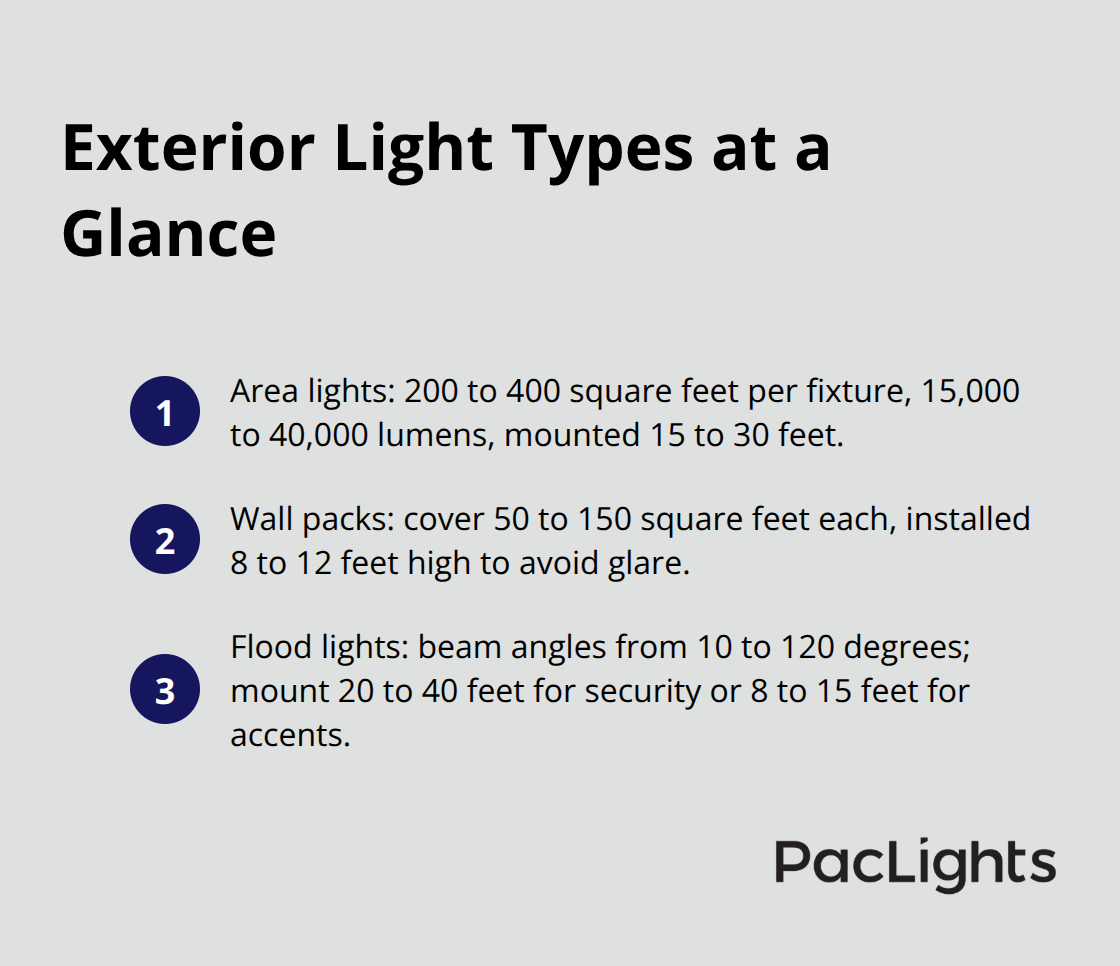
Install these at 8 to 12 feet high for optimal coverage without creating glare issues.
Area Lights for Parking Lots
Parking lot lights require fixtures that deliver 136 lumens per watt minimum to meet federal efficiency standards. LED area lights now dominate this space because they last 50,000 hours compared to 24,000 hours for metal halide alternatives. A typical 300-watt LED area light produces the same illumination as a 750-watt metal halide while it cuts energy costs by 60 percent annually. Position these lights 100 to 150 feet apart in parking areas to maintain consistent foot-candle levels between 0.5 and 2.0 across the entire surface.
Wall Pack Solutions for Building Perimeters
Wall pack lights work perfectly for walkways and building perimeters where you need downward illumination. Choose fixtures with 3,000 to 8,000 lumens for standard applications and space them 30 to 50 feet apart along building walls. These fixtures mount directly to exterior walls and provide consistent light distribution without creating hot spots or dark areas between fixtures.
Flood Lights for Security and Accent Applications
Flood lights excel at security applications and architectural accent work with beam angles from 10 to 120 degrees. Mount security floods 20 to 40 feet high to cover large areas while accent floods work better at 8 to 15 feet to highlight specific building features. Wide beam floods (90-120 degrees) work best for general security coverage, while narrow beam options (10-30 degrees) create dramatic architectural effects on building facades.
The right fixture type depends on your specific coverage needs, but performance specifications matter just as much as the fixture category you choose.
What Performance Specs Actually Matter for Commercial Exterior Lighting
Performance specifications determine whether your lighting system delivers adequate coverage without wasting energy. Light output measured in lumens tells only part of the story – distribution patterns matter more for commercial applications. A 20,000-lumen fixture with poor optics creates hot spots and shadows, while a well-designed 15,000-lumen fixture provides uniform coverage across the target area. Federal Energy Management Program data shows that fixtures meeting the 136 lumens per watt minimum can save $325 in lifetime energy costs compared to less efficient alternatives.

Color temperature between 4000K and 5000K works best for security applications because it enhances visibility and reduces eye strain for employees who work evening shifts.
Energy Costs Drive Long-Term Value
Operating costs over a 15-year lifespan often exceed initial fixture prices by 300 to 400 percent. LED fixtures that consume 150 watts cost approximately $132 annually in electricity at $0.099 per kWh, while equivalent 400-watt metal halide fixtures cost $349 yearly. The payback period for LED upgrades typically ranges from 12 to 18 months in commercial applications. Networked lighting controls add 20 to 30 percent additional energy savings through occupancy sensors and daylight harvesting features that adjust output based on actual conditions.
Weather Resistance Prevents Costly Failures
Exterior fixtures must withstand temperature swings from -40°F to 140°F while they maintain performance. IP65 ratings provide adequate protection against dust and water ingress for most commercial applications, but coastal locations require IP66 or higher ratings due to salt spray exposure. Fixtures with die-cast aluminum housings last longer than plastic alternatives in harsh weather conditions. Fixtures with surge protection rated for 10kV minimum prevent damage from electrical storms that commonly affect outdoor lighting systems.
Installation Requirements Shape Your Options
Professional installation becomes mandatory when fixtures exceed certain wattage thresholds or require specialized mounting hardware. Most commercial exterior lights need electrical permits and code compliance verification before activation. Installation height affects both performance and maintenance access (fixtures mounted above 20 feet require specialized equipment for service calls). Local building codes often dictate specific mounting requirements and electrical connections that influence your fixture selection process.
What Installation and Maintenance Requirements Apply to Commercial Exterior Lighting
Professional electrical contractors must handle installations that exceed 277 volts or fixtures mounted above 15 feet according to National Electrical Code requirements. Permits cost between $150 and $500 per project (depending on your municipality), and inspections add another $200 to $400 to installation expenses. Most commercial exterior projects require dedicated 20-amp circuits with GFCI protection, while high-wattage area lights need 30-amp circuits to handle startup currents safely. Electrical contractors charge $85 to $125 per hour for commercial work, which makes proper project coordination essential to avoid costly change orders.
Code Compliance Affects Project Timeline
Local building codes dictate specific mount requirements and electrical connections that influence your fixture selection process. Projects must pass electrical inspections before activation, and failed inspections can delay completion for weeks. Some municipalities require photometric plans that show light distribution patterns before they issue permits. These plans cost $500 to $1,200 but prevent compliance issues that force expensive fixture replacements after installation.
Smart Maintenance Strategies Reduce Long-Term Costs
LED fixtures require minimal maintenance over their 50,000-hour lifespan, but accessibility matters when service becomes necessary. Fixtures mounted above 20 feet need bucket trucks that cost $300 to $500 per service call, while ground-accessible wall packs can be serviced for $75 to $150 per visit. Photocells and occupancy sensors need cleaning every six months to maintain proper operation – dirty sensors cause lights to stay on during daylight hours and increase energy costs by 40 percent.

Group replacement of multiple fixtures reduces labor costs compared to individual replacements, with maintenance contractors offering 15 to 25 percent discounts for projects that involve ten or more fixtures.
Warranty Terms Impact Total Cost of Ownership
Standard LED fixture warranties range from five to ten years, but driver warranties often differ from LED chip coverage. Choose manufacturers that offer separate driver warranties of at least seven years because drivers fail more frequently than LED components in outdoor applications. Some manufacturers exclude surge damage from warranty coverage, which makes surge protectors a smart investment in areas with frequent thunderstorms. Extended warranty options cost 10 to 15 percent of fixture price but can save thousands in replacement costs for large installations with hundreds of fixtures.
Final Thoughts
Exterior commercial building lights demand careful evaluation of performance specs, energy efficiency, and maintenance requirements. Focus on fixtures that produce 136 lumens per watt minimum while they distribute light uniformly across target areas. LED technology provides the best value with 50,000-hour lifespans and cuts energy costs by 60 percent compared to traditional options.
Professional assessments identify optimal fixture placement and prevent compliance problems before they occur. Qualified contractors calculate proper spacing, verify code requirements, and create photometric plans that pass municipal inspections immediately. This upfront investment prevents expensive retrofits and guarantees your system performs as designed.
Document current conditions and energy costs before you start implementation. Calculate potential savings with actual utility rates and fixture specifications rather than generic estimates (avoid manufacturer marketing claims). We at PacLights help businesses select the right fixtures and provide technical support throughout the installation process.
Disclaimer: PacLights is not responsible for any actions taken based on the suggestions and information provided in this article, and readers should consult local building and electrical codes for proper guidance.