

Outdoor LED building lights transform dark properties into well-lit, secure spaces while cutting energy costs by up to 75% compared to traditional lighting systems.
These versatile fixtures provide superior illumination for commercial buildings, warehouses, and residential properties. We at PacLights help property owners choose the right LED solutions for maximum efficiency and safety.
Why LED Building Lights Cut Costs and Boost Security
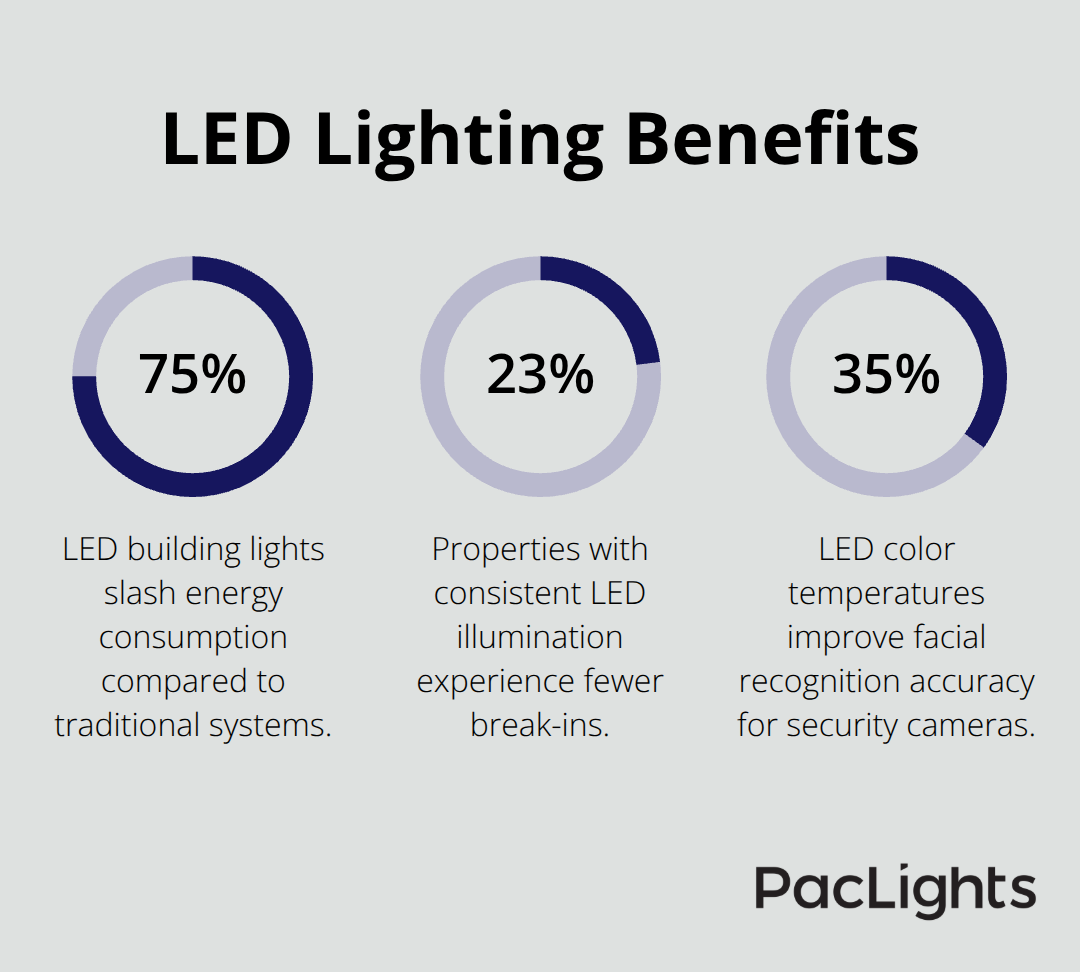
LED building lights slash energy consumption by 75% compared to traditional systems, which delivers immediate cost reductions that compound over decades. The U.S. Department of Energy reports that commercial properties that switch to LED outdoor lights save an average of $3,200 annually per 1,000 square feet of space they illuminate. These savings stem from LED efficiency ratings of 80-120 lumens per watt versus just 15-20 lumens per watt for incandescent fixtures.
Energy Bills Drop Immediately After Installation
Commercial LED fixtures consume 40-60 watts while they produce the same light output as 250-400 watt metal halide or high-pressure sodium lights. A typical warehouse with 20 outdoor fixtures reduces monthly electricity costs from $480 to $120 after LED conversion. Many utility companies offer rebates worth 20-40% of LED installation costs (with some regions that provide instant rebates at point of purchase). Smart controls amplify these savings when they automatically dim lights during low-traffic periods or activate motion sensors that reduce runtime by 30-50%.
Security Improves With Consistent Bright Illumination
LED fixtures eliminate the warm-up delays and frequent burnouts that create security vulnerabilities with traditional systems. Metal halide lights require 3-5 minutes to reach full brightness, while LEDs provide instant maximum output. Studies from the International Association of Chiefs of Police show that properties with consistent LED illumination experience 23% fewer break-ins compared to those with traditional systems. LED color temperatures of 4000K-5000K enhance facial recognition capabilities for security cameras (which improves identification accuracy by 35% according to security industry research).
Maintenance Costs Vanish With 50,000-Hour Lifespans
Quality LED fixtures operate for 10-15 years without replacement, compared to 1-2 years for metal halide bulbs. This longevity eliminates the costs that recur from bulb purchases, ladder rentals, and maintenance crew labor. A property manager who oversees 100 outdoor fixtures saves approximately $8,000 annually in maintenance expenses after the switch to LEDs. Weather-resistant LED housings with IP65 ratings withstand temperature extremes from -40°F to 140°F, which prevents premature failures that plague traditional outdoor systems.
The right LED fixture type maximizes these benefits for specific applications and architectural requirements.
Which LED Fixture Type Works Best for Your Building
Wall Pack Lights Secure Building Perimeters
Wall pack lights mount directly to exterior walls and distribute light in precise patterns that eliminate dark corners where security risks concentrate. These LED fixtures produce 3,000-8,000 lumens with beam angles of 110-140 degrees, which covers 20-40 feet of ground area per fixture. Commercial properties install wall packs at 8-12 foot intervals along facades to maintain consistent 2-5 foot-candle illumination levels that meet insurance requirements for liability coverage.
Full-cutoff wall packs direct light downward to prevent light trespass violations that trigger fines (often $500-2,000 in most municipalities). Property managers choose these fixtures because they provide reliable perimeter security without creating glare that disturbs neighboring properties.
Flood Lights Cover Large Areas Effectively
Flood lights handle expansive coverage with 10,000-50,000 lumen outputs that illuminate parking lots, loading docks, and perimeter fencing across distances up to 150 feet. These fixtures mount on poles, buildings, or ground stakes with adjustable brackets that aim light precisely where needed. Security-focused installations use 5000K color temperature floods because this daylight-white spectrum enhances camera performance and facial recognition accuracy by 40% compared to warm white alternatives.
Property owners select flood lights when they need to cover multiple acres or when standard wall packs cannot reach distant areas that require illumination.

Canopy Lights Excel in Covered Spaces
Canopy lights excel in covered areas like gas stations, drive-throughs, and overhangs where they provide uniform downward illumination without glare. These fixtures integrate into ceiling structures with low-profile designs that resist vandalism while they deliver 4,000-12,000 lumens across 15-25 foot coverage areas. Motion sensor integration reduces energy consumption by 60% in low-traffic canopy applications.
These specialized fixtures work best when standard wall packs or floods would create unwanted shadows or when architectural constraints limit other fixture types. The right brightness levels and smart controls maximize performance across all these fixture categories.
What Technical Specs Matter Most for LED Selection
Brightness Output Determines Coverage Area
Lumen output directly controls how much ground area each fixture illuminates effectively. Commercial properties need 2-5 foot-candles for basic security, which requires 3,000-5,000 lumens per wall pack to cover 400-600 square feet. Parking lots demand higher illumination of 5-10 foot-candles, so flood lights with 15,000-25,000 lumens handle 1,500-2,500 square feet per fixture. The Illuminating Engineering Society recommends that you measure actual foot-candle levels with a light meter after installation because manufacturer beam angle specifications often prove inaccurate in real-world conditions.
Light distribution patterns matter more than raw lumen numbers. Type III distribution spreads light forward from walls in a rectangular pattern that maximizes usable illumination, while Type V creates circular coverage for pole-mounted applications. Property managers who choose fixtures with asymmetric optics reduce the number of required fixtures by 20-30% compared to symmetric alternatives.

Weather Ratings Prevent Costly Failures
IP65 ratings represent the minimum acceptable protection for outdoor LED fixtures because lower ratings allow moisture infiltration that destroys internal components within 2-3 years. Quality fixtures feature IP66 or IP67 ratings that withstand direct water jets and temporary submersion. Temperature ratings from -40°F to 140°F handle extreme weather without performance loss, while cheaper fixtures fail when temperatures drop below 10°F or exceed 100°F.
Salt spray resistance becomes critical for coastal properties within 10 miles of oceans. Fixtures without marine-grade coatings corrode within 18 months in salt air environments (which creates $2,000-4,000 replacement costs per failed unit). IK08 impact ratings protect against vandalism and accidental damage from maintenance equipment.
Smart Controls Amplify Energy Savings
Occupancy sensors reduce runtime by 40-60% in low-traffic areas when they activate lights only upon motion detection. Photocells prevent daytime operation that wastes energy, while astronomical timers adjust on/off schedules based on sunrise and sunset times throughout the year. Controls maintain minimum security illumination at 30-50% output during off-peak hours, then boost to full brightness when sensors detect activity.
Networked systems allow remote control of individual fixtures, which helps facility managers identify failures before they compromise security. These systems cost $50-150 per fixture but pay for themselves through reduced maintenance calls and optimized energy consumption (integration with management systems creates automated responses to security events or weather conditions).
Final Thoughts
Outdoor LED building lights cut energy costs by 75% while they boost security through consistent illumination that spans 10-15 years without maintenance. These fixtures eliminate recurring expenses and security vulnerabilities that traditional systems create. Professional installation positions fixtures correctly and integrates smart controls that maximize energy savings.
Property owners recover their investment within 2-4 years through reduced electricity bills and eliminated maintenance costs. Utility rebates and tax incentives accelerate these returns (which improve annually as energy prices rise). Quality LED systems provide reliable performance that protects properties while they reduce operational expenses.
We at PacLights offer LED lighting solutions that include lighting layouts and ROI assessments for your specific needs. Our team helps you select the right fixtures and controls for maximum efficiency. Contact us to transform your property with energy-efficient LED technology that delivers measurable results.
Disclaimer: PacLights is not responsible for any actions taken based on the suggestions and information provided in this article, and readers should consult local building and electrical codes for proper guidance.