

Hazardous work environments demand lighting that doesn’t compromise on safety. Vapor tight industrial lights are engineered to protect your facility from dust, moisture, and explosive atmospheres while delivering reliable illumination.
At PacLights, we’ve seen firsthand how the right lighting solution prevents equipment failures and keeps workers safe. This guide walks you through everything you need to know about selecting and implementing vapor tight lighting for your operation.
What Vapor Tight Industrial Lights Actually Protect
Vapor tight industrial lights are sealed luminaires that block moisture, dust, chemical vapors, and corrosive substances from reaching internal components. Unlike standard fixtures with open designs, vapor tight lights use gasket-sealed housings and corrosion-resistant materials to maintain performance in wet, dirty, or chemically aggressive environments. The key distinction lies in their construction: integrated molding minimizes gaps at joints, waterproof connectors seal external power and signal lines, and many high-demand models use potting or encapsulation to protect internal circuits. IP65, IP66, or IP67 ratings indicate the level of protection, with IP66 being the most common standard for industrial vapor tight applications. This matters because facilities operating in moisture-heavy or contaminated spaces face real financial consequences-equipment failures cost money, unplanned downtime disrupts production, and worker safety suffers when lighting fails unexpectedly.
Where These Lights Perform Best
Vapor tight fixtures belong in food processing plants, cold storage facilities, car washes, pharmaceutical manufacturing, chemical storage areas, and outdoor environments exposed to rain or salt spray. Food processing demands IP66 minimum ratings plus NSF certification to meet sanitary requirements; using non-compliant lighting in these spaces creates inspection failures and liability exposure. Cold storage and refrigerated warehouses operate at temperatures down to -40°F, where standard fixtures become brittle and fail; vapor tight LED solutions rated for these extremes deliver reliable performance.
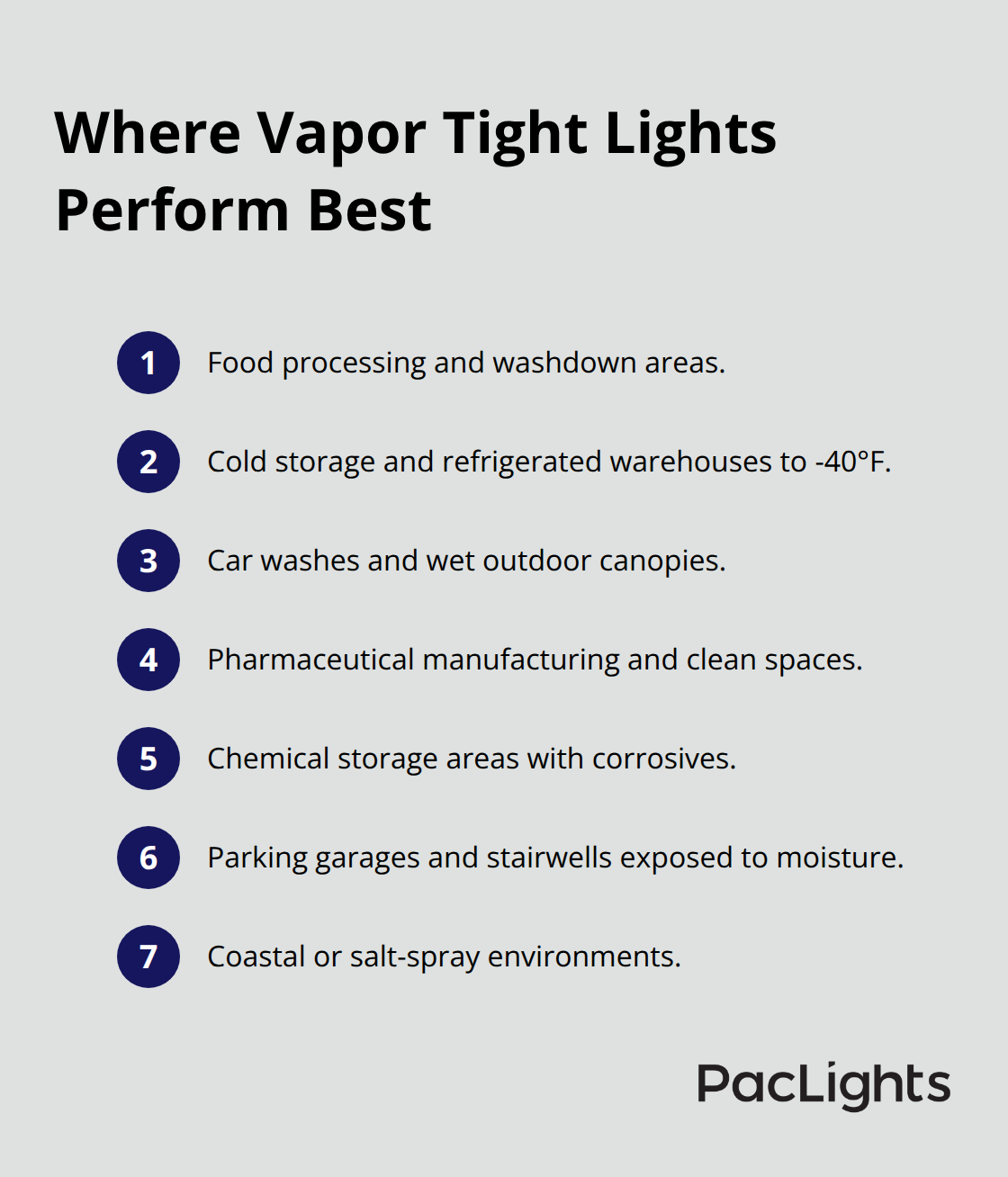
Parking garages, stairwells, and outdoor canopies require vapor tight protection because moisture accumulation inside standard fixtures causes corrosion, reducing lumen output and creating safety hazards. Oil refineries, chemical plants, and grain handling facilities face additional complexity: they may require explosion-proof or hazardous location certification beyond basic vapor tight sealing, depending on OSHA classification of the space.
Compliance Standards That Matter
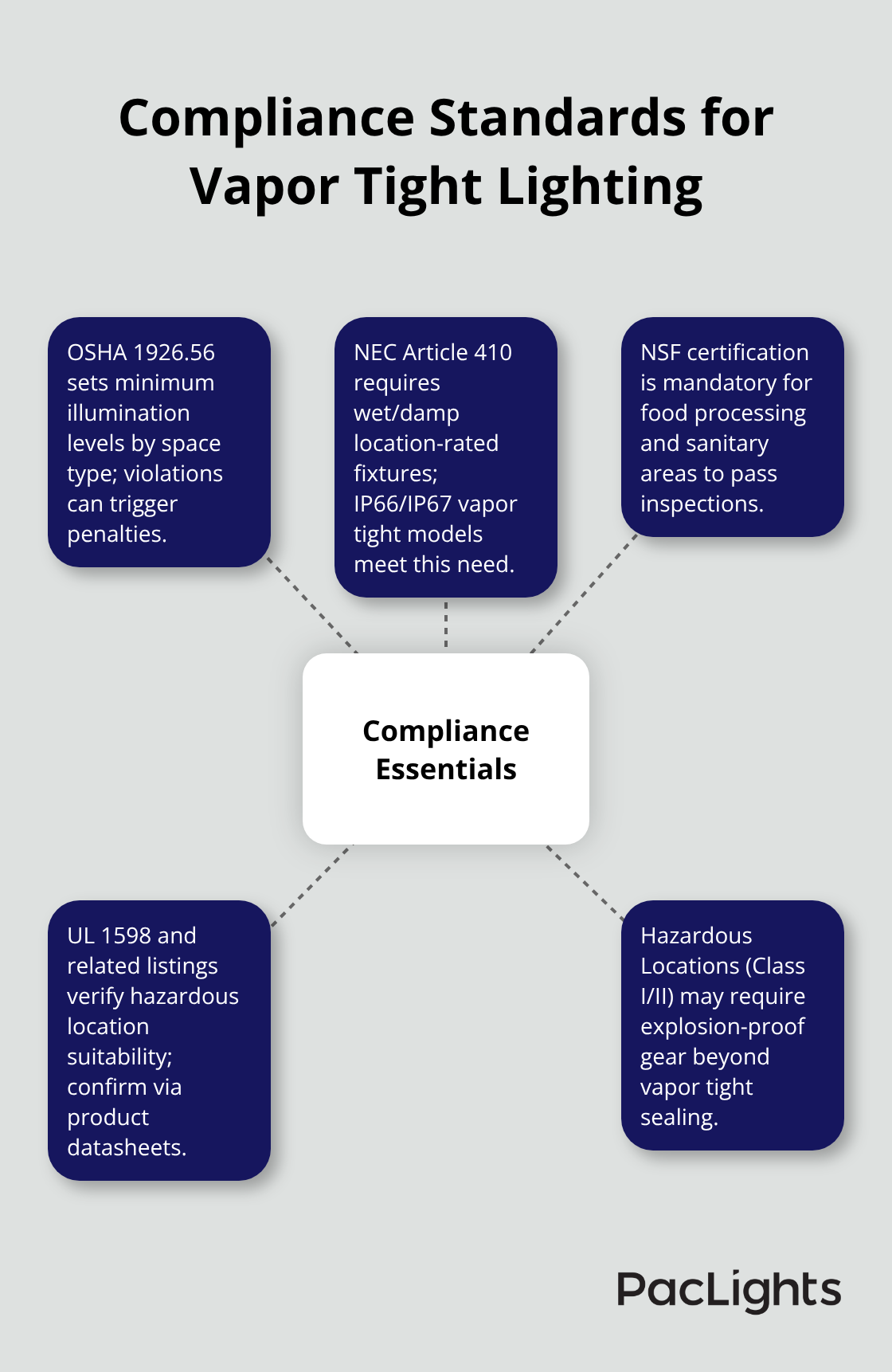
OSHA 1926.56 sets illumination minimums across industrial spaces: general construction areas require 5 foot-candles, while plant shops and active storage demand 10 foot-candles. NEC Article 410 specifies that wet and damp locations must use fixtures rated for those conditions; vapor tight fixtures with appropriate IP ratings satisfy this requirement without costly retrofits. NSF certification becomes mandatory in food processing and sanitary environments-skipping this step invites regulatory penalties. UL 1598 listings or equivalent third-party certifications verify that fixtures meet hazardous location standards; always verify these certifications in product datasheets rather than assuming compliance from marketing claims. Facilities operating in Class I, Division 1 environments (where flammable gases or vapors may be present during normal operations) or Class II locations (where combustible dusts exist) need specialized equipment beyond standard vapor tight protection. The financial stakes are significant: OSHA penalties for noncompliance reach up to $15,000 per violation, and insurance claims or litigation from equipment failures compound the cost.
Moving Forward With Your Selection
Verifying IP ratings, temperature compatibility, and applicable certifications during the selection phase prevents expensive compliance failures later. The right vapor tight fixture protects your workers, maintains regulatory standing, and keeps your operation running smoothly-but only if you select equipment that matches your specific environment and hazard classification.
How Vapor Tight Lights Prevent Safety Failures
Moisture and Corrosion Stop at the Seal
Sealed fixtures stop moisture and corrosives before they damage electrical components-and that protection matters more than most facility managers realize. Water reaches the ballast, wiring, and light source within weeks when it enters a standard fixture, not months. Corrosion accelerates in food processing plants, chemical storage areas, and coastal facilities where salt spray or acidic vapors attack metal contacts. Vapor tight construction uses gasket-sealed housings and corrosion-resistant die-cast aluminum or copper-free composites to block these hazards entirely. The internal potting or encapsulation in high-demand models protects circuits from moisture that might otherwise short out the fixture or create fire risk.
Real-world data from food processing facilities show 60 to 70 percent reductions in maintenance labor after switching to vapor tight LED systems, because sealed designs prevent dirt and moisture accumulation inside the fixture. Your maintenance team spends less time climbing ladders to replace failed lights and more time on productive work. IP66 rated fixtures handle washdown environments without degradation; IP67 models withstand temporary submersion. Vapor tight LEDs rated for extreme temperatures avoid the brittleness and failure rates that plague standard fixtures in refrigerated spaces operating down to -40°F.
Compliance and Regulatory Protection
OSHA 1926.56 mandates 5 to 10 foot-candles depending on the space type, and failed lighting creates compliance violations that invite regulatory scrutiny and penalties up to $15,000 per violation. Vapor tight fixtures rated IP66 or IP67 with appropriate temperature codes prevent the moisture-related electrical faults that trigger equipment shutdowns. Selecting fixtures with NSF certification for food processing or UL 1598 listings for hazardous locations eliminates costly retrofit failures and inspection rejections. Temperature compatibility matters: fixtures rated for -40°F to +122°F operate reliably across warehouses, outdoor canopies, and hot industrial spaces where standard equipment fails.
Beyond Vapor Tight: Hazardous Location Requirements
Explosive atmospheres demand fixtures engineered to contain or prevent ignition, and vapor tight alone does not meet this requirement. Class I Division 1 environments-where flammable gases or vapors exist during normal operations in chemical plants, oil refineries, or laboratories-require explosion-proof luminaires certified under UL 844 and CSA standards, not just sealed designs. Class II locations with combustible dusts in grain silos or food processing plants need equipment rated for dust ignition hazards. A non-compliant fixture in a hazardous location creates immediate liability: equipment failure causes production downtime, worker injury risk rises, and insurance claims or litigation can cost far more than the lighting investment.
The Financial Impact of Equipment Failures
Unplanned downtime in manufacturing averages $260,000 per hour according to industry benchmarks, making sealed, reliable lighting a financial necessity, not an option. Proper installation-sealing conduits, maintaining gasket compression, and using waterproof connectors for external power lines-preserves the sealed integrity that protects your operation and your workers. These steps transform vapor tight fixtures from passive components into active safeguards against the costly failures that disrupt production schedules and compromise worker safety.
The right sealed fixture prevents electrical hazards, but selecting equipment for your specific environment requires understanding the energy efficiency gains that justify the investment.
How Vapor Tight LED Lighting Cuts Your Operating Costs
Energy Savings That Compound Over Time
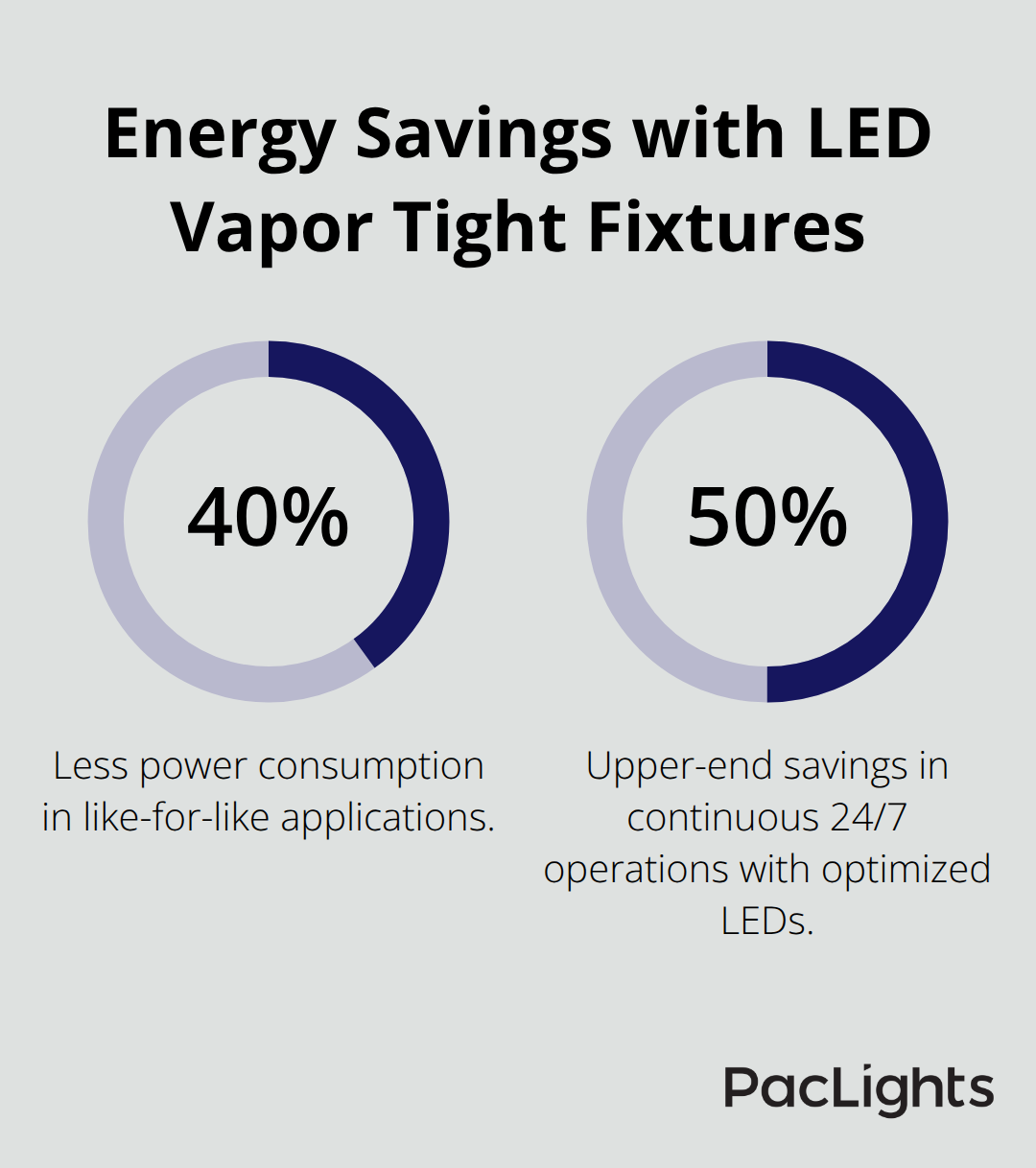
LED vapor tight fixtures consume 40 to 50 percent less power than older HID or metal halide systems while delivering equal or superior lumen output, which translates directly to measurable savings in 24/7 operations. A 4-foot vapor tight LED delivering 21,600 lumens at 80 watts outperforms a 60-watt model with only 14,000 lumens, meaning you get better illumination for less energy consumption.
In food processing plants running continuous operations, this efficiency difference compounds quickly: replacing a 150-watt HID vapor tight system with an 80-watt LED equivalent saves approximately 61,320 kilowatt-hours annually across a typical 40-fixture installation. At average industrial electricity rates of $0.12 per kilowatt-hour, that equals $7,358 in annual energy savings per facility. The payback period typically runs 3 to 4 years when accounting for the higher upfront cost of LED vapor tight fixtures, after which the savings flow directly to your bottom line for the remaining 15 to 20 years of fixture lifespan.
Slashing Maintenance Labor and Downtime
Traditional vapor tight fixtures using fluorescent or HID lamps require replacement every 10,000 to 20,000 operating hours, forcing facility teams into frequent climbing, fixture removal, and disposal cycles. LED vapor tight fixtures last 50,000 hours or more, which means a fixture running 24/7 operates for nearly 6 years before replacement becomes necessary instead of 1 to 2 years. Real-world data from food processing and cold storage operations show 60 to 70 percent reductions in maintenance labor after converting to LED vapor tight systems. This matters because maintenance technicians cost $35 to $50 per hour on average, and a single fixture replacement in a high-bay warehouse requires 45 minutes to an hour of labor when you account for equipment setup, fixture removal, and reinstallation.
Multiply that across 40 or 50 fixtures, and the annual labor savings reach thousands of dollars. The sealed gasket design prevents dirt and moisture accumulation inside the fixture, which eliminates the cleaning cycles that plague standard installations and further reduces maintenance frequency. Your team spends less time on ladder work and more time on productive operations.
Preventing the Real Cost: Unplanned Downtime
Avoiding equipment failures prevents the consequence that matters most: unplanned downtime that costs manufacturers an average of $260,000 per hour according to industry benchmarks. Moisture-related electrical faults trigger production shutdowns when standard fixtures fail in humid or contaminated environments. Vapor tight LED fixtures with appropriate IP ratings, temperature compatibility, and third-party certifications eliminate these faults and transform your lighting investment from an expense into operational insurance. Selecting the right sealed fixture protects your workers, maintains production schedules, and keeps your operation running smoothly-but only if you match equipment to your specific environment and hazard classification. A formal site assessment and supplier-provided ROI tools help you calculate your specific savings before committing to an upgrade, because energy efficiency gains vary based on fixture count, operating hours, and local electricity rates.
Final Thoughts
Vapor tight industrial lights deliver measurable protection and financial returns that standard fixtures cannot match. The sealed construction, appropriate IP ratings, and temperature compatibility prevent moisture-related failures, regulatory violations, and the unplanned downtime that costs manufacturers $260,000 per hour. LED vapor tight systems cut energy consumption 40 to 50 percent compared to older HID equipment while lasting 50,000 hours or more, reducing maintenance labor by 60 to 70 percent in real-world food processing and cold storage operations.
Selecting the right vapor tight industrial lights requires matching equipment to your specific environment and hazard classification. Start with your facility safety officers and engineering teams to document your space classification, then verify IP ratings, temperature compatibility, and third-party certifications in product datasheets. NSF certification matters for food processing; UL 1598 listings apply to hazardous locations; OSHA 1926.56 sets illumination minimums your fixtures must meet.
We at PacLights understand that upgrading your facility’s lighting demands careful planning and accurate financial projections. Contact PacLights to discuss your facility’s requirements and receive a customized lighting plan that protects your workers, maintains compliance, and delivers measurable cost savings.
Disclaimer: PacLights is not responsible for any actions taken based on the suggestions and information provided in this article, and readers should consult local building and electrical codes for proper guidance.