

Warehouse lighting typically accounts for 20–25% of total facility energy consumption, yet most operations still rely on outdated systems that waste thousands annually. At PacLights, we’ve seen facilities cut their warehouse lights energy savings potential in half simply by switching to modern solutions.
The good news? You don’t have to choose between lower bills and proper visibility. This guide shows you exactly how to reduce energy costs while maintaining the brightness your team needs.
How Much Energy Traditional Warehouse Lights Actually Cost You
The Real Price of Outdated Fixtures
Traditional warehouse lighting systems drain far more energy than most facility managers realize. High-intensity discharge lamps like metal halide and high-pressure sodium fixtures consume between 400–1,000 watts per fixture, depending on the wattage rating. A typical 50,000-square-foot warehouse with 100 fixtures running 12 hours daily uses roughly 480,000–1,200,000 kilowatt-hours annually. At the U.S. average industrial electricity rate of $0.07 per kilowatt-hour, that translates to $33,600–$84,000 per year just for lighting. Many facilities pay even more because older systems run longer than necessary and lose efficiency over time. The inefficiency compounds because traditional bulbs also produce excessive heat, which forces air conditioning systems to work harder during warm months.
Maintenance Costs That Add Up Fast
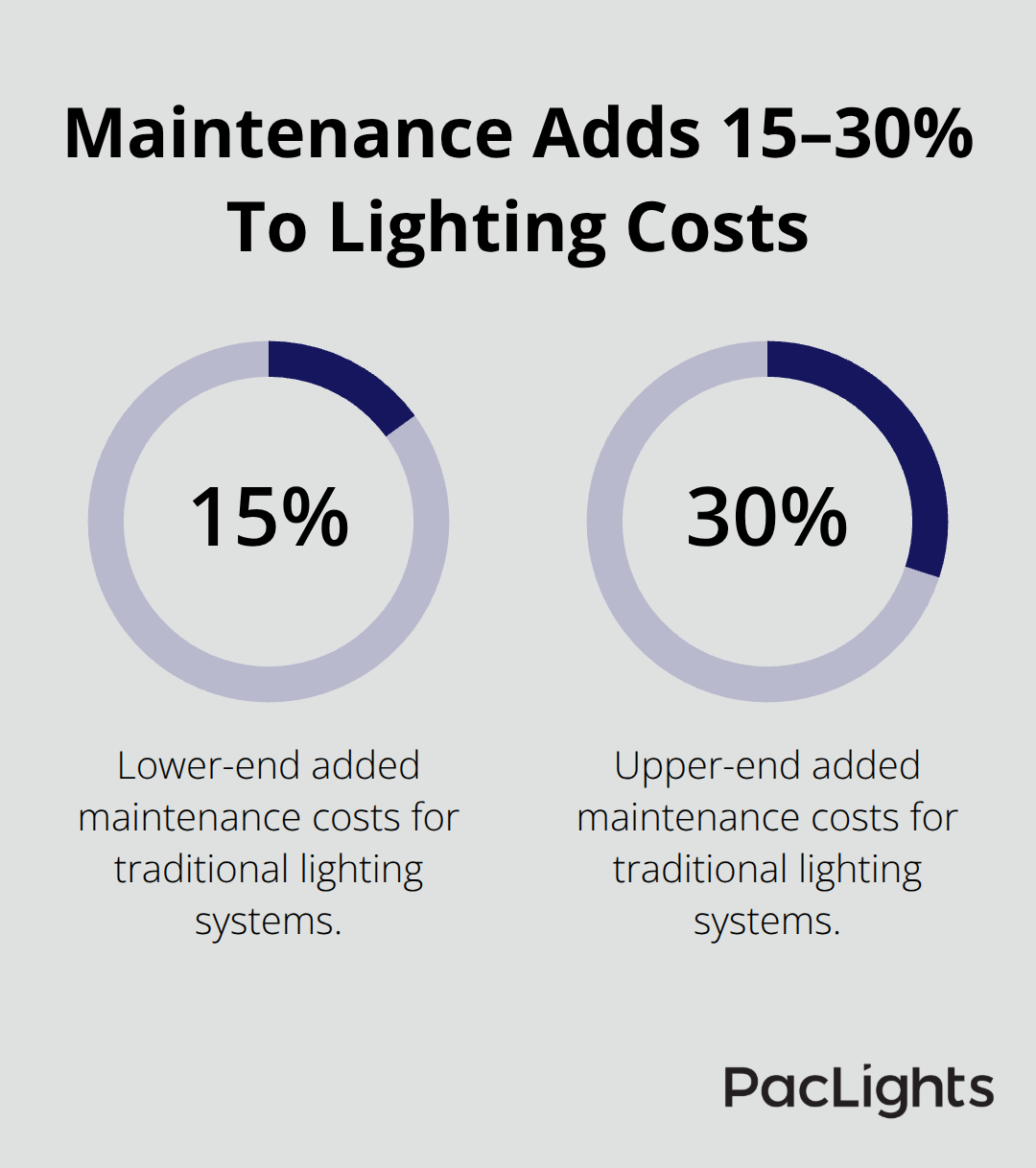
The actual expense extends far beyond raw energy consumption. Maintenance costs for traditional systems add another 15–30% to annual lighting budgets. Metal halide bulbs require replacement every 10,000–15,000 hours, and high-pressure sodium bulbs last 16,000–24,000 hours, meaning a warehouse replaces dozens of fixtures annually. Labor costs for bulb replacement, ballast repairs, and fixture maintenance accumulate quickly in large facilities.
Additionally, outdated systems rarely include controls, so lights run at full brightness regardless of occupancy or available daylight.
The Hidden Waste Nobody Tracks
A warehouse that operates with lights on during daylight hours or in unoccupied zones wastes 20–40% of its lighting energy, according to the U.S. Department of Energy. This waste happens silently because facility managers lack visibility into which areas consume power unnecessarily. Facilities running older systems also face higher downtime risk, as ballast failures and component breakdowns interrupt operations unexpectedly. These failures don’t just cost money-they disrupt workflow and reduce productivity across the entire operation.
The path forward involves more than swapping out old bulbs for new ones. Modern LED solutions paired with smart controls transform how warehouses manage their lighting energy, and the financial impact proves substantial when you examine the numbers.
LED Retrofits Deliver Real Warehouse Energy Savings
How Much Energy LEDs Actually Save
LED fixtures consume 50–70% less energy than traditional metal halide or high-pressure sodium systems while delivering equal or superior brightness. A 50,000-square-foot warehouse replacing 100 traditional 400-watt fixtures with LED equivalents reduces annual energy consumption by approximately 480,000–720,000 kilowatt-hours. At industrial electricity rates, this translates to $33,600–$50,400 in annual savings before accounting for maintenance cost reductions.
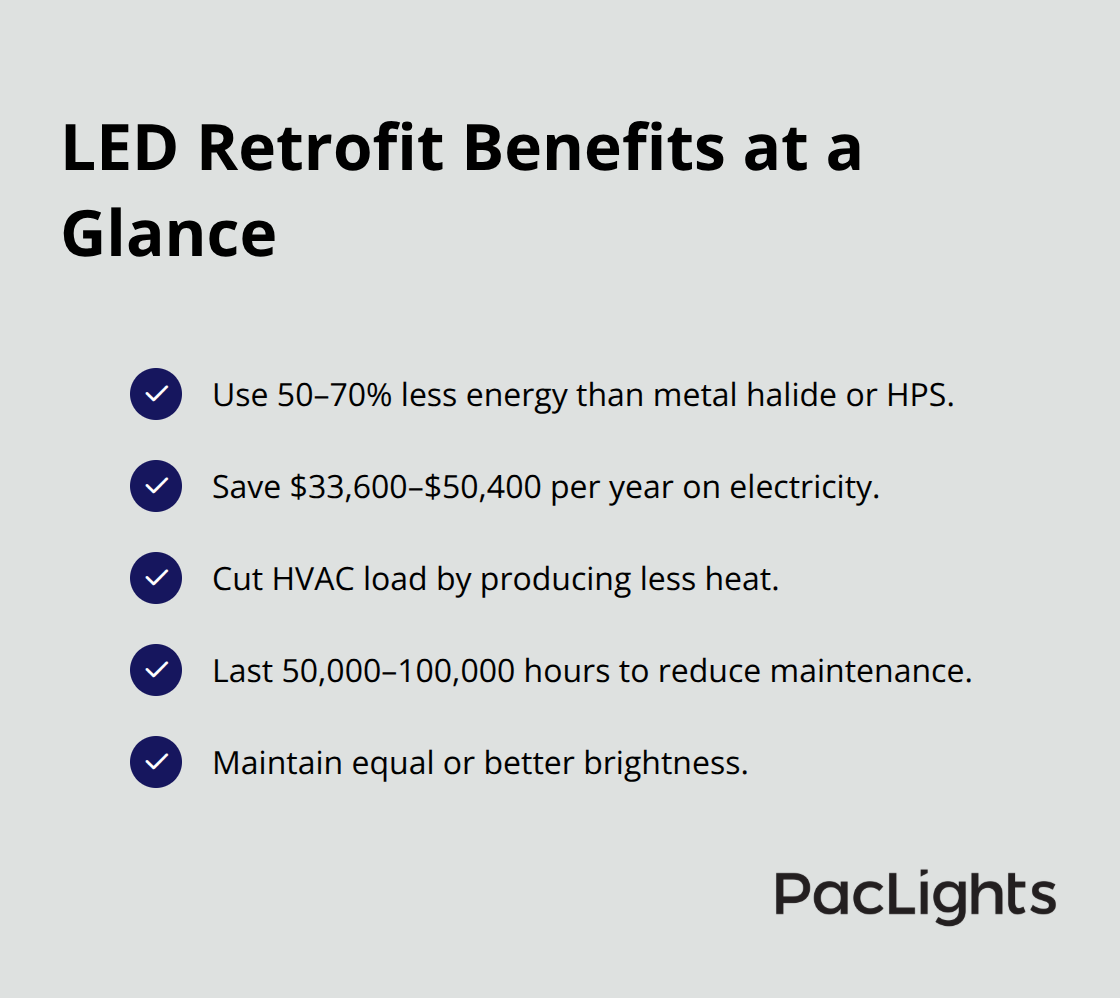
LEDs convert more electrical input directly into light rather than heat, which eliminates the air conditioning burden that traditional systems create. LED fixtures last 50,000–100,000 hours compared to 10,000–24,000 hours for traditional bulbs, so your facility replaces fixtures far less frequently and reduces labor costs associated with maintenance crews.
The Financial Payback Timeline
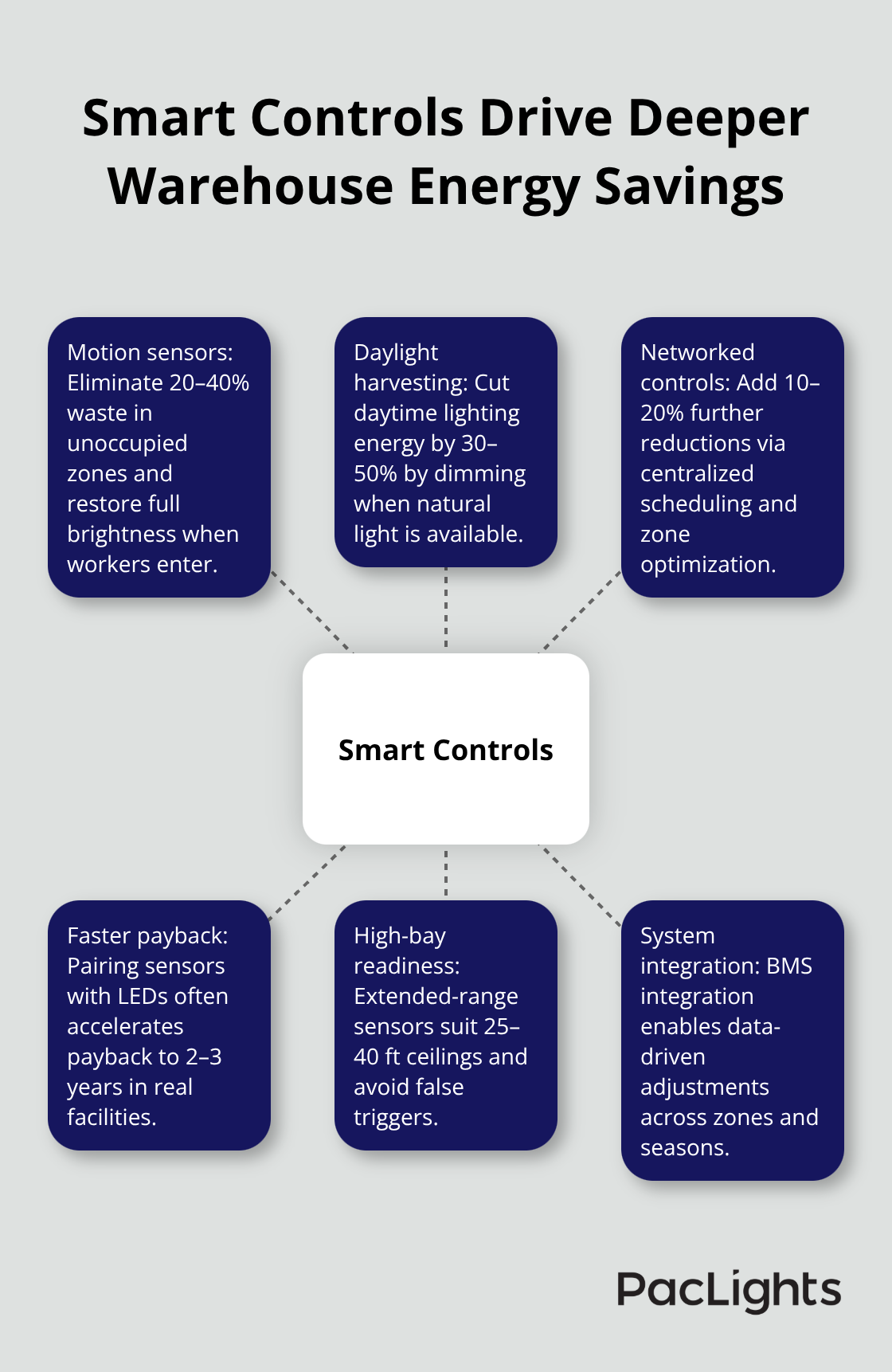
The financial payback on warehouse LED retrofits typically occurs within 3–5 years, making these upgrades one of the highest-return facility investments available. A warehouse spending $84,000 annually on traditional lighting can invest approximately $120,000–$180,000 in a complete LED retrofit and recoup that investment through energy and maintenance savings alone. After the payback period ends, the facility enjoys pure savings for the remaining 20–30 years of LED fixture lifespan. Real-world data from industrial facilities shows that adding motion sensors and daylight harvesting controls to LED systems accelerates payback to 2–3 years (by eliminating unnecessary runtime in unoccupied zones and during daylight hours).
Maximizing Savings With Smart Controls
Facilities that implement networked lighting controls alongside LED retrofits report capturing an additional 10–20% in energy reductions through centralized optimization across multiple zones and shift schedules. Motion sensors detect occupancy and adjust brightness accordingly, while daylight harvesting systems reduce artificial light output when natural light becomes available. These controls work together to eliminate the waste that plagues traditional systems, where lights run at full brightness regardless of actual need. The combination of LED efficiency and intelligent controls transforms warehouse lighting from a fixed cost drain into a dynamic system that responds to real operational conditions.
Advanced control systems open the door to even greater savings potential, but only when paired with the right hardware and strategic implementation across your entire facility.
Advanced Controls Transform Warehouse Lighting Performance
Motion Sensors Eliminate Wasted Energy in Unoccupied Zones
Motion sensors and occupancy detection represent the most straightforward way to eliminate the 20–40% of energy waste that occurs in unoccupied zones. These sensors detect movement and automatically adjust lighting levels, dimming fixtures when no activity occurs and restoring full brightness when workers enter the space. A warehouse with multiple production zones, storage areas, and office sections benefits tremendously because each zone operates independently based on actual occupancy rather than a fixed schedule. Installing motion sensors costs between $50–$200 per fixture depending on sensor quality and wireless capabilities, and the payback occurs within 12–18 months through reduced runtime alone.
High-bay sensors work differently than standard motion detectors because warehouse ceilings often reach 25–40 feet, requiring sensors with extended detection ranges and adjustable sensitivity to avoid false triggering from forklift movement or conveyor systems. These specialized sensors account for the unique challenges of large industrial spaces and prevent the lighting disruptions that plague poorly configured systems.
Daylight Harvesting Captures Natural Light Savings
Daylight harvesting systems measure natural light levels and automatically reduce artificial lighting output when sufficient daylight enters the space. A warehouse with skylights or clerestory windows can reduce daytime lighting energy by 30–50% through this approach, particularly during spring and summer months when daylight availability peaks. The U.S. Department of Energy reports that facilities combining daylight harvesting with occupancy sensors capture cumulative savings of 40–60% compared to traditional always-on systems.
This dual-control strategy addresses both occupancy and natural light availability, creating a responsive lighting environment that adapts to real conditions rather than operating on fixed schedules.
Networked Lighting Controls Optimize Facility-Wide Performance
Networked lighting controls elevate efficiency across entire facilities by centralizing management and enabling data-driven optimization. These systems connect fixtures through wireless protocols or hardwired networks, allowing facility managers to monitor energy consumption in real-time, adjust brightness across multiple zones simultaneously, and schedule lighting based on shift patterns or seasonal changes. A large warehouse can identify underutilized zones consuming unnecessary power and reallocate resources accordingly.
Integration with building management systems provides visibility into lighting performance alongside HVAC and other facility operations, revealing interactions that isolated systems miss. For example, reducing nighttime outdoor area lighting by 20% affects security and safety, but networked controls allow managers to maintain motion-activated brightness in high-traffic zones while dimming less-critical areas. Implementation typically requires coordination with IT departments for network integration, but the investment pays dividends through reduced maintenance labor, faster troubleshooting of failed fixtures, and the ability to implement facility-wide changes without physically visiting each location.
PacLights offers advanced lighting controls (such as networked lighting controls) that work alongside energy-efficient fixtures to maximize operational savings. Our optional motion and daylight controls integrate with your existing systems to capture the full range of efficiency gains available in modern warehouse environments.
Final Thoughts
Warehouse lights energy savings represent far more than a line-item reduction on your utility bill. Switching from traditional fixtures to LED systems paired with motion sensors and daylight harvesting cuts your annual lighting costs by $33,600–$50,400 while improving visibility and reducing maintenance headaches. The payback timeline of 2–5 years means your facility stops losing money on outdated systems and starts building genuine operational efficiency.
Modern controls eliminate the 20–40% of energy waste that occurs in unoccupied zones and during daylight hours because they respond to real conditions rather than operating on fixed schedules. Motion sensors detect occupancy, daylight harvesting reduces artificial light when natural light becomes available, and networked controls optimize performance across your entire facility. These systems work together to transform lighting from a fixed expense into a dynamic asset that adapts to your actual operational needs.
Evaluating your facility’s lighting needs starts with understanding your current consumption and identifying which zones waste the most energy. PacLights provides free lighting layout designs and ROI assessments that show exactly how much you can save with a retrofit tailored to your specific warehouse configuration. Our energy-efficient fixtures, optional motion and daylight controls, and advanced networked lighting controls work together to capture the full range of efficiency gains available in modern warehouse environments.
Disclaimer: PacLights is not responsible for any actions taken based on the suggestions and information provided in this article, and readers should consult local building and electrical codes for proper guidance.