

Datacenter retrofit lighting ideas are no longer optional-they’re a business necessity. Legacy lighting systems drain energy, generate excess heat, and fail to meet modern safety standards.
At PacLights, we’ve helped datacenters cut lighting costs by upgrading their rack lighting without disrupting operations. This guide shows you how to do the same with minimal downtime.
Why Your Datacenter’s Lighting System Is Costing You Money
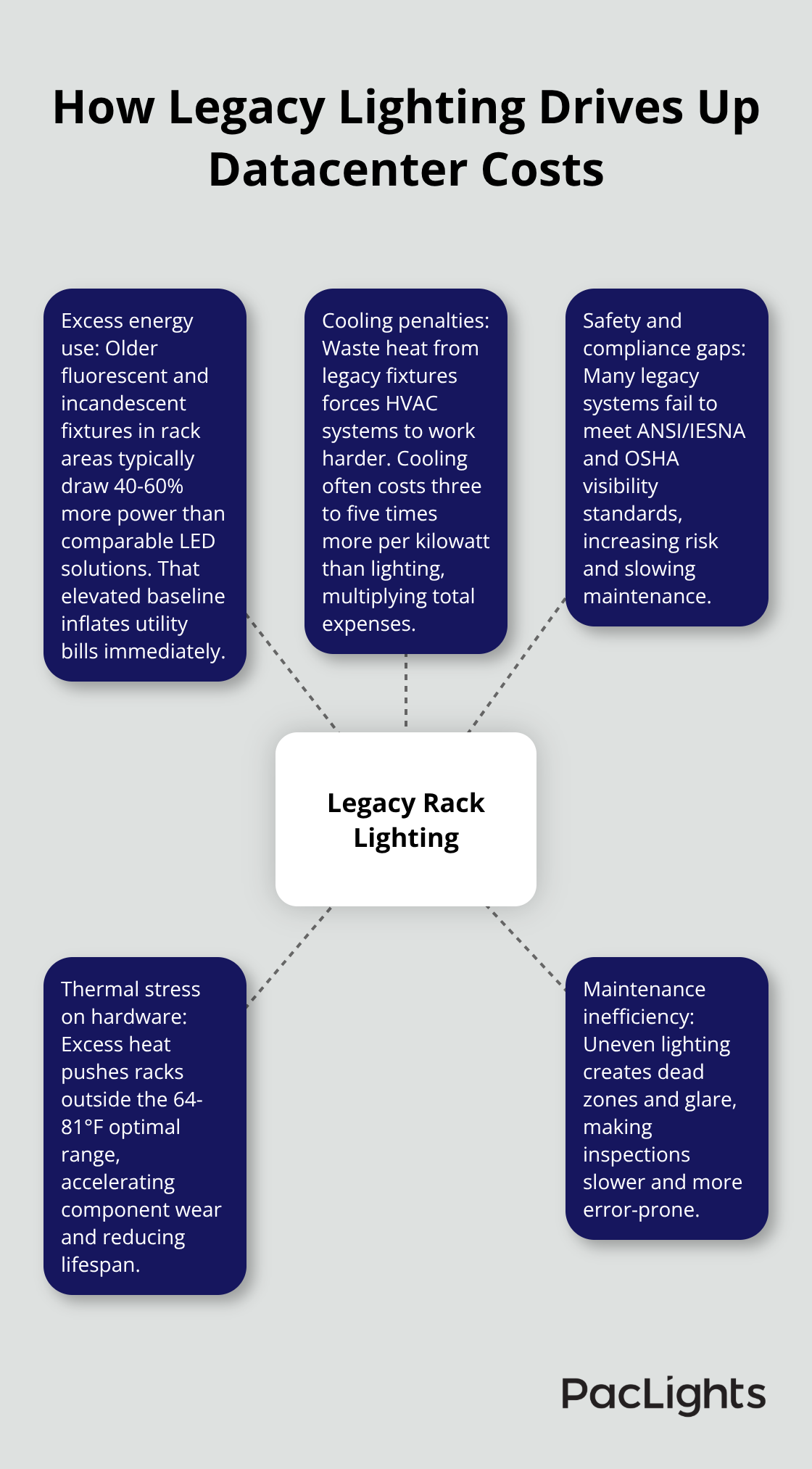
Legacy lighting systems in datacenters consume significantly more energy than modern alternatives. Older fluorescent and incandescent fixtures in rack areas typically draw 40-60% more power than comparable LED solutions, according to data from the U.S. Department of Energy. A datacenter with 500 racks using outdated lighting can spend $15,000 to $25,000 annually on lighting alone, with most of that energy wasted as heat rather than useful illumination. The problem compounds when you factor in cooling costs. Every watt of lighting energy generates additional cooling demand, and datacenter cooling systems often cost three to five times more per kilowatt than the lighting itself. This means a 10-kilowatt lighting system doesn’t just cost money to run-it forces your HVAC systems to work harder, pushing your total operational expense even higher.
Heat Generation Directly Impacts Your Bottom Line
Outdated lighting fixtures generate substantial waste heat inside your racks, raising ambient temperatures and forcing cooling systems into overdrive. A single incandescent or older halogen fixture emits 80-90% of its energy as heat. When you multiply this across hundreds of fixtures in a confined space, your cooling infrastructure must compensate continuously. The Uptime Institute reports that cooling accounts for 30-40% of total datacenter operating costs. Upgrading to LED fixtures immediately reduces this thermal load. LEDs emit 70-80% less heat than legacy systems, which directly translates to lower cooling demands and measurably reduced utility bills. Beyond cost, excessive heat shortens equipment lifespan. Server hardware operates optimally at 64-81 degrees Fahrenheit, and temperature fluctuations accelerate component degradation. Poor lighting heat management forces your infrastructure to work in suboptimal conditions.
Safety and Compliance Standards Have Changed
Modern datacenters must meet ANSI/IESNA standards for illumination levels and safety, along with OSHA requirements for worker visibility during maintenance. Many legacy lighting systems fail to meet these standards, creating liability exposure. Poor visibility in rack areas increases the risk of equipment damage, miscabling, and safety incidents during maintenance work. Current standards require minimum 50 foot-candles of illumination in equipment areas, with better color rendering for accurate cable identification. Older systems often provide uneven lighting with dead zones and glare, making compliance difficult and maintenance slower. LED retrofit solutions deliver consistent, controllable illumination that meets current safety requirements while reducing energy waste. Motion sensors and dimming controls add another layer of compliance (preventing unnecessary energy consumption during unoccupied periods) and enable automatic adjustment based on occupancy.
The Path Forward Requires Strategic Planning
Your datacenter’s lighting upgrade doesn’t happen overnight, and the right approach minimizes operational disruption. The next section outlines how to implement LED retrofit solutions across your racks without shutting down critical systems or sacrificing performance.
LED Retrofit Solutions That Work With Your Current Setup
Modular LED fixtures designed for datacenter racks eliminate the need for complete system overhauls. Unlike legacy systems that require rewiring entire sections, modern LED retrofit kits install directly into existing mounting infrastructure. A typical rack retrofit takes 30-45 minutes per unit when performed during maintenance windows, compared to 4-6 hours for traditional fixture replacement. Your technicians can install the pre-wired and tested fixtures without specialized electrical knowledge. Retrofit solutions engineered for datacenter environments mount to standard rack rails and integrate with your current power distribution. The modular approach matters because it lets you upgrade one section at a time without staging expensive equipment moves or temporary lighting solutions. Most datacenters find that upgrading 50-100 racks monthly keeps operational disruption below 2% of total capacity.
Smart Controls Reduce Energy Waste Without Manual Intervention
Motion sensors and dimming controls transform retrofit lighting from a simple energy swap into an intelligent system. Datacenters typically operate at 40-60% occupancy during off-peak hours, yet legacy lighting runs at full capacity continuously. Motion sensors cut unnecessary lighting runtime by 35-50% in areas with intermittent access, according to data from the Lawrence Berkeley National Laboratory.
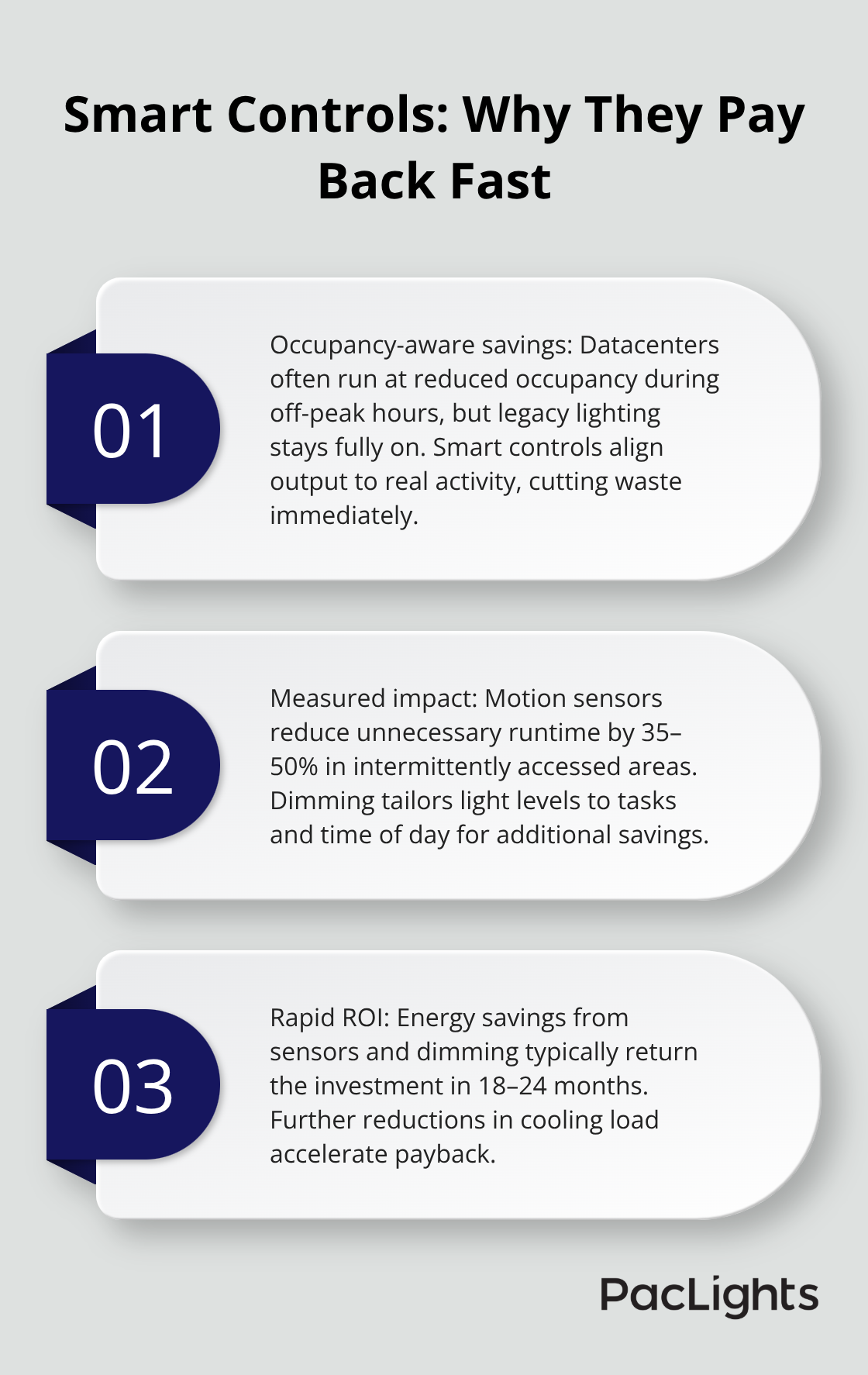
Dimming controls allow you to set illumination levels based on time of day or specific tasks, reducing energy consumption during routine monitoring versus active maintenance work. These controls integrate with your facility management system and provide real-time data on lighting usage patterns and energy savings. Advanced networked lighting controls enable remote adjustments across multiple racks without physical visits, saving technician time and reducing operational disruption. The payback period for motion sensors and dimming systems typically ranges from 18-24 months through energy savings alone, before factoring in reduced cooling costs.
Compatibility Prevents Costly Infrastructure Replacement
Your existing rack power distribution, mounting structures, and cable routing require no replacement during a retrofit. LED fixtures designed for datacenter environments use standard mounting interfaces and operate on existing 120V or 240V circuits without requiring panel upgrades. This compatibility matters significantly because rewiring a datacenter section costs $8,000-$15,000 in labor and infrastructure changes, while a modular retrofit costs $2,000-$4,000 per 20-rack section. Fixture compatibility also means your team can train on installation quickly, reducing external contractor dependency. Testing compatibility before full deployment prevents installation delays and ensures proper integration with your specific rack configuration and power load. Most modern LED retrofit solutions work with existing emergency backup systems and UPS infrastructure without modification, maintaining your current reliability standards.
Installation Speed Depends on Your Approach
The speed of your retrofit directly correlates with how you plan your rollout. Pre-wired fixtures arrive ready to mount, which eliminates weeks of on-site electrical work that traditional upgrades require. Your team can schedule installations during planned maintenance windows (typically 2-4 hours per section) without affecting production capacity. Testing each fixture before full deployment takes an additional 30-45 minutes per section but prevents compatibility issues that could halt operations. Datacenters that coordinate retrofit work with their regular maintenance schedules experience zero unplanned downtime, while those attempting ad-hoc installations often face unexpected delays. The next section outlines how to structure your implementation timeline to maximize efficiency and keep your facility running at full capacity throughout the upgrade process.
Implementation Strategy for Minimal Downtime
Divide Your Retrofit Into Manageable Sections
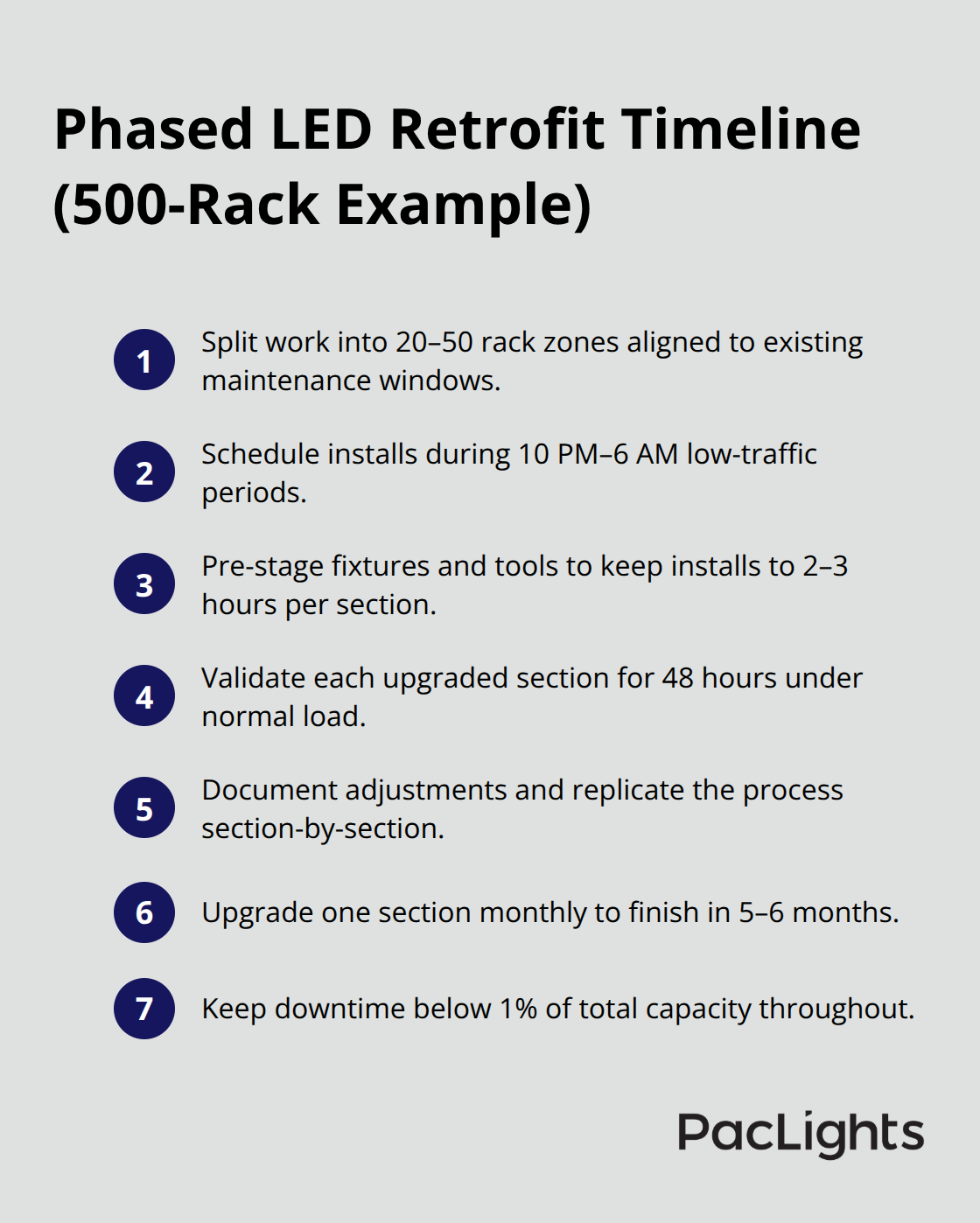
Split your retrofit into smaller zones of 20-50 racks and schedule installations during your regular maintenance windows. This phased strategy maintains full production capacity while systematically replacing outdated fixtures. A datacenter with 500 racks completes a full retrofit in 5-6 months by upgrading one section monthly, keeping downtime below 1% of total operational capacity. The key involves coordinating with your existing maintenance schedule instead of creating new installation windows. Most datacenters already perform planned maintenance during specific time blocks each month, so integrating retrofit work into these windows eliminates the need for additional facility disruptions.
Schedule Work During Low-Traffic Hours
Your technicians should schedule each section installation during your lowest-traffic periods, typically between 10 PM and 6 AM when monitoring demands are minimal. Pre-staging your fixtures and tools before each window reduces installation time to 2-3 hours per section, allowing work to complete before peak hours begin. This approach also gives you time to validate each upgraded section before moving to the next area, catching any compatibility issues early rather than discovering problems after completing multiple sections. Coordinating with your operations team ensures that installation windows align with your actual facility usage patterns rather than theoretical schedules.
Validate Each Section Before Proceeding
Install your first section and run the fixtures for 48 hours under normal operating conditions. Verify that illumination levels meet your 50 foot-candle standard and that motion sensors and dimming controls respond correctly. Check that your facility management system receives accurate data from the networked controls and that power consumption matches your projections. This validation typically takes 4-6 hours of technician time but eliminates the risk of installing incompatible fixtures across your remaining racks.
Document Results and Replicate Consistently
Only after confirming successful performance should you proceed to your next section. Document your installation notes and any adjustments made during testing so your team can replicate the process consistently across remaining sections. If you discover issues during testing, address them at this stage-costs for correction remain far lower than retrofitting multiple sections incorrectly and requiring reinstallation later. Consistent documentation also accelerates training for additional technicians who join the retrofit effort, reducing your reliance on external contractors and keeping installation schedules on track.
Final Thoughts
Datacenter retrofit lighting ideas deliver measurable financial returns within 18-24 months through reduced energy consumption and lower cooling costs. A 500-rack datacenter spending $15,000-$25,000 annually on legacy lighting recovers that entire investment within two years after upgrading to LED fixtures with motion sensors and dimming controls. The energy savings compound over time, with most facilities achieving 40-60% reductions in lighting-related operational expenses.
The phased implementation approach keeps your facility operational throughout the retrofit process. Your technicians gain hands-on experience with the new systems during early phases, reducing external contractor dependency and accelerating subsequent installations. Scheduling work during low-traffic hours and validating each section before proceeding maintains full production capacity while systematically upgrading your infrastructure.
Contact PacLights to explore retrofit options tailored to your rack configuration and operational requirements. We provide free lighting layout designs and ROI assessments to help you understand your specific upgrade costs and savings potential. Our LED retrofit solutions integrate seamlessly with your existing facility management systems and support your long-term growth.
Disclaimer: PacLights is not responsible for any actions taken based on the suggestions and information provided in this article, and readers should consult local building and electrical codes for proper guidance.