

NSF certification benefits lighting in ways that directly impact your bottom line. Products that meet NSF standards gain immediate credibility in regulated industries like food processing, pharmaceuticals, and healthcare.
At PacLights, we’ve seen firsthand how NSF-certified solutions open doors to markets that demand proven safety and compliance. This certification isn’t just a badge-it’s your competitive advantage.
What NSF Certification Actually Means
NSF certification for lighting isn’t a generic safety stamp. It’s a rigorous, third-party verification that your fixtures meet specific sanitation and contamination-prevention standards set by NSF International and ANSI. The NSF/ANSI 2 standard covers lighting used in food zones, splash zones, and non-food zones, with each zone requiring distinct materials, construction methods, and durability features.
Construction Standards That Prevent Contamination
Food zone fixtures must use shatterproof polycarbonate or acrylic lenses, sealed housings with no gaps or exposed fasteners, and corrosion-resistant hardware to withstand repeated washdowns and sanitizing chemicals. Splash zone fixtures require a minimum IP65 rating, though IP69K protection proves essential for high-pressure, high-temperature washdowns common in processing plants. The FDA Food Code specifies exact illumination levels: 108 lux in storage areas, 215 lux where food is handled, and 540 lux where employees inspect or process food. NSF-certified fixtures deliver these light levels while maintaining sealed, contamination-resistant construction that prevents bacterial or mold growth in crevices.
How NSF Differs from Other Standards
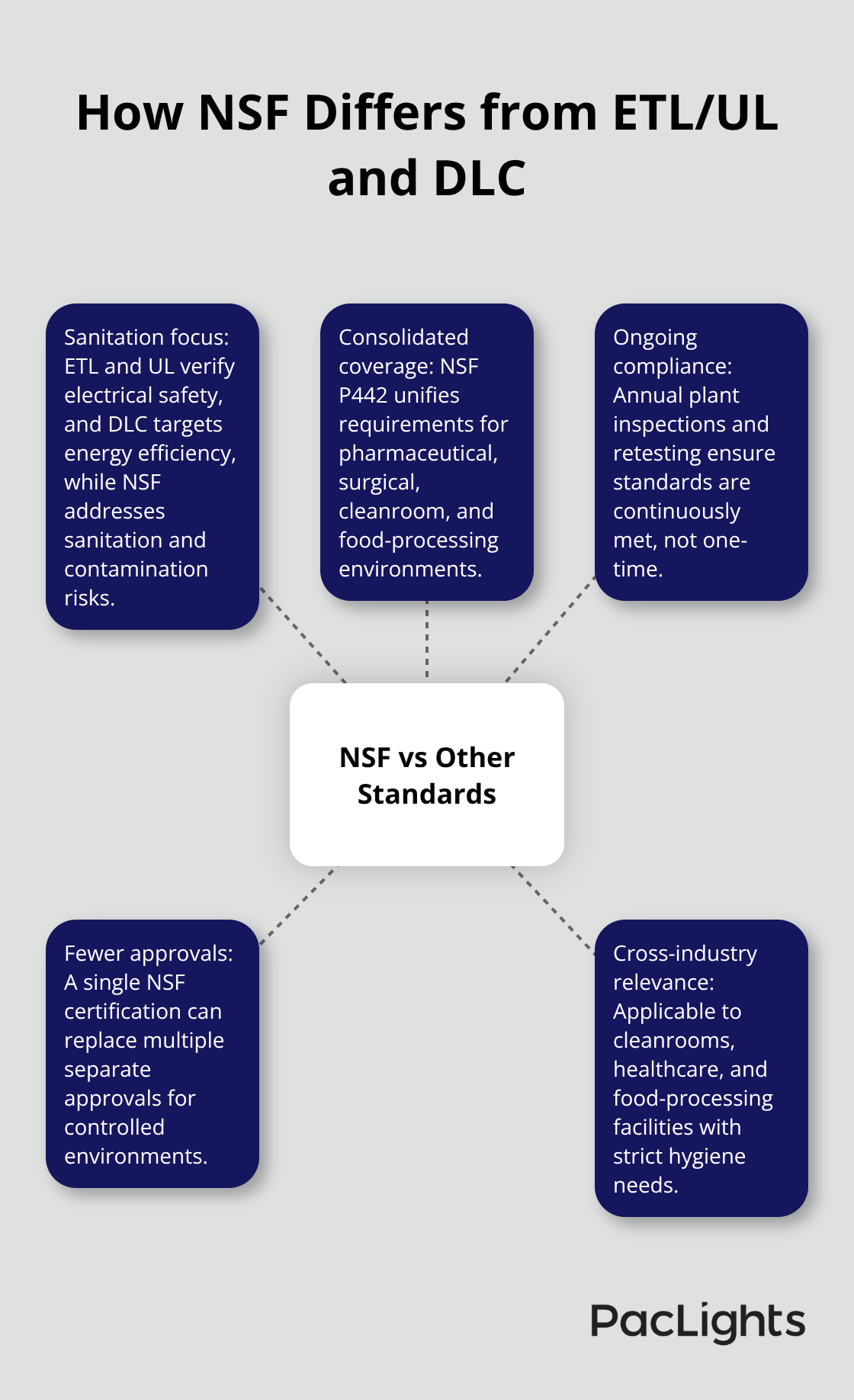
ETL and UL certifications verify electrical safety, while DLC ratings focus on energy efficiency-neither addresses sanitation risks. NSF P442, the newer controlled-environment standard, consolidates testing for pharmaceutical, surgical, cleanroom, and food-processing facilities into one certification, eliminating the need for multiple approvals. NSF certification requires annual plant inspections and retesting, meaning compliance remains an ongoing commitment rather than a one-time achievement.
The Rigorous Certification Process
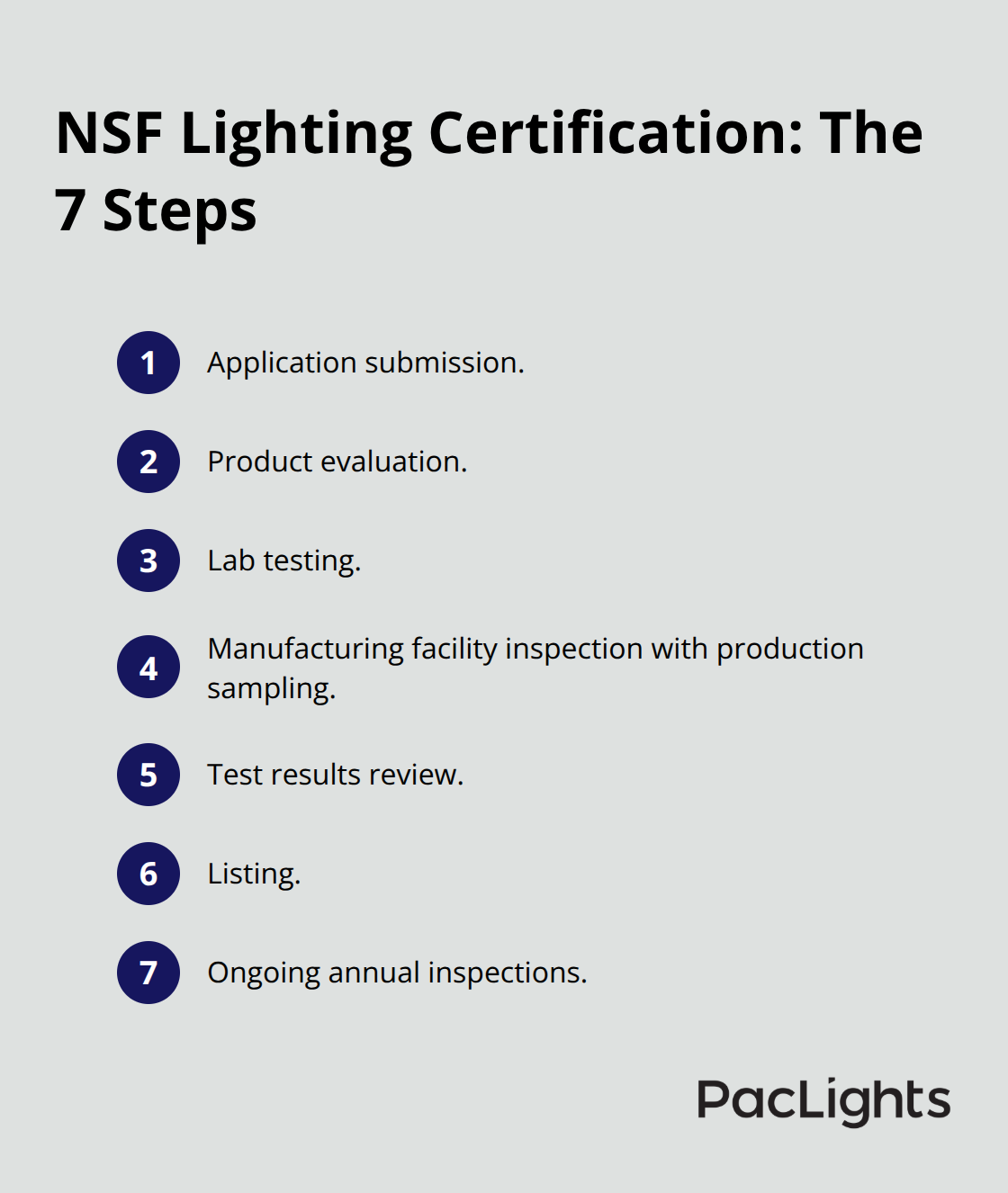
The certification process involves seven steps: application submission, product evaluation, lab testing, manufacturing facility inspection with production sampling, test results review, listing, and ongoing annual inspections. Testing includes pressure-wash simulations and chemical exposure trials to prove the fixture survives real-world sanitation cycles.
NSF-certified fixtures typically last 50,000 to 75,000 hours with full warranties, and facilities report 40–50% reductions in maintenance labor due to fewer premature failures.
Measurable Business Impact
Upgrading to NSF-certified lighting eliminates contamination incidents-facilities report zero lighting-related incidents in the first year versus 2–3 per year with non-certified fixtures. ROI typically appears in 18 to 24 months when combining energy savings from LED technology with durability benefits and reduced downtime. These financial gains make NSF certification a strategic investment that protects both your operations and your reputation, setting the stage for understanding how these benefits translate across different facility types.
Why NSF-Certified Lighting Protects Your Facility and Bottom Line
NSF-certified lighting eliminates the guesswork from sanitation compliance. When you install fixtures that meet NSF/ANSI 2 standards, you obtain documented proof that your facility meets FDA Food Code requirements and NSF International’s rigorous testing protocols. Facilities that switched to NSF-certified fixtures report zero lighting-related contamination incidents in their first year, compared to 2–3 incidents annually with non-certified alternatives. This isn’t theoretical; it’s the difference between maintaining continuous operations and facing costly shutdowns.
How NSF Certification Reduces Your Liability
Insurance carriers increasingly require NSF certification as a condition of coverage, meaning your liability exposure drops measurably when you upgrade. The sealed housings, shatterproof polycarbonate lenses, and corrosion-resistant materials prevent bacterial colonies from forming in crevices or gaps-something standard ETL or UL-rated fixtures cannot guarantee. Your facility avoids the contamination risks that trigger recalls, regulatory violations, or temporary shutdowns until compliant lighting is installed.
Energy Savings and Maintenance Efficiency
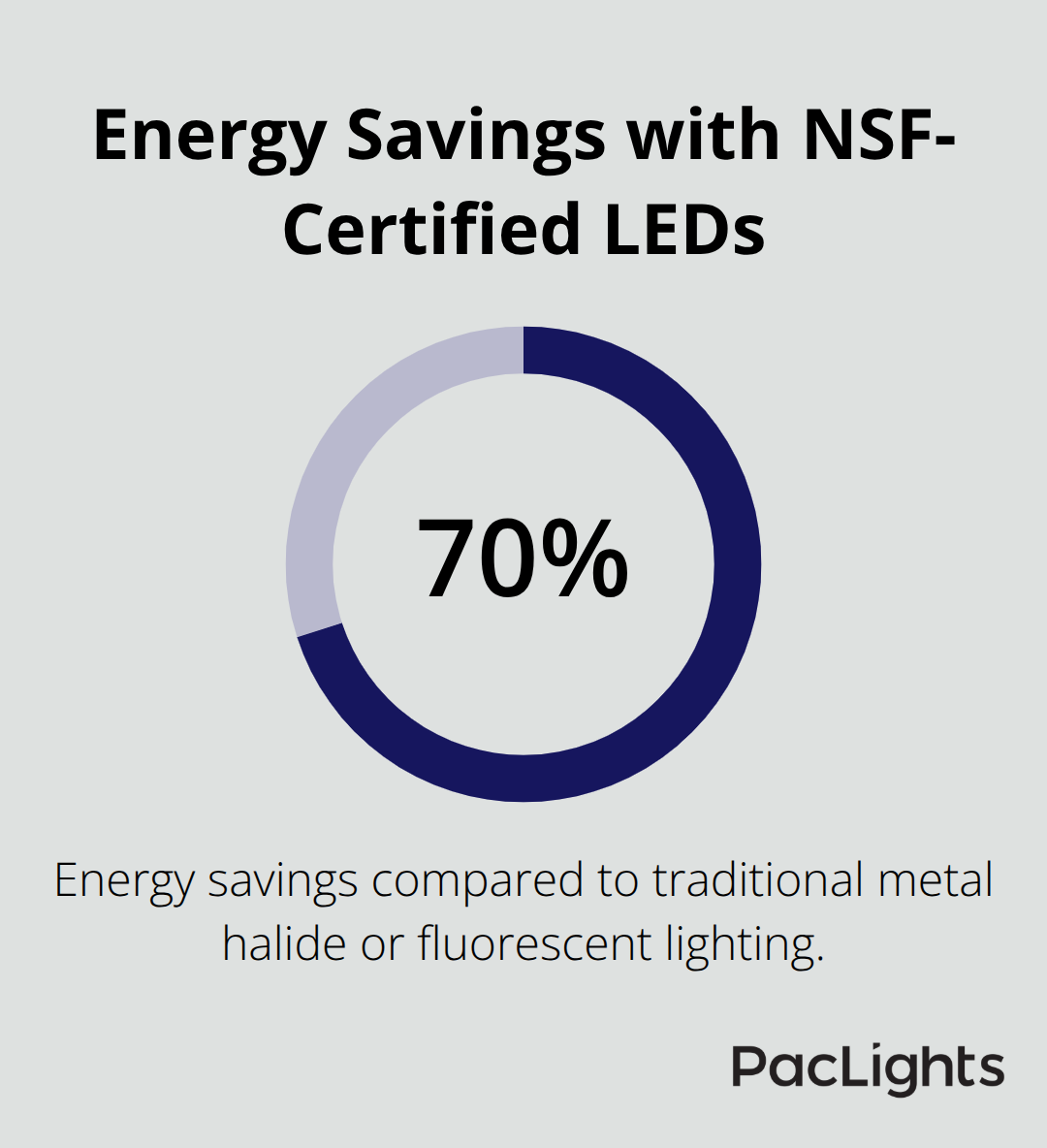
NSF-certified LED fixtures deliver up to 70% energy savings compared to traditional metal halide or fluorescent lighting, with typical ROI appearing in 18 to 24 months. Maintenance labor drops 40–50% because fixtures rated for 50,000 to 75,000 hours experience far fewer premature failures in washdown environments.
Your staff spends less time replacing broken components and more time on productive tasks.
Regulatory Audits and Documentation
Regulatory audits become straightforward when your lighting documentation is complete. NSF certification is recognized in over 180 countries, which matters if your facility operates across multiple jurisdictions or faces international compliance reviews. The seven-step certification process-including annual plant inspections and retesting-means your supplier maintains ongoing compliance, not a one-time approval that expires. When regulators or customers ask whether your lighting meets sanitation standards, you provide NSF certification documents instead of uncertain explanations.
Building Customer Trust Through Transparency
This transparency builds customer trust, particularly in food processing, pharmaceuticals, and healthcare where contamination risks carry reputational and financial consequences. NSF certification demonstrates your commitment to safety standards that matter to your customers and regulators. Your compliance documentation becomes a competitive asset that sets you apart from facilities relying on non-certified alternatives. As you evaluate which lighting solutions fit your specific operational zones and facility type, understanding how NSF standards apply across different environments helps you make informed decisions that protect both your operations and your reputation.
Where NSF-Certified Lighting Makes the Biggest Difference
Food Processing Plants Demand Sealed, Contamination-Resistant Fixtures
Food processing plants operate under the harshest sanitation demands in any industry, and NSF-certified lighting directly addresses them. The FDA Food Code mandates 540 lux where employees inspect or process food, and fixtures must withstand daily high-pressure washdowns with caustic chemicals that corrode standard lighting. Meat processing facilities operate at temperatures near freezing, where traditional metal halide fixtures fail to deliver instant illumination and waste energy heating unused spaces.
NSF-certified LED fixtures eliminate these problems entirely. They deliver consistent brightness in cold storage instantly, consume 70% less energy than metal halide alternatives, and sealed polycarbonate lenses prevent bacterial colonies from forming in microscopic gaps. Processing plants switching to NSF P442-certified fixtures report zero lighting-related contamination incidents in their first year, compared to 2–3 per year with non-certified options.
Pharmaceutical and Cleanroom Facilities Require Particle-Free Environments
Pharmaceutical and cleanroom facilities operate under even stricter protocols. NSF P442 consolidates sanitation testing with environmental protection into a single certification, eliminating the confusion of juggling multiple approvals for different equipment. Surgical suites and pharmaceutical processing areas require lighting that withstands repeated sterilization cycles and chemical exposure without shedding particles or degrading.
IP69K-rated NSF fixtures handle 80-degree Celsius washdowns and high-pressure jets that would destroy standard high bays within months. Healthcare facilities gain documented proof of compliance during regulatory audits, and insurance carriers increasingly require NSF certification as a coverage condition, directly reducing liability exposure.
Commercial Kitchens and Restaurants Face Identical Contamination Risks
Commercial kitchens and restaurants operate differently but face identical contamination risks. Health inspectors specifically examine lighting for gaps, exposed fasteners, and glass components that violate sanitation codes. Many jurisdictions now require NSF/ANSI 2 certification in food preparation areas, making non-certified fixtures a liability.
Restaurants upgrading to NSF-certified fixtures report maintenance labor dropping 40–50% because sealed housings and corrosion-resistant hardware survive repeated cleaning without premature failure. A typical commercial kitchen replaces lighting every 2–3 years with standard fixtures; NSF-certified alternatives last 50,000 to 75,000 hours, stretching replacement cycles to 5–7 years and delivering ROI in 18–24 months through energy savings alone.
Final Thoughts
NSF certification benefits lighting by eliminating contamination incidents, cutting maintenance labor by 40–50%, and delivering ROI within 18 to 24 months. Facilities that switch to NSF-certified fixtures gain documented compliance proof across over 180 countries, and insurance carriers increasingly require this certification as a coverage condition. Your investment in compliant lighting protects operations, strengthens your reputation, and transforms regulatory audits from stressful events into straightforward documentation reviews.
The competitive advantage belongs to facilities that act now. NSF/ANSI 2 and NSF P442 certifications open access to markets demanding proven safety standards, and your compliance status becomes a differentiator that sets you apart from competitors relying on non-certified alternatives. Customers and regulators recognize these certifications globally, meaning your facility gains credibility whether you operate locally or internationally.
We at PacLights offer free lighting assessments to help you understand exactly how NSF-certified fixtures fit your specific zones and operational requirements. Our energy-efficient LED solutions deliver the compliance, durability, and cost savings your facility demands. Contact us today to schedule your assessment and take the first step toward lighting that protects your bottom line.
Disclaimer: PacLights is not responsible for any actions taken based on the suggestions and information provided in this article, and readers should consult local building and electrical codes for proper guidance.