

Vapor tight fixture ratings determine whether your lighting will survive harsh industrial environments or fail prematurely. Most facility managers don’t understand what these ratings actually mean, which leads to costly mistakes.
At PacLights, we’ve seen firsthand how the right rating prevents equipment failure in food processing plants, chemical facilities, and wet environments. This guide breaks down what vapor tight ratings mean and how to pick the right one for your operation.
What IP and NEMA Ratings Actually Protect
IP Ratings and NEMA Types Measure Different Things
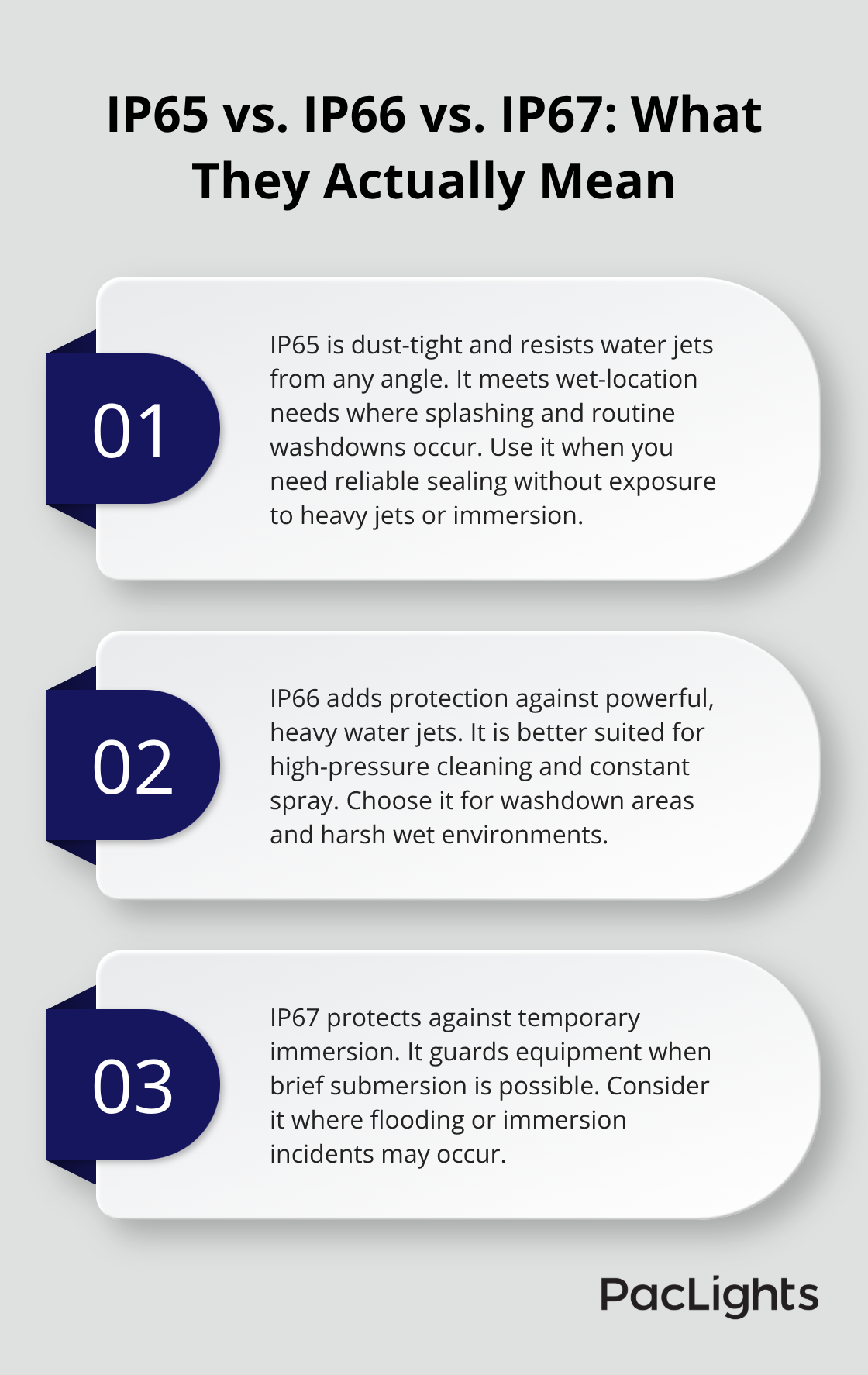
IP ratings and NEMA enclosure types are not interchangeable labels-they measure different protection mechanisms, and most facility managers confuse them. IP ratings, governed by the International Electrotechnical Commission, measure protection against solid objects and water ingress on a scale from IP00 to IP69K. IP65 means dust-tight protection and resistance to water jets from any angle, while IP66 adds defense against heavy water jets. IP67 protects against temporary immersion. The National Electrical Code Article 410 requires specific ratings based on location type: wet locations demand IP65 minimum, damp locations need IP54 or better.
NEMA enclosure types follow a different standard entirely. NEMA 4 provides water and corrosion resistance suitable for outdoor and washdown environments. NEMA 4X adds stainless steel construction for chemical exposure, critical in food processing and pharmaceutical facilities. NEMA 6 permits temporary submersion, making it essential for tunnels, underground parking, and flood-prone areas.
How to Match Ratings to Your Environment
A fixture marked IP65 and NEMA 4 offers solid protection, but NEMA 4X or IP67 delivers superior reliability in harsh chemical or salt-spray conditions. Many manufacturers list both ratings to satisfy different regional codes-the NEC governs U.S. installations while other countries reference IP standards exclusively. Selecting the wrong rating costs money fast. An IP54-rated fixture in a car wash fails within months due to high-pressure spray breaching the enclosure, forcing replacement plus downtime. An IP65 fixture survives but develops corrosion around gaskets within two years. An IP66 fixture with proper gasket maintenance lasts seven to ten years in the same environment.
Temperature Extremes and Material Selection
Temperature extremes compound the problem: standard gasket materials degrade in freezing cold storage at minus 20 degrees Fahrenheit or in steamy commercial kitchens above 140 degrees Fahrenheit. Polycarbonate enclosures resist fading and warping better than aluminum in these conditions, extending service life by three to five years. NEMA 4X stainless steel construction prevents rust entirely in salt-air coastal facilities or chemical plants, justifying the higher upfront cost through eliminated replacement cycles.
Conduct a Site Assessment First
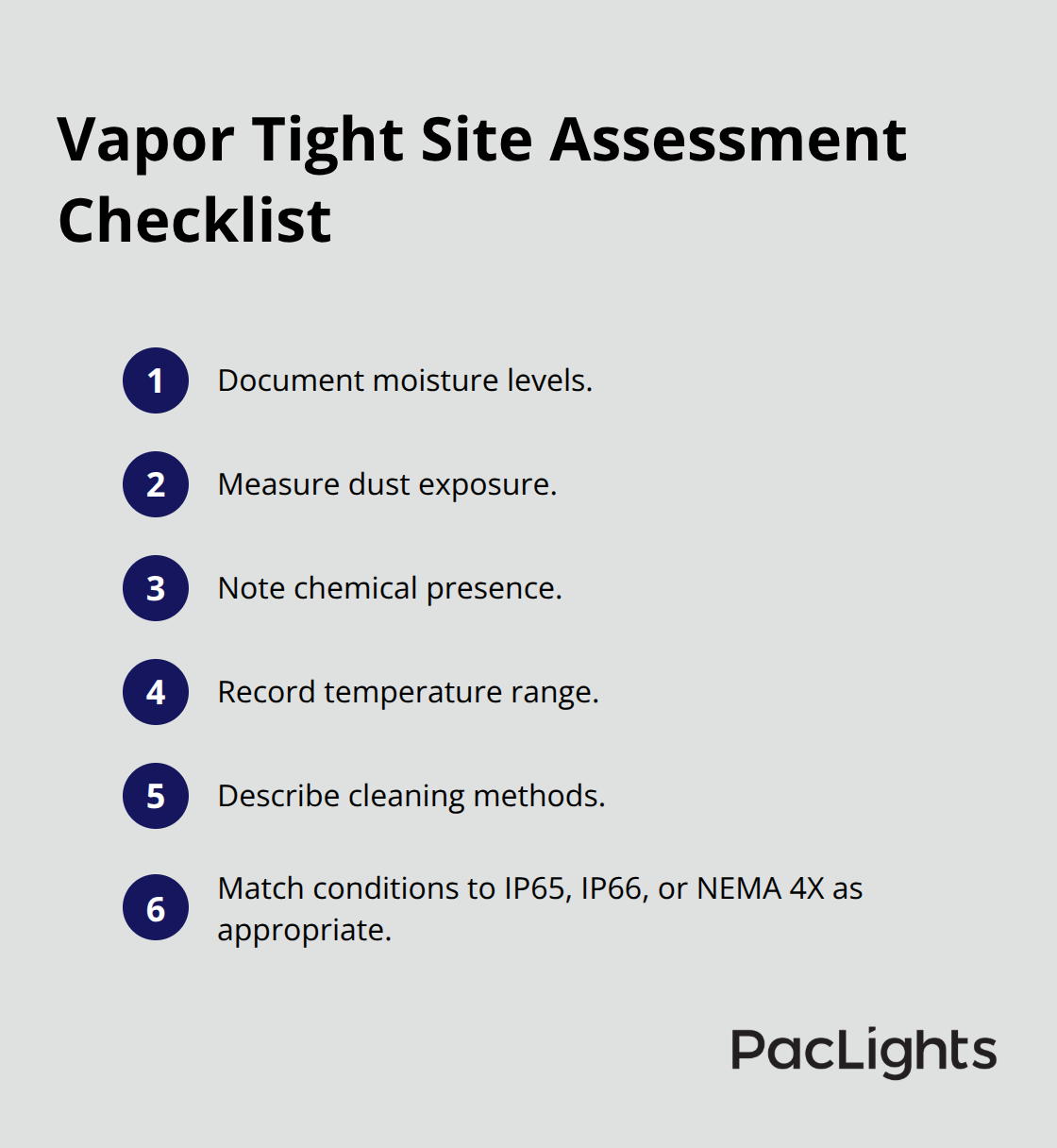
A site assessment determines the right rating for your operation. Document moisture levels, dust exposure, chemical presence, temperature range, and cleaning methods. Match those conditions to the appropriate rating rather than overshooting or undershooting protection. A food processing plant needs NSF certification compliance plus IP66 minimum; a warehouse needs IP54 or better depending on humidity levels. Getting this decision right on the first installation prevents the expensive cycle of premature failures and emergency replacements that drain budgets and disrupt operations.
Understanding these distinctions sets the stage for examining how different facilities apply these ratings in practice.
Where Vapor Tight Fixtures Prove Their Worth
Food Processing Plants Face Extreme Temperature Swings
Food processing plants operate in conditions that destroy standard lighting within months. Temperatures swing from minus 20 degrees Fahrenheit in freezer sections to 140 degrees Fahrenheit in cooking areas, while humidity levels stay near saturation year-round. The National Electrical Code Article 410 mandates IP66 minimum for these wet locations, but NSF International certification adds another layer of requirement that most facility managers overlook. NSF Standard 2 compliance ensures the fixture itself won’t contaminate food products if components fail.
Cold storage creates a specific problem: standard gaskets become brittle at minus 20 degrees, cracking within 18 months. Polycarbonate enclosures rated for extreme temperature ranges outperform aluminum in these conditions, lasting seven to ten years versus three to four years. The upfront cost difference of 15 to 25 percent pays for itself in the first replacement cycle avoided. A facility in Wisconsin switched from fluorescent fixtures with IP54 ratings to LED vapor tight fixtures rated IP66 with NSF certification and saw freezer section lighting failures drop from eight per year to zero over five years.
Chemical Plants and Breweries Require Stainless Steel Construction
Chemical plants and breweries demand IP66 or NEMA 4X ratings because moisture combines with corrosive vapors or cleaning chemicals to accelerate seal degradation. A brewery in Colorado that failed to specify NEMA 4X stainless steel construction in its fermentation room discovered corrosion around gaskets within 14 months, requiring fixture replacement across 32 units. The same facility later installed IP66 fixtures with NEMA 4X stainless steel construction and reported zero failures over six years of operation.
Maintenance protocols matter as much as the rating itself. Quarterly inspection of gaskets and seals, combined with gentle exterior cleaning to remove salt spray or chemical residue, prevents premature degradation. A parking garage in Boston that implemented quarterly seal inspections on IP66 fixtures in salt-spray coastal conditions extended fixture life from four years to nine years.
Car Washes Test Sealing Integrity Constantly
Car washes present a different challenge: high-pressure spray systems create water ingress at angles that test fixture sealing integrity constantly. Facilities using IP65 fixtures in car wash bays experience gasket failure and internal corrosion within two years, while IP66 rated units with proper maintenance last seven years. The maintenance protocol determines whether a fixture reaches its rated lifespan or fails prematurely.
Temperature Extremes Across Multiple Process Areas
Temperature extremes combined with moisture create the worst-case scenario. Breweries in Minnesota that operate both cold fermentation rooms at 55 degrees Fahrenheit and hot conditioning rooms at 95 degrees Fahrenheit need fixtures rated for the full temperature range. Standard fixtures designed for office environments fail in these conditions. Specifying vapor tight fixtures with temperature ratings spanning minus 20 to 140 degrees Fahrenheit ensures performance across all process areas without requiring different fixture types throughout the facility, which simplifies inventory management and reduces installation complexity.
These real-world applications reveal that selecting the correct rating prevents costly failures, but the actual cost savings extend far beyond avoiding replacements. Understanding how sealed LED technology delivers financial benefits over time shows why vapor tight fixtures represent a smart investment for any facility operating in harsh conditions.
How Long Does a Vapor Tight Fixture Actually Last
LED Vapor Tight Fixtures Outlast Traditional Lighting by Significant Margins
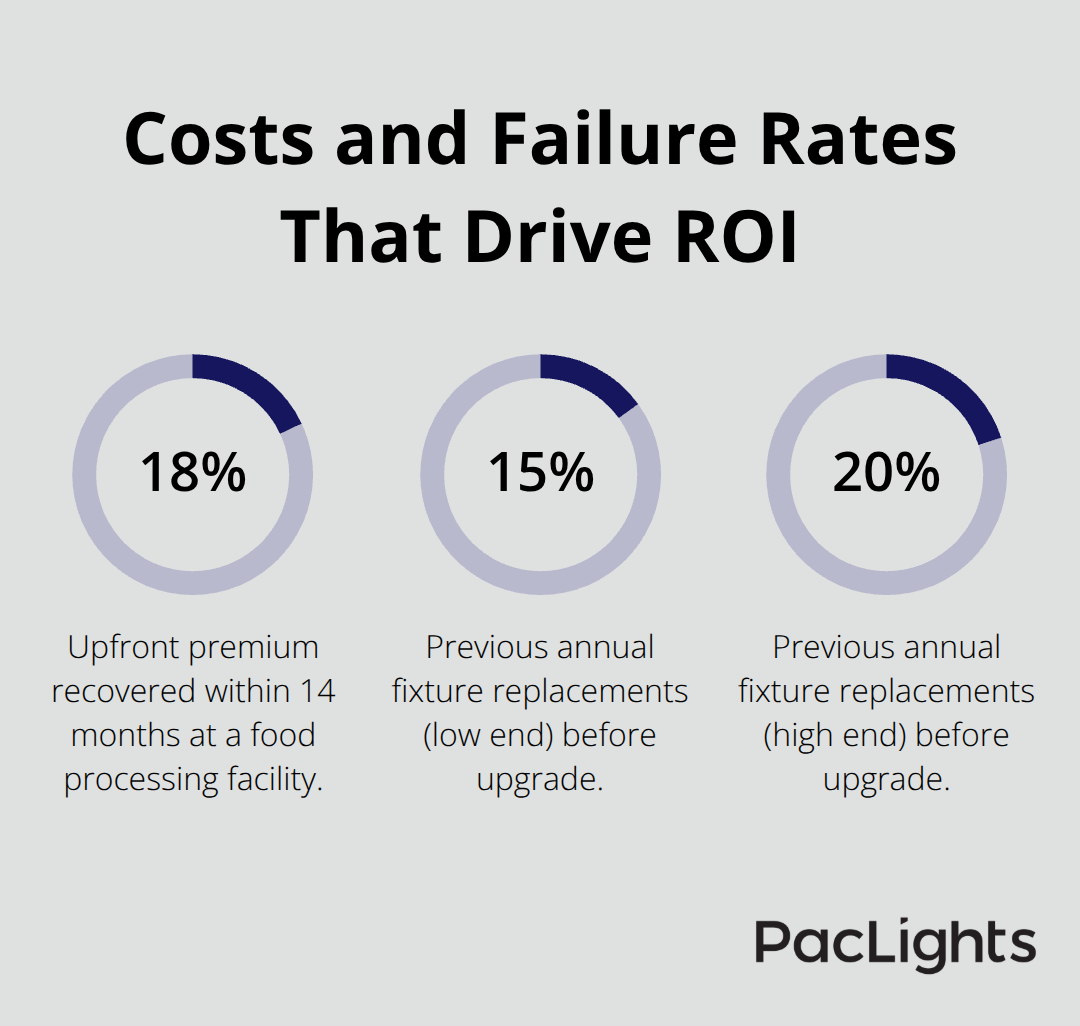
Sealed LED vapor tight fixtures outlast traditional lighting by a factor of three to five in corrosive environments, but the financial calculation extends far beyond raw lifespan numbers. A food processing facility in Wisconsin replaced fluorescent fixtures with LED vapor tight units rated IP66 and NSF certified, reducing annual maintenance labor by 40 hours while eliminating eight emergency replacement calls per year in freezer sections. The facility spent 18 percent more upfront but recovered that investment within 14 months through avoided downtime and labor savings.
Energy Savings Compound Over a Decade
LED vapor tight fixtures generate immediate payback through energy consumption alone. A 32-unit installation of 4-foot LED vapor tight linear fixtures consuming 40 watts each versus 65-watt fluorescent equivalents saves approximately 8,000 kilowatt-hours annually at typical industrial electricity rates of 0.12 dollars per kilowatt-hour, yielding 960 dollars in annual energy savings before accounting for maintenance differences. Over a ten-year lifespan, that facility avoids 960 dollars times ten years while replacing fluorescent units five to six times versus once with LED sealed technology.
Preventive Maintenance Extends Fixture Life Dramatically
Corrosion prevention justifies higher material costs because gasket degradation and internal corrosion create hidden expenses that standard cost-per-fixture analysis misses. A brewery in Colorado discovered that quarterly gasket inspections combined with gentle exterior cleaning extended IP66 fixture life from four years to nine years-a 125 percent lifespan extension through preventive maintenance protocols that cost under 200 dollars annually across their entire facility. Stainless steel NEMA 4X construction prevents rust entirely in salt-air environments, eliminating the replacement cycle that aluminum fixtures enter after three to four years of coastal exposure.
Coastal and Extreme Temperature Environments Show Dramatic ROI
A parking garage in Boston operating under salt-spray conditions transitioned to IP66 fixtures with NEMA 4X stainless construction and logged zero corrosion-related failures over six years of operation versus the previous pattern of replacing 15 to 20 percent of fixtures annually. The upfront material cost premium of 22 to 28 percent vanishes when you compare total cost of ownership across a decade of operation. Temperature-rated polycarbonate enclosures spanning minus 20 to 140 degrees Fahrenheit handle extreme swings that standard materials cannot tolerate, preventing the brittleness failures that occur in freezer sections or the warping that compromises seals in hot process areas (such as commercial kitchens or fermentation rooms).
Total Cost of Ownership Eliminates False Economy
These sealed systems eliminate the false economy of buying cheaper fixtures that fail prematurely. Facility managers who purchase low-cost fixtures enter expensive replacement cycles that consume budget faster than proper specification on the initial purchase. Sealed LED technology with appropriate ratings for your environment delivers financial performance that extends far beyond the first year of operation.
Final Thoughts
Vapor tight fixture ratings directly determine whether your facility avoids costly failures or enters expensive replacement cycles. The distinction between IP and NEMA standards matters because selecting the wrong rating wastes money fast, while choosing correctly prevents emergency downtime and extends equipment life by years. Food processing plants, chemical facilities, and wet environments all demand different protection levels, and matching your site conditions to the appropriate rating eliminates guesswork from your purchasing decisions.
Your facility’s specific environment dictates the right choice-document moisture levels, temperature extremes, chemical exposure, and cleaning methods, then match those conditions to IP65, IP66, or NEMA 4X ratings accordingly. The financial case for sealed LED vapor tight fixtures extends far beyond avoiding replacements, as energy savings compound over a decade while preventive maintenance protocols extend fixture life by 125 percent or more. A facility that implements quarterly gasket inspections and gentle exterior cleaning transforms a four-year lifespan into nine years of reliable performance.
We at PacLights understand that selecting the right vapor tight fixtures requires more than comparing part numbers-our team offers free lighting layout designs and ROI assessments to help you choose the correct rating for your specific environment. Contact PacLights to discuss your facility’s conditions and discover how proper fixture selection delivers dependable lighting while protecting your budget from preventable failures.
Disclaimer: PacLights is not responsible for any actions taken based on the suggestions and information provided in this article, and readers should consult local building and electrical codes for proper guidance.