

Food processing plants, hospitals, and pharmaceutical labs operate under strict regulations. Contamination isn’t just a quality issue-it’s a liability risk that can shut down operations.
NSF certification benefits lighting by guaranteeing products meet rigorous safety and sanitation standards. At PacLights, we’ve seen firsthand how certified fixtures protect facilities while reducing compliance headaches and long-term costs.
What NSF Certification Actually Protects
NSF certification isn’t a generic safety label-it’s a rigorous verification system that tests lighting fixtures against specific sanitation and contamination standards. The National Sanitation Foundation develops these standards across industries, and NSF/ANSI 2 applies directly to food equipment and lighting. When a fixture carries the NSF mark, independent testing confirms that materials won’t leach toxins, surfaces resist corrosion from sanitizing chemicals, and design prevents microbial harborage. Standard commercial lighting often contains crevices, exposed fasteners, or glass components that create contamination risks. NSF certification requires sealed housings with minimum IP65 ingress protection ratings, shatterproof polycarbonate lenses instead of glass, and smooth, non-porous surfaces that facilitate thorough cleaning. Testing includes pressure washing simulations and chemical exposure trials to verify durability. NSF P442 certification extends these same sanitation principles to pharmaceutical processing, surgical suites, and cleanrooms-environments where contamination compromises product integrity or patient safety.
Compliance Zones Shape Your Lighting Strategy
Food facilities operate across three distinct zones, each with different lighting requirements. Food zones involve direct contact with food products and demand completely sealed fixtures with no gaps or exposed fasteners. Splash zones experience frequent high-pressure washdowns and chemical exposure, requiring IP65 or IP69K ratings and water-shedding geometry to prevent moisture retention.
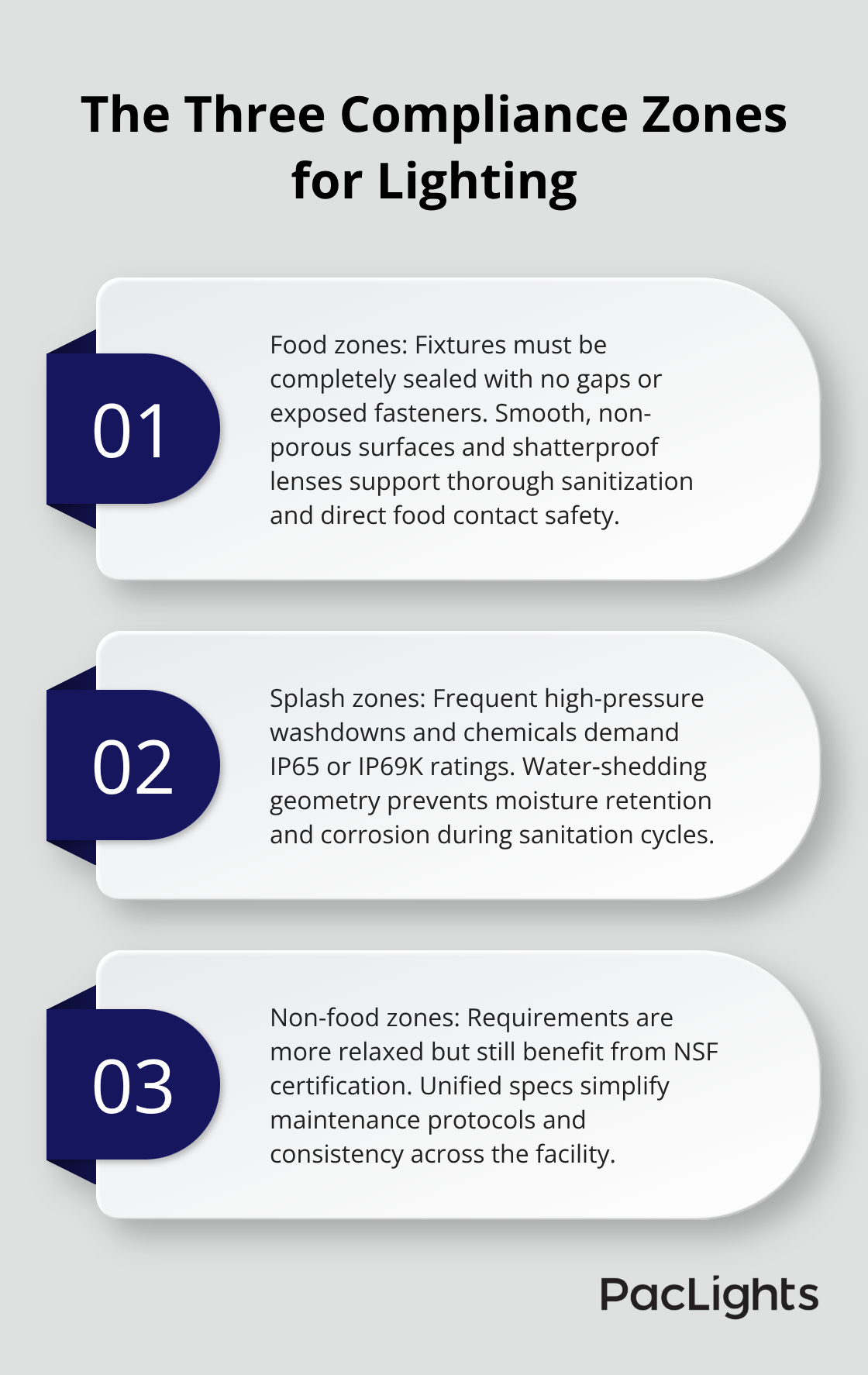
Non-food zones have relaxed requirements but still benefit from NSF certification for consistency and easier maintenance protocols. The FDA Food Code specifies minimum light intensities for each zone: 10 footcandles in walk-in storage, 20 footcandles in prep areas, and 50 footcandles where employees inspect or process food. Wrong fixture selection for your zone creates compliance gaps. A standard LED fixture in a splash zone fails during washdowns, and inadequate lighting in food zones obscures contamination during inspection. NSF-certified vapor tight fixtures handle splash zones effectively because they’re engineered specifically for water exposure. High bay fixtures certified to NSF standards deliver the brightness needed in processing areas while maintaining sealed construction.
Why NSF Beats Competing Standards
ETL NSF Standard 2 certification exists as an alternative path, but NSF International’s direct certification carries stronger market recognition. NSF certifications are recognized across more than 180 countries, giving facilities confidence in global supply chain compliance. Other certifications like UL listing verify electrical safety but don’t address sanitation or contamination prevention. DLC qualification confirms energy efficiency but says nothing about contamination risks. NSF certification combines safety, sanitation, materials testing, and design verification into one credential, reducing procurement confusion and simplifying compliance documentation during regulatory audits.
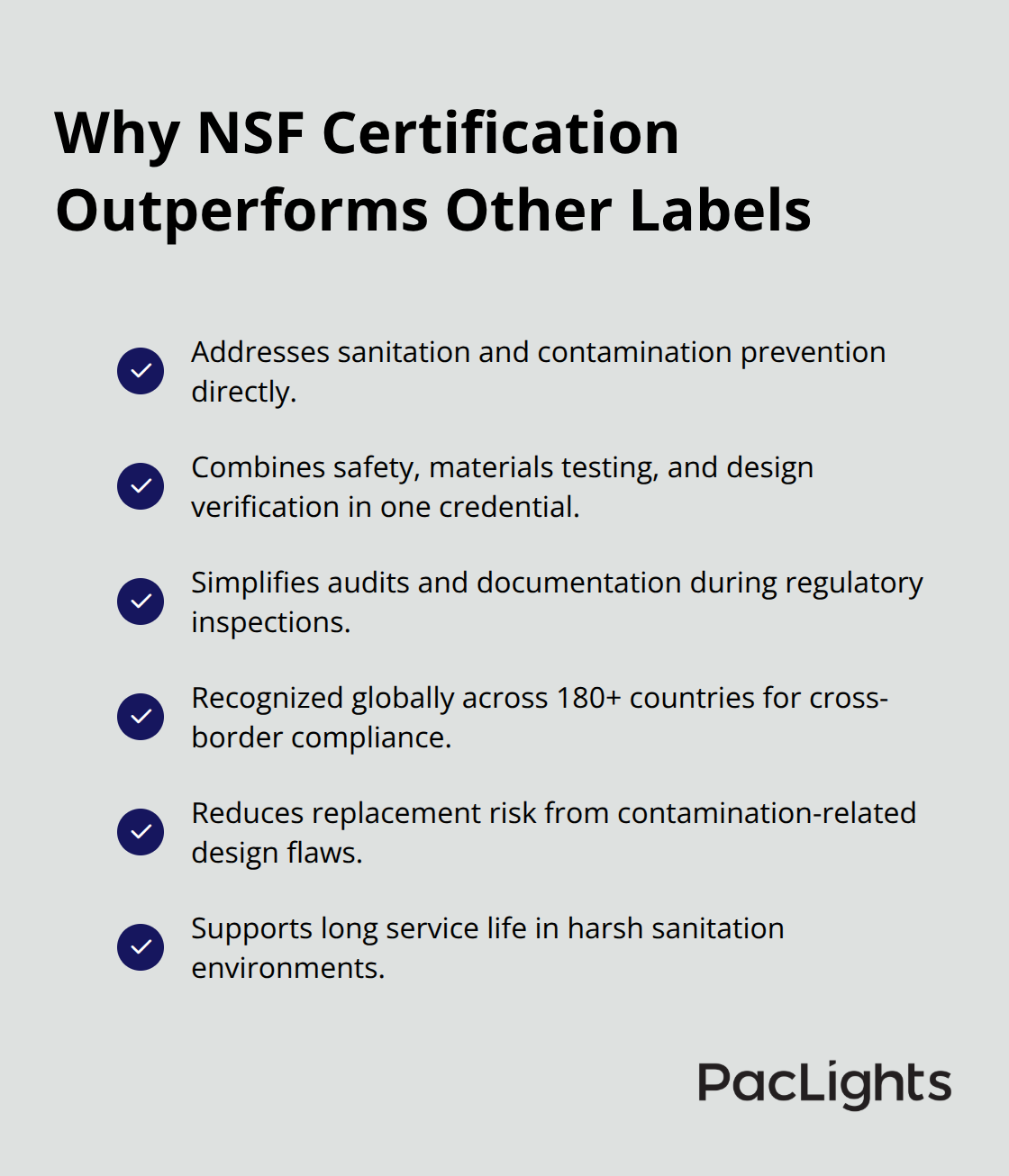
Facilities that select fixtures based only on energy efficiency or cost often discover they need replacements when health inspectors identify contamination risks or design flaws. NSF-certified LED fixtures typically last 50,000 to 75,000 hours with warranties covering this lifespan, meaning fewer replacements and lower maintenance disruption compared to non-certified alternatives that fail prematurely in harsh sanitation environments.
How NSF Certification Protects Your Bottom Line
Energy efficiency and durability work together to reduce operational costs. LED technology in NSF-certified fixtures consumes far less energy than traditional metal halide or fluorescent lighting, delivering strong returns on investment. The sealed, easy-to-clean design means minimal maintenance and reduced downtime from lamp replacements. Facilities adopting NSF-certified lighting report improved visibility in processing and inspection areas, reduced eye strain, and fewer unplanned repairs. Non-compliant fixtures raise contamination risks, potential recalls, and the possibility of facility shutdowns during inspections. The combination of energy savings and enhanced safety provides a compelling financial case for upgrading to NSF-certified solutions. Your facility’s specific needs-whether food processing, healthcare, or pharmaceutical manufacturing-determine which NSF-certified fixtures deliver the best performance and compliance outcomes.
Where NSF Certification Matters Most
Food Processing: Meeting FDA Requirements and Contamination Standards
Food processing facilities operate under FDA Food Code requirements that mandate NSF-certified lighting in specific zones. The FDA specifies 50 footcandles in food preparation areas where employees handle products directly, and inspectors must see clearly to detect contamination. Standard LED fixtures fail this requirement because they contain crevices where bacteria accumulate or lack the sealed construction needed to survive daily washdowns with caustic chemicals. NSF-certified vapor tight fixtures with IP65 or IP69K ratings withstand high-pressure cleaning and chemical exposure without degrading, protecting both product safety and worker visibility.
Food storage areas present different challenges: walk-in coolers operate at temperatures between 32°F and 40°F, and many standard fixtures lose efficiency or fail prematurely in cold conditions. NSF P442 certified fixtures maintain performance across operating ranges from -40°F to 113°F, critical for facilities managing both refrigerated storage and hot processing lines. Facilities that skip NSF certification during equipment selection discover compliance failures during health inspections, forcing expensive retrofits or temporary shutdowns. The cost of upgrading lighting after inspection violations far exceeds the upfront investment in certified fixtures.
Healthcare Facilities: Protecting Sterile Environments
Healthcare and pharmaceutical environments demand NSF certification for different reasons than food plants, though the core principle remains identical: sealed construction prevents contamination. Surgical suites require lighting that won’t shed particles into sterile fields, and hospital-grade fixtures must resist moisture from frequent cleaning and steam sterilization. Pharmaceutical manufacturing facilities process medications in controlled environments where airborne particles compromise product integrity, and NSF P442 certification confirms fixtures meet the contamination control standards required by FDA pharmaceutical manufacturing guidelines.
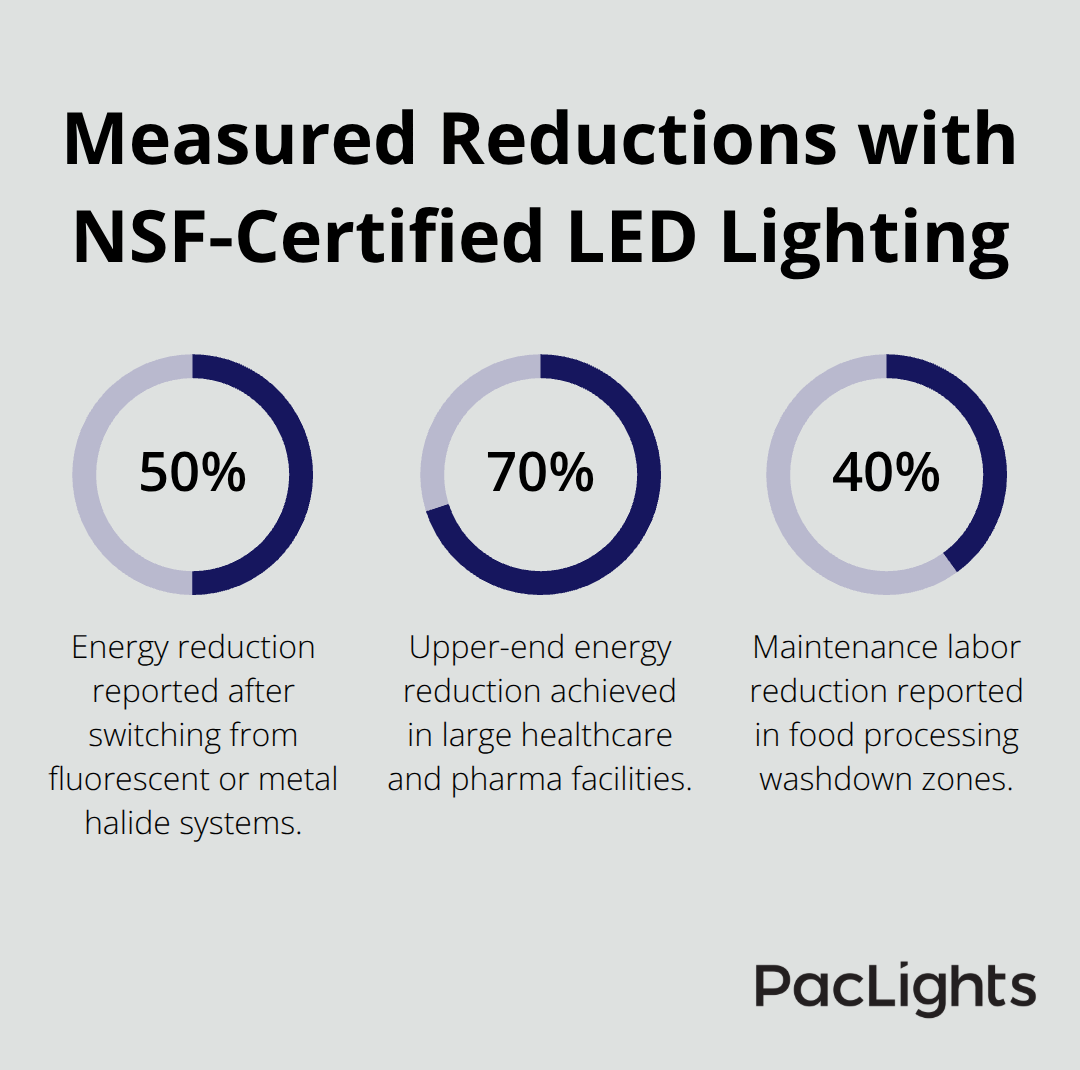
Cleanroom facilities use NSF-certified high bay fixtures that deliver 75,000 to 100,000 lux without creating dust or particle shedding. Laboratory settings benefit from NSF-certified lighting because sealed housings prevent chemical vapors from corroding internal components, extending fixture life beyond standard commercial alternatives. Healthcare facilities switching to NSF-certified LED fixtures report energy reductions of 50% to 70% compared with older fluorescent or metal halide systems, translating to substantial operational savings across large buildings.
Long-Term Performance and Maintenance Advantages
The sealed design reduces maintenance frequency: NSF-certified fixtures typically last 50,000 to 75,000 hours with full warranties, meaning fewer lamp replacements and less disruption to critical care operations. This durability advantage extends across all facility types-food plants, hospitals, and pharmaceutical labs all benefit from fixtures that perform reliably in harsh sanitation environments. When you select NSF-certified lighting, you eliminate the hidden costs of premature failures, emergency replacements, and compliance violations that plague non-certified alternatives.
Why NSF Certification Stops Contamination Before It Starts
NSF-certified fixtures physically prevent contamination through design, not just compliance paperwork. Sealed housings with minimum IP65 ratings block moisture, dust, and chemical residue from entering fixture cavities where bacteria colonize and multiply. Standard commercial lighting contains exposed fasteners, gasket seams, and internal voids that trap contaminants even after cleaning. NSF certification requires polycarbonate lenses instead of glass, eliminating shatter risks that introduce foreign particles into food, pharmaceuticals, or sterile environments. The FDA Food Code doesn’t specify lighting materials by accident-broken glass in a food processing facility triggers recalls, facility shutdowns, and liability claims that cost hundreds of thousands of dollars.
NSF-certified vapor tight and high bay fixtures feature smooth, non-porous surfaces that shed water and debris during washdowns, preventing moisture retention that breeds mold and bacterial biofilms. Testing includes high-pressure spray simulations and chemical exposure protocols to verify fixtures withstand caustic sanitizers used in food plants and hospital sterilization cycles. Facilities that upgrade from standard LEDs to NSF-certified alternatives report zero contamination incidents attributed to lighting within their first year of operation, compared to baseline rates of 2–3 incidents annually in comparable facilities using non-certified fixtures.
Durability That Justifies the Investment
NSF-certified LED fixtures operate 50,000 to 75,000 hours with full warranties, compared to 25,000 to 35,000 hours for non-certified alternatives in harsh environments. Sealed construction means internal components never corrode from moisture or chemical exposure, so fixtures maintain brightness output across their entire lifespan without degradation. Food processing facilities switching to NSF-certified lighting report 40–50% reductions in maintenance labor because sealed designs eliminate premature failures that plague non-certified fixtures in washdown zones.
Cold storage areas operating at -40°F present extreme durability challenges; NSF P442 certified fixtures maintain full performance across this range, while standard LEDs experience capacitor failures and reduced output in freezing conditions. Healthcare facilities adopting NSF-certified lighting across surgical suites and pharmaceutical labs report energy consumption drops of 50–70% compared with older fluorescent systems, translating to $15,000 to $40,000 in annual savings for medium-sized facilities (depending on operating hours and local electricity rates). The combination of extended lifespan, reduced maintenance, and superior energy efficiency delivers positive ROI within 18 to 24 months for most facility conversions.
Regulatory Compliance Eliminates Liability Exposure
NSF certification provides documented evidence of compliance during health inspections, FDA audits, and insurance reviews. Facilities using NSF-certified fixtures can reference the NSF mark and independent testing reports to demonstrate adherence to FDA Food Code lighting requirements and USDA sanitation standards. Non-compliant fixtures create liability: if contamination occurs and inspectors discover non-certified lighting in food zones, facility operators face violations, fines up to $25,000 per incident, mandatory facility closures, and potential criminal charges for negligent food safety violations.
Insurance carriers increasingly require NSF certification as a condition of coverage in food processing and healthcare facilities, meaning non-certified lighting creates uninsurable risk. Pharmaceutical manufacturers operating under FDA Current Good Manufacturing Practice regulations must document that all facility components, including lighting, meet contamination control standards-NSF P442 certification satisfies this requirement with minimal additional compliance burden. Facilities that maintain NSF-certified lighting systems pass inspections faster, avoid costly remediation orders, and retain operational continuity that protects revenue and reputation.
Final Thoughts
NSF certification benefits lighting by transforming how facilities manage contamination, compliance, and operational costs. Facilities switching to NSF-certified LED lighting report energy reductions of 50–70% compared with older systems, translating to $15,000 to $40,000 in annual savings depending on facility size. Extended lifespans of 50,000 to 75,000 hours mean fewer replacements and less maintenance labor disruption, with most facilities recovering their investment within 18 to 24 months.
NSF certification provides more than financial returns-it protects your facility’s reputation and operational continuity. Your facility passes inspections faster, avoids costly violations and shutdowns, and maintains the trust of regulators and customers. Insurance carriers increasingly require NSF certification as a coverage condition, making certified fixtures a liability protection strategy that safeguards your business.
We at PacLights specialize in NSF-certified fixtures designed for your specific environment, from high bays and vapor tight lights to retrofit solutions that upgrade existing systems. Our team provides free lighting layout designs and ROI assessments to help you identify the right certified fixtures and quantify your savings. Contact PacLights today to discuss your facility’s lighting needs and take the first step toward certified, compliant, and cost-effective illumination.
Disclaimer: PacLights is not responsible for any actions taken based on the suggestions and information provided in this article, and readers should consult local building and electrical codes for proper guidance.