

Energy bills are crushing facility budgets, but here’s the reality: you don’t have to choose between savings and performance. At PacLights, we’ve seen wrap light energy savings transform how commercial spaces operate, cutting power consumption dramatically while maintaining the light quality your operations depend on.
This guide breaks down exactly how it works, what you’ll actually save, and why your facility’s lighting quality stays intact throughout the transition.
How Wrap Lights Cut Energy Costs
LED Technology Slashes Power Consumption
LED technology converts roughly 95% of electrical energy into light, wasting only about 5% as heat. Incandescent bulbs waste 90% of their energy as heat, making the difference stark. A 60-watt incandescent fixture swapped for a 10-watt LED wrap light maintains brightness while cutting energy use by approximately 83%. For a facility running 20 wrap light fixtures across corridors and workspaces, consumption drops from 1,200 watts to 200 watts for identical illumination.
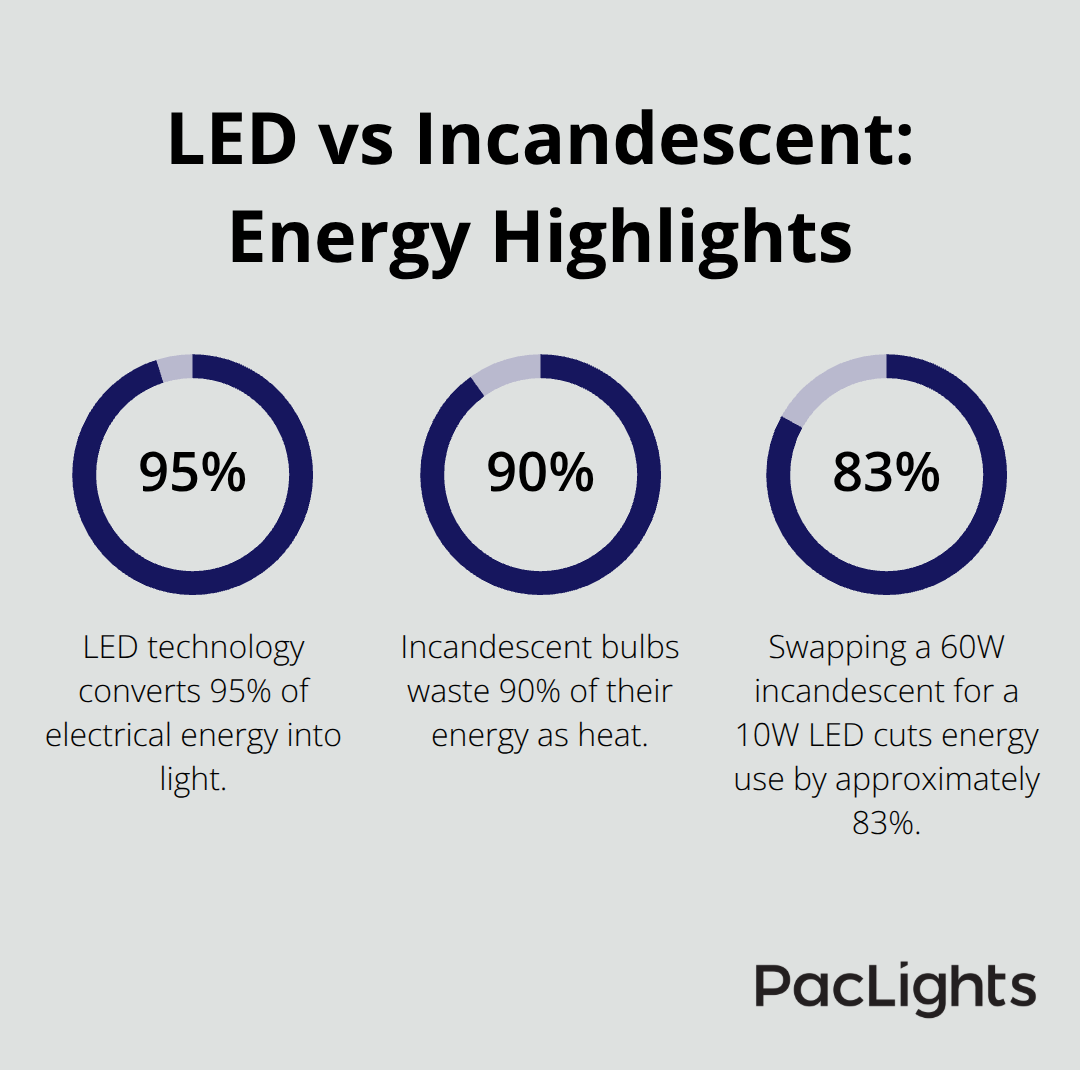
Energy Star data confirms that LED lighting uses 80-90% less energy than incandescent bulbs, which directly translates to lower monthly utility bills. A mid-sized office with 50 wrap light installations can expect to save over $20,000 annually when switching from older lighting systems.
Durability Compounds Your Savings
The real advantage emerges when you factor in operational costs beyond electricity alone. LED wrap lights last 15,000 to 50,000 hours compared to 1,000 hours for incandescent bulbs, meaning you replace fixtures far less frequently. Fewer service calls, lower labor costs, and less operational disruption follow naturally from this extended lifespan. Over a decade, the labor savings alone can rival the energy savings themselves. Wrap light fixtures designed specifically for corridors and workspace applications deliver maximum efficiency without compromising illumination when proper spacing and performance guidelines are followed.
Smart Controls Unlock Additional Savings
Motion sensors and daylight harvesting controls amplify these savings further. Occupancy sensors reduce lighting energy use by up to 40% in spaces with intermittent occupancy, such as hallways and break rooms where lights stay on whether anyone’s present or not. Daylight harvesting systems automatically dim artificial lighting when natural light is sufficient, preventing the waste of running full brightness during daylight hours. A facility that installs motion controls on 30 wrap light fixtures can realistically expect an additional 25-35% reduction beyond the baseline LED efficiency gains.
These controls match light output to actual usage patterns rather than running at constant levels. Many commercial facilities overlook this layer of optimization, leaving significant savings on the table. The payback on motion sensors and daylight controls typically occurs within 2-3 years, after which they become pure savings. PacLights offers optional motion and daylight control features integrated directly into wrap light systems, eliminating the need for separate retrofits or complex installations that add cost and complexity.
Understanding your actual energy consumption and ROI potential requires looking beyond the fixture itself-facility size, occupancy patterns, and current lighting infrastructure all shape your final numbers.
What Your Real Payback Timeline Looks Like
The Numbers Behind Mid-Sized Retrofits
A mid-sized office retrofitting 50 wrap light fixtures from incandescent to LED saves approximately $20,000 annually, according to real-world installations we’ve tracked. For a facility spending $3,000 monthly on lighting alone, that $20,000 reduction represents a genuine shift in operational budgets.
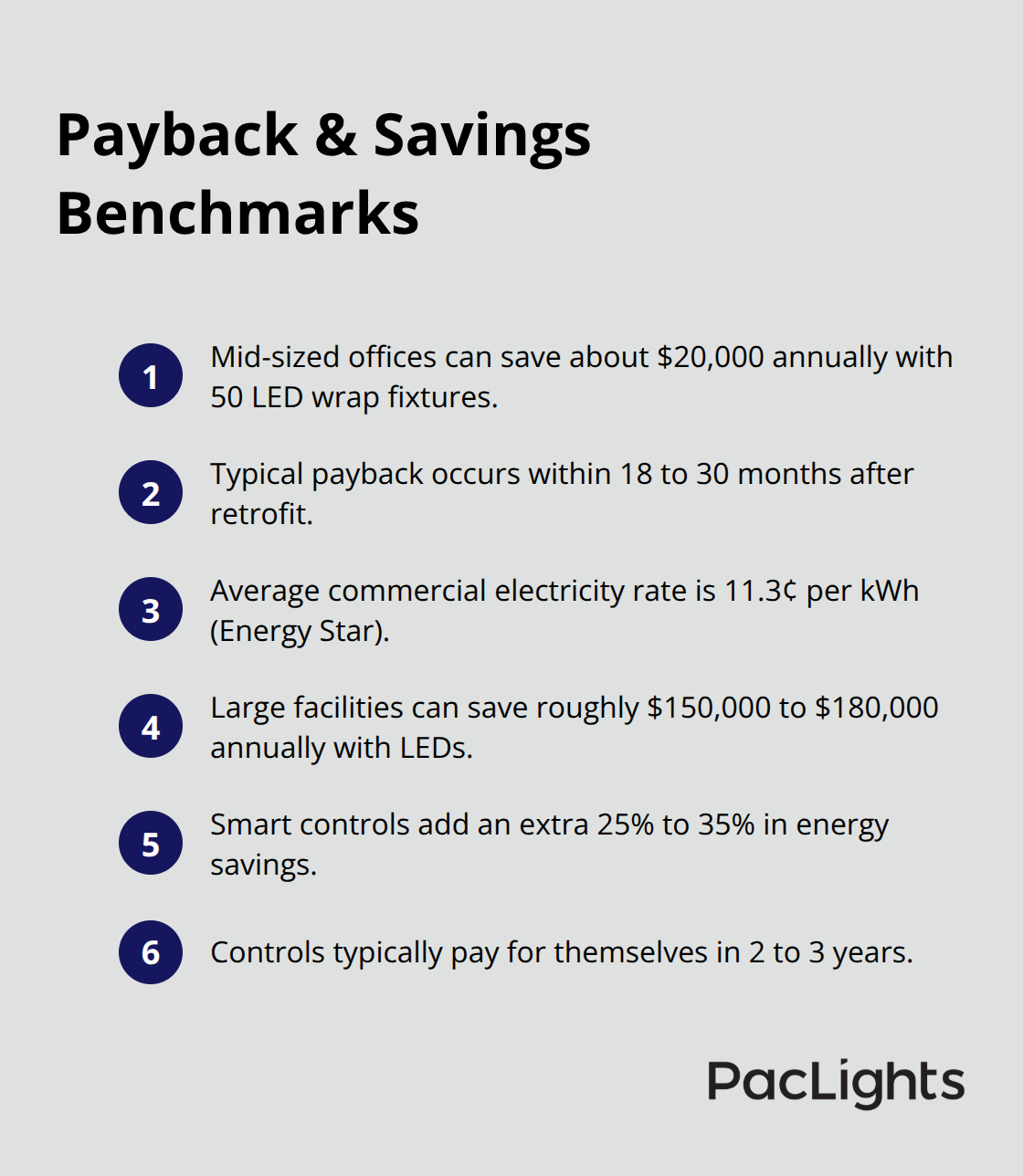
The payback period depends on your current system’s age and energy intensity. A facility with aging incandescent wrap lights recoups the LED investment within 18 to 30 months, after which every year becomes pure cost reduction. Larger installations across multiple buildings accelerate this timeline considerably.
Scaling Up: Warehouse and Large Facility Economics
A warehouse running 200 wrap light fixtures consumes 2,400 watts with incandescent systems but drops to 400 watts with LED equivalents, cutting annual electricity costs by roughly $150,000 to $180,000 depending on regional rates. At an average commercial electricity rate of 11.3 cents per kilowatt-hour according to Energy Star data, even modest facilities see substantial returns. Motion sensors and daylight harvesting controls extend savings further by reducing unnecessary operation, typically cutting an additional 25 to 35 percent from baseline LED efficiency. These controls pay for themselves in 2 to 3 years, making them cost-effective additions rather than luxury upgrades.
Environmental Impact Strengthens the Financial Case
Switching 50 wrap light fixtures from incandescent to LED prevents roughly 50 tons of carbon dioxide emissions over a decade, equivalent to removing one vehicle from roads for a year. The Department of Energy projects that LED adoption across U.S. lighting will save 569 terawatt-hours annually (equivalent to the output of more than 92,000 megawatts of power plants) when the transition reaches full scale. Your facility contributes to this shift while reducing waste through extended product lifespan. LED wrap lights lasting 15,000 to 50,000 hours versus 1,000 hours for incandescent bulbs mean fewer replacements, lower disposal costs, and reduced material consumption.
Total Cost of Ownership Over a Decade
A 10-year analysis shows that LED systems generate approximately 70 to 80 percent lower total cost of ownership when accounting for electricity, labor, and replacement materials. Facilities serious about carbon reduction and cost control should prioritize wrap light retrofits immediately rather than waiting for perfect conditions. The financial payback proves strong enough that delaying the upgrade wastes money every month the old system remains operational. Understanding how to maintain light quality throughout this transition matters just as much as the financial numbers themselves.
Maintaining Light Quality While Cutting Energy Costs
Energy savings mean nothing if your facility ends up dimmer, yellower, or harder to work in. Facilities often make this mistake by selecting the cheapest LED wrap lights, only to discover that color rendering and brightness fall short of actual needs. The truth is straightforward: maintaining light quality while cutting energy costs requires understanding three specific measurements and how they interact with your space.
Color Rendering Determines Visual Accuracy
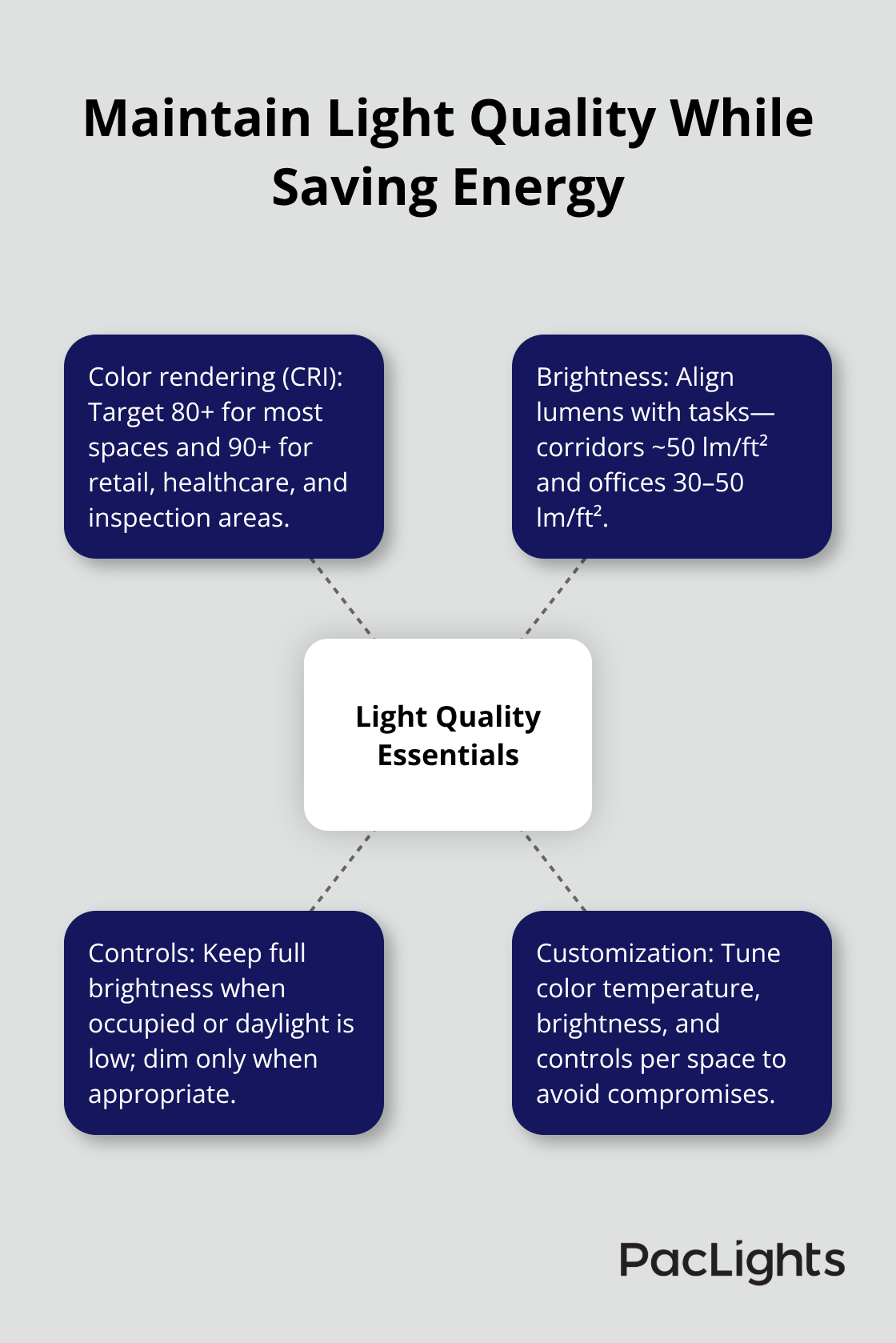
Color rendering index, measured on a scale of 0 to 100, determines how accurately colors appear under your lighting. Most commercial facilities perform adequately with a CRI of 80 or higher, but retail environments, healthcare facilities, and inspection areas demand CRI of 90 or above to avoid costly errors and customer dissatisfaction. A wrap light fixture with a CRI of 70 might save marginally more on electricity, but it creates visual strain in detailed work environments and makes merchandise look washed out in retail settings.
Energy Star certified LED products consistently deliver CRI ratings between 80 and 95, meaning you don’t sacrifice quality to achieve savings.
Brightness Levels Match Task Requirements
Brightness, measured in lumens, needs to match your actual task requirements rather than defaulting to what your previous incandescent system provided. A corridor requires roughly 50 lumens per square foot according to professional lighting standards, while an office workspace requires 30 to 50 lumens per square foot. Many facilities over-light spaces out of habit, installing more fixtures than necessary and wasting energy in the process. A proper lighting audit identifies your actual lumen requirements rather than assuming your old system got it right.
Controls Prevent Quality Compromises
Motion and daylight controls prevent the most common quality compromise: dimming fixtures below comfortable levels to squeeze out additional savings. These controls maintain full brightness when occupants are present or when natural light is insufficient, only reducing output during unoccupied periods or bright daylight hours. Facilities that implement controls without understanding this distinction end up with complaints about inadequate lighting despite lower energy bills.
Customization Delivers Both Savings and Quality
Customizing wrap light specifications for your specific application matters far more than selecting a generic energy-efficient product. A warehouse corridor has completely different requirements than a manufacturing floor inspection area, yet many facilities install identical fixtures throughout. PacLights offers advanced lighting controls and customizable wrap light options that let you optimize brightness, color temperature, and control strategies for each space independently. This approach costs slightly more upfront but eliminates the false choice between savings and quality by delivering both simultaneously. The payback analysis from the previous section assumed quality standards remained intact, and that assumption holds only when you select fixtures and controls matched to your actual operational needs rather than chasing the lowest wattage number on a specification sheet.
Final Thoughts
Wrap light energy savings deliver measurable financial returns without forcing you to accept dimmer corridors or compromised work environments. Switching from incandescent to LED wrap lights cuts energy consumption by 80 to 90 percent, translates to $20,000 annual savings for mid-sized facilities, and pays back the initial investment within 18 to 30 months. Motion sensors and daylight harvesting controls extend those savings by another 25 to 35 percent, making the financial case even stronger.
Quality standards remain intact throughout this transition when you prioritize proper fixture selection and controls matched to your actual space requirements. Color rendering index ratings between 80 and 95, brightness levels calibrated to task needs, and smart controls that maintain full illumination when occupants are present ensure your facility performs better under LED wrap lights than it did under older systems. The false choice between savings and quality disappears when you approach the upgrade strategically rather than simply selecting the cheapest option available.
Facility managers ready to move forward should start with a lighting audit to understand current consumption patterns and identify high-return upgrade opportunities. We at PacLights provide free lighting layout designs and ROI assessments that show exactly what your facility will save, how long the payback takes, and which customizable wrap light solutions match your specific operational needs. Contact PacLights to discuss your facility’s lighting strategy and begin capturing wrap light energy savings immediately.
Disclaimer: PacLights is not responsible for any actions taken based on the suggestions and information provided in this article, and readers should consult local building and electrical codes for proper guidance.