

Datacenters consume massive amounts of electricity, and lighting is a bigger culprit than most facility managers realize. At PacLights, we’ve seen firsthand how datacenter power saving lighting can slash energy bills while keeping operations running smoothly.
The good news is that modern LED solutions with smart controls deliver real results. We’re talking 40-60% energy reductions without compromising visibility or safety.
Why Lighting Drains More Energy Than You Think
Datacenters operate around the clock, and every watt counts when electricity bills run into six figures monthly. The U.S. Department of Energy reports that datacenters consume roughly 1,000 kWh per square meter annually, making them among the most energy-intensive facilities on the planet. Lighting often escapes scrutiny in energy audits because facility managers focus on servers and cooling systems, yet it remains a substantial drain that operators can actually control without major infrastructure overhauls. Traditional fluorescent and incandescent systems waste energy constantly, especially in spaces where lights run 24/7 regardless of occupancy patterns. Datacenter operators who switched to LED fixtures with smart controls cut their lighting energy consumption by 40 to 60 percent. That gap exists because most older datacenters were built with systems designed for office environments, not the continuous, high-density operations that modern facilities demand.
The True Cost of Outdated Lighting Systems
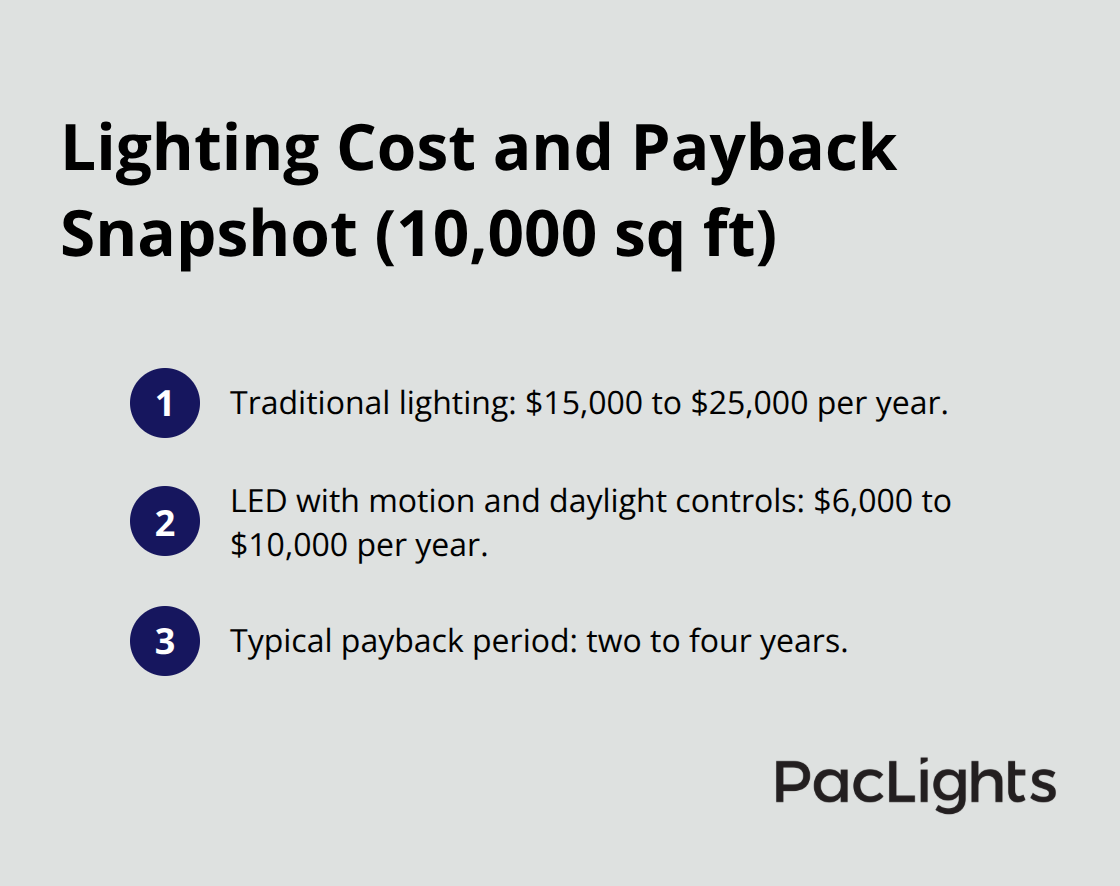
Electricity costs dominate datacenter operating expenses, and lighting represents a significant portion of that burden. A typical 10,000-square-foot datacenter running traditional lighting 24/7 spends $15,000 to $25,000 annually on lighting alone, depending on local utility rates and fixture efficiency. Switching to high-efficiency LED solutions with motion sensors and daylight harvesting reduces that number to $6,000 to $10,000 per year, delivering payback periods of two to four years in most cases.
The carbon footprint compounds the problem: continuous operation of inefficient lighting contributes directly to Scope 2 emissions that regulators and corporate sustainability goals increasingly target. California Title 24 and the EU Energy Efficiency Directive now mandate specific lighting efficiency standards for datacenters, including automated controls and occupancy sensors. Facilities that ignore these regulations face penalties and retrofitting costs far higher than proactive upgrades. Every percentage point of energy reduction translates directly to lower operating costs and improved competitiveness.
How Advanced Controls Eliminate Waste
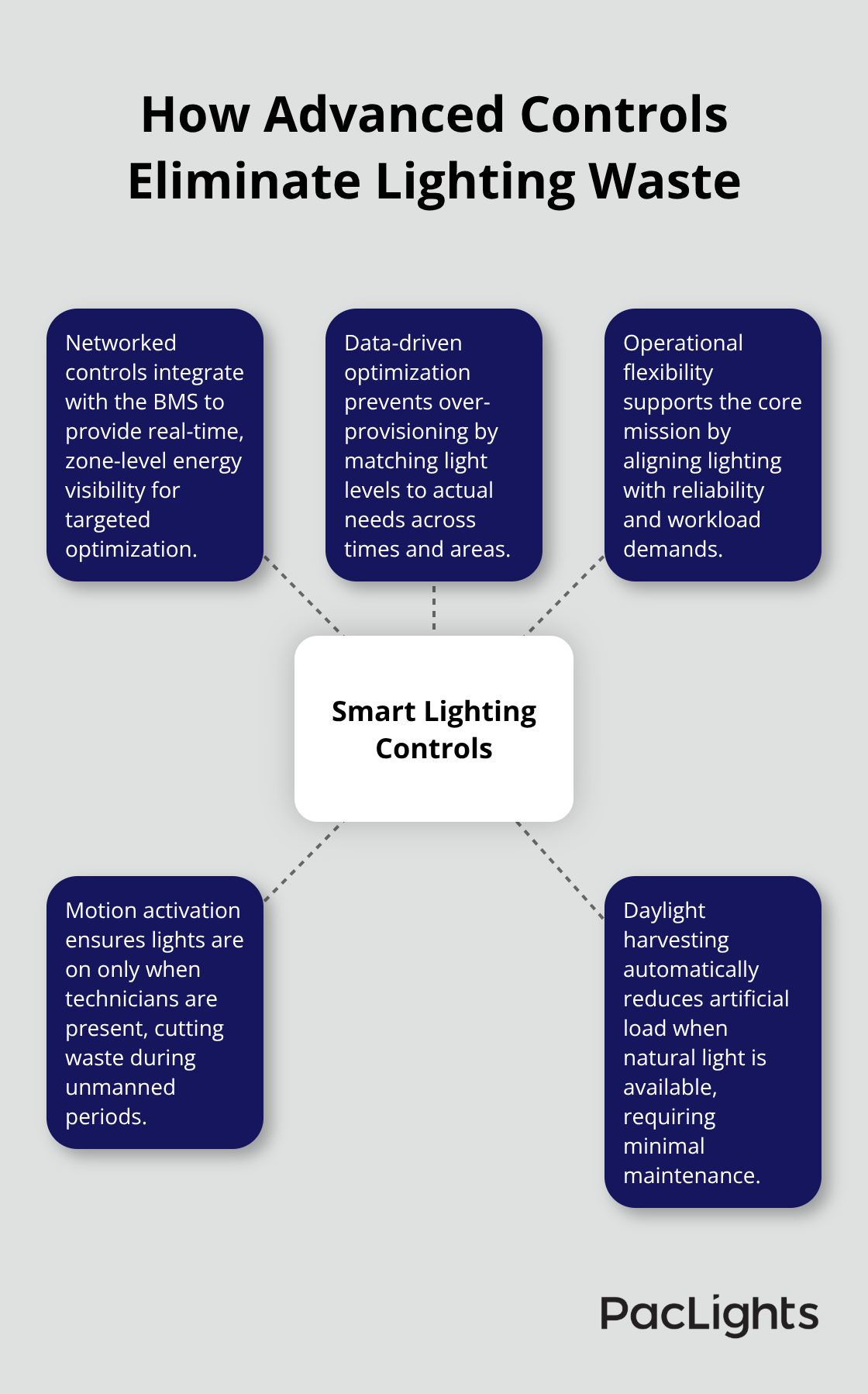
Motion-activated systems ensure lights operate only when technicians are present, eliminating waste during unmanned periods that dominate datacenter schedules. Daylight harvesting systems reduce artificial lighting loads during daylight hours-a straightforward technology that requires minimal ongoing maintenance. Networked lighting controls integrated with building management systems provide real-time visibility into energy consumption by zone, enabling facility managers to identify anomalies and optimize setpoints continuously. This data-driven approach prevents the common mistake of overprovisioning lighting for worst-case scenarios when actual needs vary throughout the day and across different areas. Operators gain operational flexibility that directly supports their core mission: reliable compute delivery.
Moving Beyond Compliance to Competitive Advantage
Compliance alone is insufficient thinking for modern datacenters. Facilities that implement advanced lighting controls gain a foundation for broader energy management that supports both financial performance and environmental responsibility. The next step involves selecting the right lighting products and controls that align with your facility’s specific layout and operational patterns.
Smart Controls That Actually Work
Motion Sensors Eliminate Wasted Hours
Motion sensors transform datacenter lighting by activating fixtures only when technicians occupy a space. In datacenters where staff spend perhaps two to four hours daily in any given area while systems run 24/7, this distinction matters enormously. The U.S. Department of Energy confirms that motion sensors paired with LED fixtures cut lighting energy use by 50 to 70 percent in facilities with intermittent occupancy patterns. This isn’t theoretical savings; it’s what happens when you stop lighting empty server rooms. Administrative and maintenance areas deliver the highest returns because occupancy is sporadic and predictable. Technicians move through these zones unpredictably, making motion activation far more effective than fixed schedules.
Daylight Harvesting Reduces Artificial Load
Daylight harvesting reduces artificial lighting loads automatically when natural light is available, requiring no behavioral changes from staff. This straightforward technology works best in datacenters with exterior walls or skylights where natural light penetrates regularly. Sensors measure incoming daylight and dim or deactivate fixtures proportionally, maintaining consistent illumination levels while cutting energy consumption. The system operates continuously without manual intervention, making it one of the most reliable efficiency tools available. Facilities with significant natural light exposure can reduce daytime lighting energy by 30 to 50 percent through harvesting alone.
Networked Controls Provide Real-Time Visibility
Networked lighting controls integrated with your building management system provide real-time energy consumption data by zone, enabling you to identify which areas waste the most power and adjust accordingly. This data-driven approach prevents the common mistake of overprovisioning lighting across an entire facility when actual usage varies dramatically between administrative areas and equipment rooms. You gain visibility into consumption patterns that manual oversight simply cannot provide, allowing continuous optimization rather than one-time adjustments. Different zones operate on different schedules based on actual operational needs rather than generic assumptions.
Combining Technologies for Maximum Impact
The real advantage emerges when you combine these technologies strategically. Facilities that implement motion sensors, daylight harvesting, and networked controls together typically achieve lighting energy reductions of 60 to 75 percent compared to traditional systems, translating to $9,000 to $16,000 annual savings in a 10,000-square-foot facility depending on local electricity rates. The payback period for this combination typically runs two to three years, after which the savings flow directly to your bottom line. PacLights offers fixtures with integrated daylight and motion control options, along with advanced networked lighting controls, enabling you to deploy this multi-layered approach without piecing together incompatible systems from different vendors. The combination also simplifies maintenance because everything operates through a single control platform rather than competing systems that create operational friction.
Measuring Results and Scaling Success
Once you implement these controls, real-time monitoring reveals exactly where energy reductions occur and which zones respond most effectively to optimization. This data guides decisions about expanding controls to additional areas or adjusting setpoints for even greater efficiency. Operators who track consumption patterns discover unexpected opportunities-perhaps a particular zone consumes far more than expected, or a specific time period shows dramatic waste. These insights drive continuous improvement cycles that compound savings over time. The foundation you build with smart controls positions your facility for additional efficiency measures that leverage the same data infrastructure.
Measuring Real Savings and Payback Periods
Datacenter operators need concrete numbers, not promises. A 10,000-square-foot facility running traditional lighting 24/7 spends $15,000 to $25,000 annually on lighting alone, depending on local electricity rates. Switching to LED fixtures with motion sensors and daylight harvesting reduces that figure to $6,000 to $10,000 yearly, delivering payback periods of two to four years in most cases. The math is straightforward: if your retrofit costs $20,000 and saves $10,000 annually, you recover that investment in two years and pocket pure savings thereafter. Larger facilities see even faster returns because fixed costs distribute across more square footage. A 50,000-square-foot datacenter implementing the same controls realizes annual savings of $40,000 to $75,000, cutting payback to 18 months or less.
The U.S. Department of Energy confirms that motion sensors paired with LED fixtures cut lighting energy use by 50 to 70 percent in facilities with intermittent occupancy. Facilities combining motion sensors, daylight harvesting, and networked controls typically achieve 60 to 75 percent reductions overall. Your specific savings depend on three factors: current fixture efficiency, occupancy patterns, and local electricity rates. A facility paying 12 cents per kilowatt-hour realizes different absolute savings than one paying 8 cents, but the percentage reduction remains consistent.
Calculate Your Baseline and Model Expected Returns
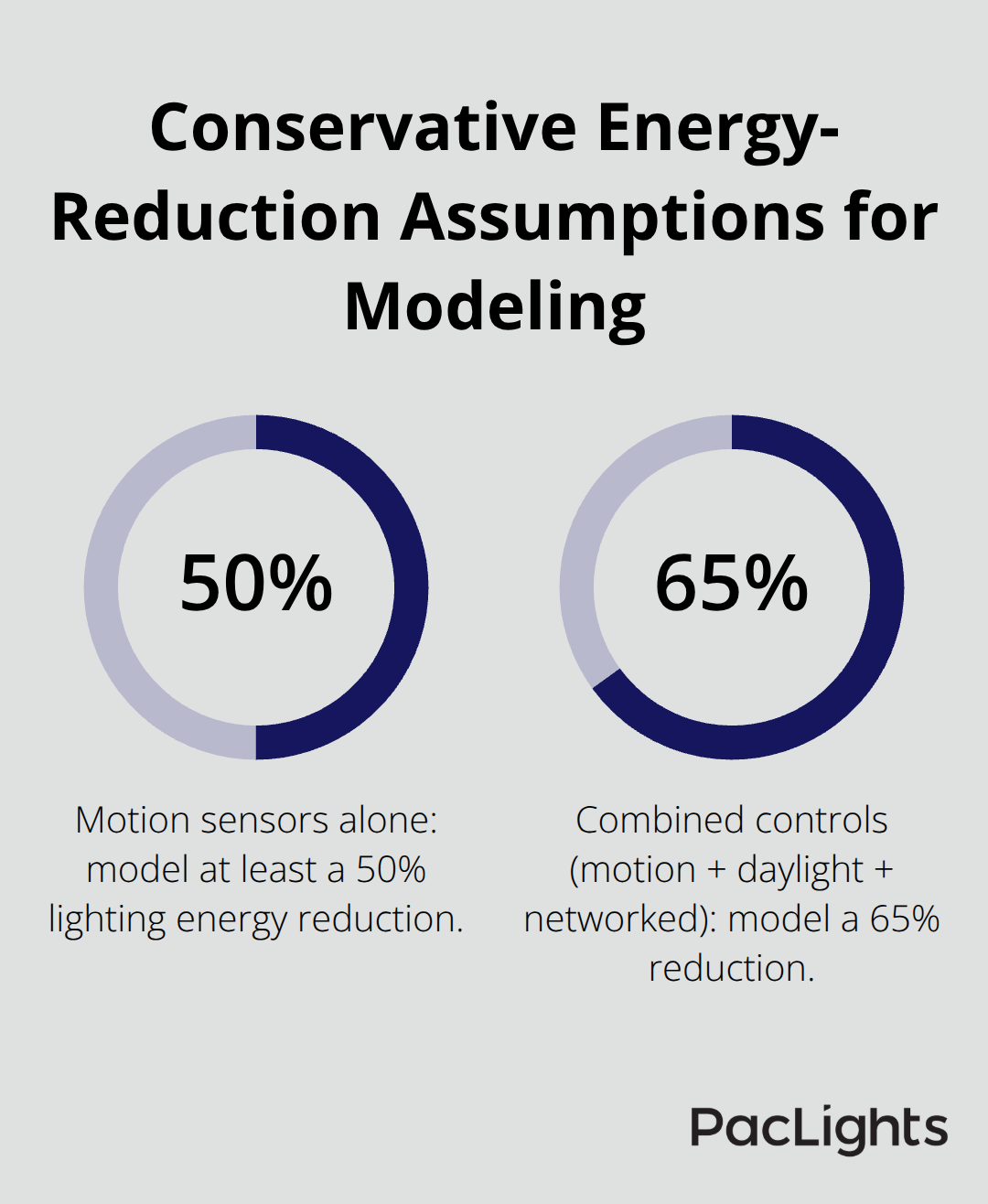
Track your current lighting energy consumption for one month, then multiply that figure by 12 to establish annual use. Apply conservative reduction percentages (50 percent minimum with motion sensors alone, 65 percent with combined controls) to model expected savings.
This calculation guides your investment decision and establishes a benchmark for measuring actual performance after retrofit. Most facilities discover that their lighting costs far exceed initial estimates once they isolate this category from total energy bills.
Motion Sensors Deliver Immediate Visibility Without Sacrificing Safety
The critical question operators ask is whether efficiency gains come at the cost of visibility or safety. They don’t. Motion sensors activate instantly when technicians enter a space, providing full illumination within milliseconds. Administrative areas and maintenance zones benefit most because occupancy is sporadic; technicians trigger motion sensors as they move through, ensuring lights activate when needed. Equipment rooms with permanent staff or high-traffic patterns deliver lower percentage savings simply because lights run more frequently, but even these zones benefit from daylight harvesting and networked optimization.
Daylight Harvesting Maintains Consistent Light Levels Automatically
Daylight harvesting maintains consistent light levels regardless of natural light availability by automatically adjusting artificial output. Networked controls allow you to set minimum illumination thresholds that prevent any zone from dropping below operational requirements while still capturing efficiency gains during lower-activity periods. Facilities that implement these controls report zero safety incidents or visibility complaints because the systems maintain baseline lighting standards while eliminating waste during unmanned periods.
Avoid Over-Aggressive Settings That Create Operational Friction
The key is avoiding the mistake of implementing controls so aggressively that staff experience dark spaces or delayed activation. Conservative sensor settings and overlapping coverage ensure reliable performance. Once your controls are operational, real-time monitoring data reveals exactly which zones consume excessive energy and which operate efficiently, guiding adjustments that balance savings and operational comfort. This feedback loop transforms lighting from a fixed cost into a managed system that responds to actual facility needs.
Final Thoughts
Datacenter power saving lighting delivers measurable financial returns while strengthening your facility’s operational foundation. Facilities implementing motion sensors, daylight harvesting, and networked controls reduce lighting energy consumption by 60 to 75 percent, translating to $40,000 to $75,000 in annual savings for a 50,000-square-foot datacenter. Payback periods of 18 months to three years transform your retrofit investment into pure profit within a short timeframe.
Efficient lighting supports broader sustainability commitments that increasingly influence business relationships and regulatory standing. California Title 24 and the EU Energy Efficiency Directive now mandate specific lighting standards for datacenters, making compliance upgrades inevitable. Facilities that implement controls proactively avoid penalties and position themselves ahead of competitors still operating outdated systems, while your carbon footprint shrinks measurably to support corporate ESG goals.
Real-time monitoring data from networked controls reveals consumption patterns that guide decisions about facility expansion, workload distribution, and additional efficiency measures. We at PacLights provide energy-efficient lighting fixtures with optional motion and daylight controls, along with advanced networked lighting controls designed specifically for datacenter environments. Contact PacLights today to begin your datacenter power saving lighting upgrade and capture the savings your facility deserves.
Disclaimer: PacLights is not responsible for any actions taken based on the suggestions and information provided in this article, and readers should consult local building and electrical codes for proper guidance.