

Choosing the right high bay lighting fixture can make a significant difference in your industrial or commercial space.
At PacLights, we understand the importance of proper illumination for productivity, safety, and energy efficiency.
This guide will walk you through the essential factors to consider when selecting the best high bay lighting fixture for your specific needs.
Understanding High Bay Lighting
Definition and Purpose
High bay lighting refers to powerful illumination solutions designed for spaces with high ceilings (typically 20 feet or more). These fixtures provide adequate light in large, open areas where traditional lighting falls short.
Common Applications
High bay lights serve as workhorses in various industrial and commercial settings:
- Warehouses and distribution centers
- Manufacturing plants
- Large retail stores
- Gymnasiums
- Exhibition halls
The U.S. Energy Information Administration reports that industrial buildings use about 58% of their electricity for lighting, which highlights the importance of efficient high bay solutions.
Lumen Output and Ceiling Height
The effectiveness of high bay lighting depends on two primary factors:
- Lumen output
- Ceiling height
For ceilings between 20-25 feet, fixtures producing 15,000-20,000 lumens usually suffice. Spaces with 40-foot ceilings might require fixtures outputting 30,000 lumens or more. Matching the lumen output with the space prevents over or under-lighting, which can affect productivity and energy costs.
Energy Efficiency and Cost Savings
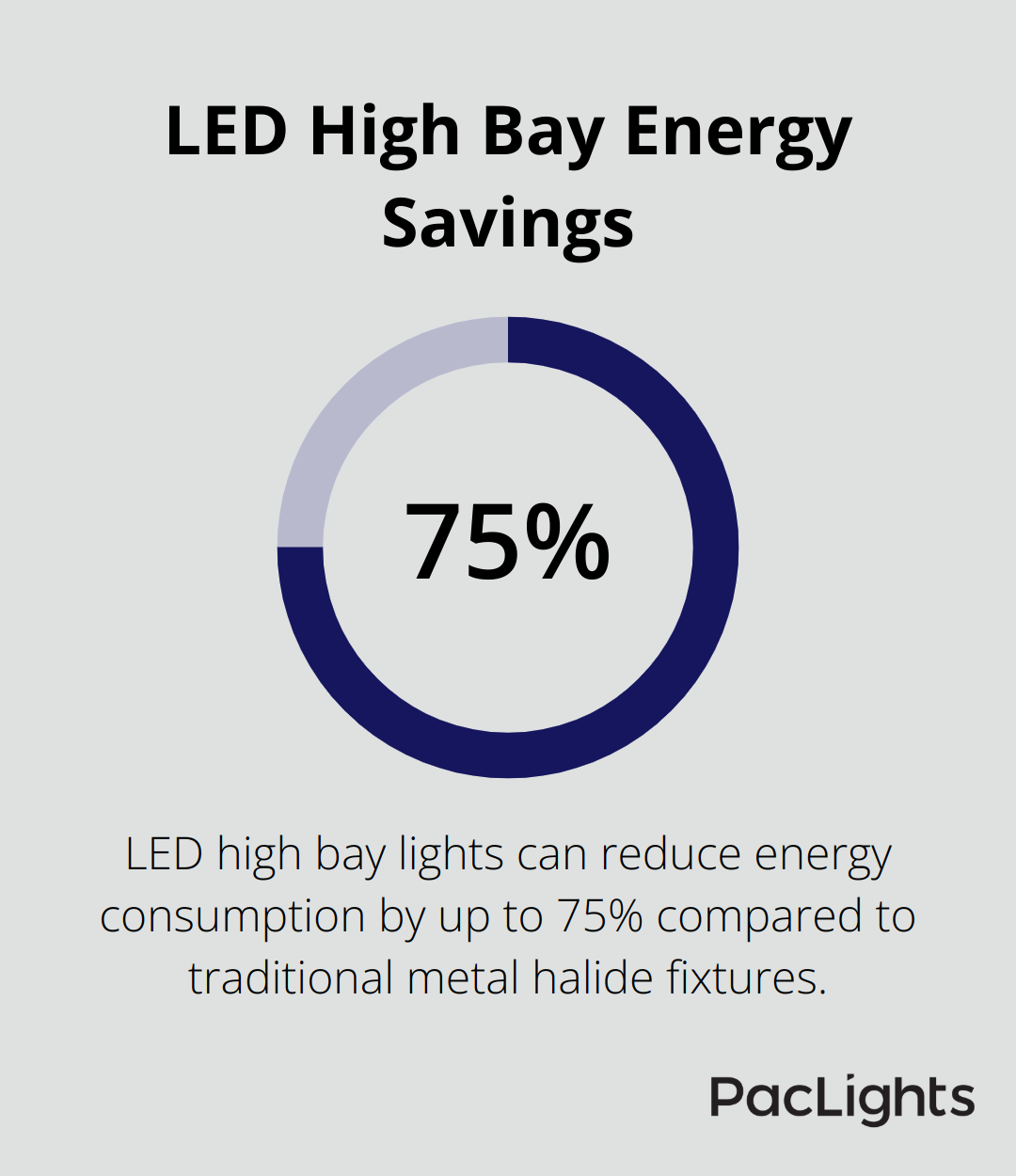
Energy efficiency plays a key role in selecting high bay lighting. LED high bay lights can reduce energy consumption by up to 75% compared to traditional metal halide fixtures. This reduction translates to significant cost savings over time.
A Department of Energy study found that widespread use of LED lighting could save 348 TWh of electricity by 2027 (equivalent to the annual output of 44 large power plants).
When selecting high bay lighting, consider the fixture’s lumens per watt (lm/W) rating. Higher ratings indicate more efficient lights. Top-performing LED high bays can achieve ratings of 150 lm/W or more, which maximizes light output while minimizing energy use.
Key Factors for Selection
Several factors influence the choice of high bay lighting:
- Ceiling height and mounting options
- Light distribution patterns
- Color temperature and color rendering index
- Durability and maintenance requirements
- Control options and compatibility
These factors will determine the most suitable high bay lighting solution for your specific needs. In the next section, we’ll explore the different types of high bay lighting fixtures available in the market.
Types of High Bay Lighting Fixtures
LED High Bay Lights
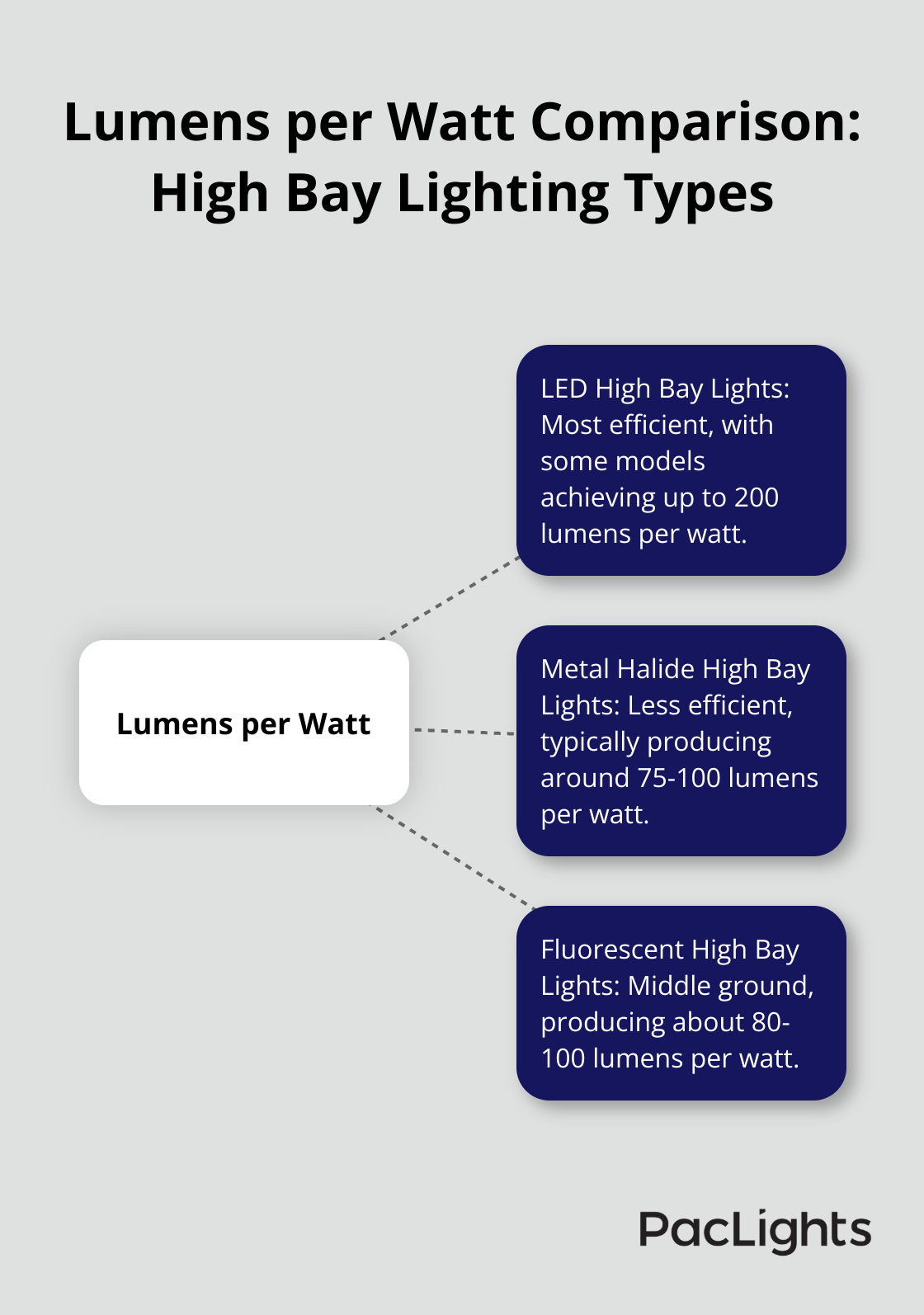
LED high bay lights have become the gold standard in industrial and commercial lighting. They offer superior energy efficiency, with some models achieving up to 200 lumens per watt. This translates to significant energy savings over time.
The U.S. Department of Energy reports that LEDs use 75-80% less energy than traditional incandescent bulbs. For large spaces requiring high bay lighting, this efficiency can lead to substantial cost reductions.
LED high bays also boast impressive lifespans, often exceeding 50,000 hours. This longevity reduces maintenance costs and minimizes disruptions due to light replacements.
Metal Halide High Bay Lights
Metal halide high bay lights have been a popular choice for decades. They produce a bright, white light that closely mimics natural daylight. However, they’re less energy-efficient than LEDs, typically producing around 75-100 lumens per watt.
One drawback of metal halide lights is their warm-up time. They take several minutes to reach full brightness, which may cause problems in spaces requiring instant illumination.
Metal halide bulbs also have a shorter lifespan compared to LEDs (typically lasting around 10,000 to 20,000 hours). This results in more frequent replacements and higher maintenance costs over time.
Fluorescent High Bay Lights
Fluorescent high bay lights offer a middle ground between LEDs and metal halides in terms of energy efficiency and cost. They produce about 80-100 lumens per watt and have a lifespan of around 20,000 hours.
One advantage of fluorescent lights is their ability to provide diffused, even lighting. This benefits environments where glare reduction is important.
However, fluorescent lights contain mercury, which raises environmental concerns. They also perform poorly in cold temperatures, which can be a significant drawback for unheated warehouses or outdoor applications.
Comparison of Light Quality and Performance
When comparing these options, LEDs clearly stand out as the most energy-efficient and long-lasting choice. While they may have a higher upfront cost, the long-term savings in energy and maintenance make them a smart investment for most high bay lighting applications.
LEDs offer superior light quality (with a Color Rendering Index often exceeding 80) and instant-on capabilities. They also provide better directional lighting, which reduces light waste and improves overall efficiency.
Metal halide lights, while less efficient, still provide excellent color rendering (CRI of 65-90). However, their light output decreases significantly over time (up to 50% by the end of their lifespan).
Fluorescent lights offer good color rendering (CRI of 80-85) but may flicker or buzz, especially as they age. This can be distracting or even problematic in certain work environments.
The choice between these types of high bay lighting fixtures depends on various factors specific to each application. To make the best decision, it’s essential to consider not only the type of fixture but also how it fits with other important aspects of lighting design. Let’s explore these factors in the next section.
How to Select the Perfect High Bay Lighting

Ceiling Height and Mounting Options
The height of your ceiling directly impacts the type of fixture and mounting option you need. Linear high bays work well for ceilings between 15-25 feet. UFO-style fixtures suit ceilings above 25 feet better.
Chain or cable suspension is common for most high bay applications. Surface mounting might be more practical for areas with high ceilings or limited access. The National Electrical Manufacturers Association (NEMA) provides guidelines on fixture types based on mounting height (a helpful reference for selection).
Light Output and Distribution
Match the lumen output of your high bay lights to your space’s requirements. Try to achieve about 1 lumen per square foot for every foot of ceiling height. For example, a 30-foot ceiling needs roughly 30 lumens per square foot.
Light distribution matters equally. Wide beam angles (120-180 degrees) suit open areas, while narrower beams (60-90 degrees) work better for aisles or focused task lighting. Many modern LED high bays offer adjustable beam angles, which provides flexibility for different applications.
Color Quality and Temperature
Color temperature affects the ambiance and functionality of your space. Cooler temperatures (5000K-6500K) promote alertness and visibility in industrial settings. Retail spaces often benefit from warmer tones (3000K-4000K) for a more inviting atmosphere.
The Color Rendering Index (CRI) is important for tasks requiring color accuracy. A CRI of 80 or above suits most industrial applications, while retail or quality control areas might need a CRI of 90 or higher.
Energy Efficiency and Long-term Savings
Energy efficiency impacts long-term operational costs. Select fixtures with high lumens per watt ratings. Top-tier LED high bays can achieve over 150 lumens per watt, which significantly outperforms traditional lighting options.
Consider the potential savings over time. For instance, replacing 400W metal halide fixtures with 150W LED high bays in a 100,000 square foot warehouse could save over $40,000 annually in energy costs alone (based on average U.S. electricity rates).
Durability and Smart Controls
In industrial environments, durability is paramount. Choose fixtures with robust construction and high IP ratings. An IP65 rating or higher ensures protection against dust and moisture, which is essential in many industrial settings.
Integrate smart controls to further optimize your lighting system. Occupancy sensors reduce energy use in low-traffic areas, while daylight harvesting systems adjust artificial light based on available natural light. Some advanced systems offer networked controls, which allow for granular management of individual fixtures or zones. The DesignLights Consortium (DLC) reports that networked lighting controls can lead to energy savings of up to 47% over non-controlled LED systems.
Final Thoughts
The selection of a high bay lighting fixture impacts productivity, safety, and energy efficiency in industrial spaces. LED high bay lights excel in energy efficiency, longevity, and light quality compared to traditional options. Factors such as ceiling height, lumen output, and color temperature must be considered to create an optimal lighting environment.
Energy efficiency should be prioritized as it affects long-term costs and environmental impact. Durability and smart control options are vital, especially in industrial settings where fixtures face harsh conditions. High IP ratings and integration with advanced lighting control systems maximize the benefits of your lighting investment.
We at PacLights offer free lighting layout designs and ROI assessments to help you make informed decisions. Our energy-efficient LED high bay lighting fixtures meet diverse industrial needs, reduce costs, and minimize carbon footprints. The right high bay lighting fixture enhances visibility, safety, and contributes to significant energy savings.
Disclaimer: PacLights is not responsible for any actions taken based on the suggestions and information provided in this article, and readers should consult local building and electrical codes for proper guidance.