

Property crime affects over 7 million businesses annually in the United States, with inadequate lighting being a primary factor in 60% of break-ins.
Building security lights serve as your first line of defense against intruders while reducing liability risks. We at PacLights have seen how proper lighting systems can cut crime rates by up to 39% around commercial properties.
The right security lighting setup requires careful consideration of multiple factors to maximize protection and minimize costs.
Which Security Light Type Fits Your Building
LED Floodlights Dominate Perimeter Defense
LED floodlights remain the gold standard for perimeter protection because they deliver 20,000 to 50,000 lumens across wide areas. These fixtures typically cover 150 to 300 feet of linear perimeter when you mount them at proper heights. Commercial-grade LED floodlights consume 80% less energy than traditional metal halide equivalents while they last 50,000 hours. Installation costs run $200 to $800 per fixture (depending on wattage and mounting requirements). The National Institute of Justice reports that well-lit perimeters reduce break-in attempts by 42% compared to poorly illuminated boundaries.
Motion-Activated Wall Lights Secure Entry Points
Wall-mounted motion sensors provide targeted illumination for doorways, loading docks, and service entrances where most intrusions occur. These fixtures detect movement within 20 to 50 feet and activate instantly to flood entry points with 3,000 to 8,000 lumens. Quality motion sensors feature adjustable sensitivity settings and dual-detection technology that reduces false alarms by 65%. Battery backup systems keep these lights operational during power outages. Installation typically requires 4 to 6 hours per fixture when you hardwire to existing electrical systems.
High-Intensity Area Lights Cover Large Spaces
Parking lots, loading areas, and equipment yards demand high-intensity lights that deliver 400 to 1,000 lumens per square foot. These fixtures mount on 20 to 40-foot poles and cover areas up to 10,000 square feet each.
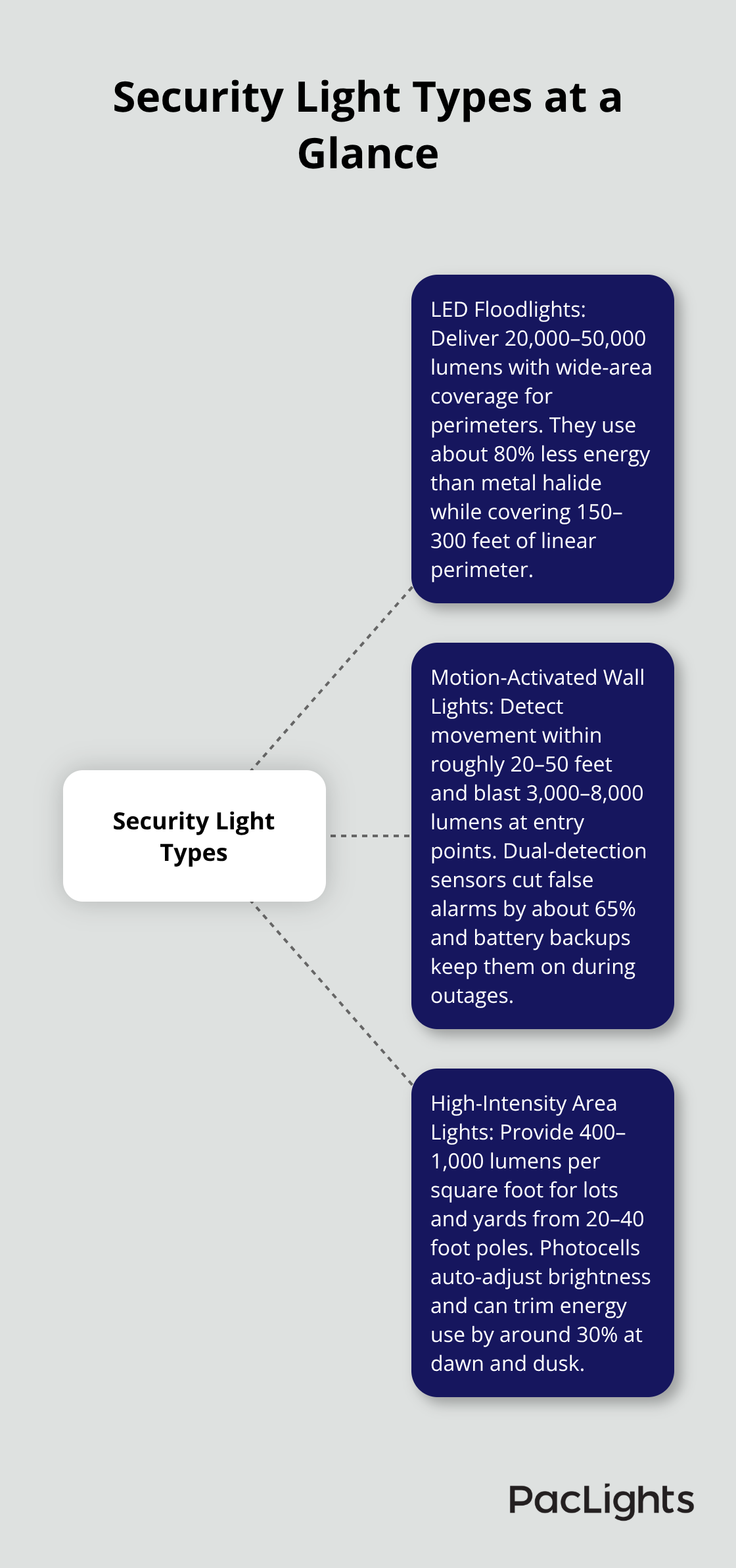
Modern LED area lights include photocells that automatically adjust brightness based on ambient conditions (reducing energy consumption by 30% during dawn and dusk periods). Professional installation costs $1,500 to $4,000 per pole including electrical work and foundation requirements.
Once you select the right fixture type for each area, you must evaluate specific performance features that determine how effectively your lights protect your property.
What Performance Specs Actually Matter for Security Lights
Lumens Output Determines Real Coverage Area
Lumens output determines your actual coverage area, but most facility managers calculate requirements incorrectly. Commercial properties need 2-5 foot-candles for basic security, which requires 3,000-5,000 lumens per wall pack to cover 400-600 square feet. High-security zones like cash handling areas need 50 to 100 lumens per square foot for adequate protection. A 20,000-lumen LED floodlight covers approximately 2,000 square feet at security-grade illumination levels. The Illuminating Engineering Society recommends you measure maintained lumens rather than initial output because LED fixtures lose 10% to 15% brightness over their first 10,000 hours of operation.
Motion Detection Range Affects Response Time
Detection range specifications often mislead buyers because manufacturers test under ideal conditions. Real-world detection drops 30% to 40% in windy conditions or when sensors face direct sunlight. Quality motion sensors should detect human-sized movement at 40 feet minimum with adjustable sensitivity from 10% to 100%. Dual-technology sensors that combine passive infrared and microwave detection reduce false alarms by 80% compared to single-technology units. Professional-grade sensors include pet immunity settings that ignore movement under 40 pounds while they maintain full human detection capability.
Weather Resistance Ratings Determine Lifespan
IP65 ratings represent the minimum acceptable weather protection for outdoor security lights, but IP67 ratings extend fixture life by 60% in harsh coastal or industrial environments. Temperature ratings matter more than most buyers realize because LED performance drops 25% when internal temperatures exceed 185°F. Quality fixtures include thermal management systems that maintain optimal LED temperatures even during 100°F summer days (which protects your investment and maintains consistent light output). Salt spray tests per ASTM B117 standards indicate how fixtures perform in corrosive environments, with 1,000-hour ratings suitable for most commercial applications.

These technical specifications directly impact how you position and install your security lights to achieve maximum protection across your property.
How Should You Position Security Lights for Maximum Protection
Strategic Placement Follows the 30-Foot Rule
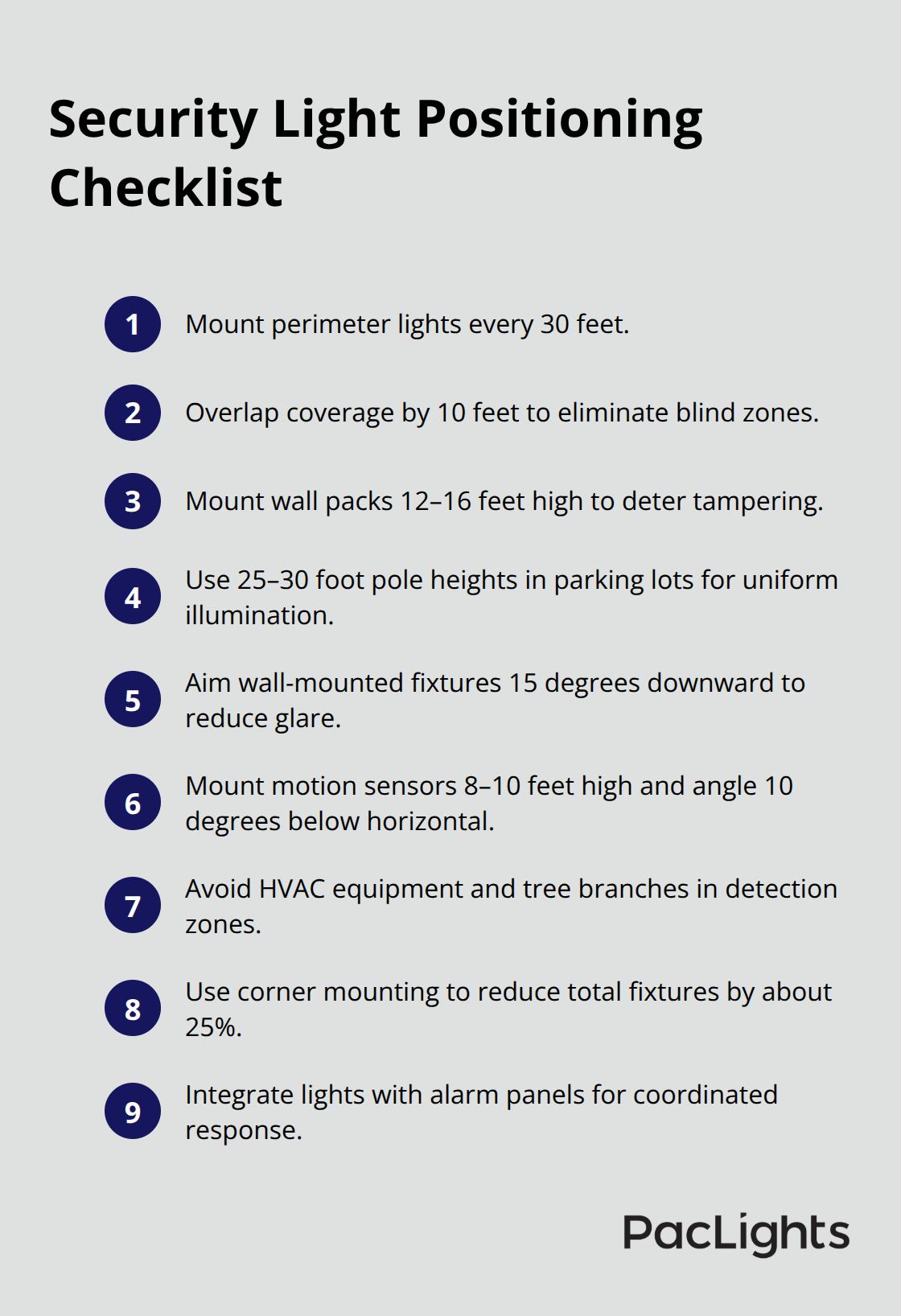
Strategic placement starts with the 30-foot rule that security professionals follow religiously. Mount perimeter lights every 30 feet along building edges to eliminate dark spots where intruders hide, with each fixture overlapping coverage by 10 feet to prevent blind zones. The International Association for Healthcare Security recommends mounting wall packs 12 to 16 feet high on building walls to prevent tampering while maintaining optimal light distribution. Parking lot fixtures require 25 to 30-foot pole heights to achieve uniform illumination patterns without creating harsh shadows under vehicles.
Corner Mounting Reduces Fixture Requirements
Corner-mounted fixtures provide 180-degree coverage and reduce the total number of fixtures you need by 25% compared to linear wall mounting arrangements. This approach cuts installation costs while maintaining comprehensive perimeter protection. Property managers who implement corner mounting strategies report fewer blind spots and improved overall security coverage across their facilities.
Height and Angle Calculations Prevent Vulnerabilities
Height and angle calculations determine whether your lights actually protect or create vulnerabilities. Security consultants specify 15-degree downward angles for wall-mounted fixtures to minimize glare while maximizing ground coverage (with photometric studies showing this angle provides 40% better facial recognition capability at 50 feet). Flood lights aimed too high create bright spots directly below fixtures but leave approach paths in darkness.
Motion Sensor Placement Maximizes Detection
Motion sensors work best when mounted 8 to 10 feet high with detection zones angled 10 degrees below horizontal to catch movement before intruders reach building walls. This height prevents tampering while maintaining optimal detection range across approach paths. Professional installers position sensors to avoid HVAC equipment and tree branches that trigger false alarms.
System Integration Creates Coordinated Response
Integration with existing alarm systems requires hardwired connections to security panels that trigger all perimeter lights simultaneously when motion detection occurs in any zone. This coordinated response overwhelms intruders with sudden illumination across multiple areas (creating confusion and deterring criminal activity). Modern security systems can activate specific light zones based on threat level and time of day.
Final Thoughts
Effective building security lights require you to balance lumens output, detection capabilities, and weather resistance ratings against your specific facility needs. Properties that invest in professional-grade LED fixtures with 20,000+ lumens, IP67 weather protection, and dual-technology motion sensors see crime reduction rates of 39% within the first year of installation. Quality systems deliver measurable returns through reduced insurance premiums, lower crime-related losses, and decreased liability exposure.
Professional installation matters more than most facility managers realize. Improper mounting heights, incorrect detection angles, and inadequate electrical connections reduce security effectiveness by 50% while they create maintenance headaches. Licensed electricians who specialize in commercial security lighting complete installations 60% faster and provide warranty coverage that protects your investment.
Commercial LED fixtures last 50,000 hours, which means you avoid replacement costs for 15 to 20 years with proper maintenance schedules. The energy efficiency of modern LED technology reduces operational costs by 80% compared to traditional lighting systems (while maintaining superior illumination levels). We at PacLights offer comprehensive building security lighting solutions that help facility managers protect their properties with proven LED technology.
Disclaimer: PacLights is not responsible for any actions taken based on the suggestions and information provided in this article, and readers should consult local building and electrical codes for proper guidance.