

Warehouse high bay lighting is one of the most overlooked investments in industrial operations, yet it directly impacts safety, productivity, and your bottom line. At PacLights, we’ve seen firsthand how poor lighting leads to accidents, slower work rates, and wasted energy dollars.
The right lighting solution transforms your facility. This guide walks you through everything you need to know to make the smart choice for your warehouse.
Why High Bay Lighting Directly Affects Your Bottom Line
Safety Compliance and Accident Prevention
Poor warehouse lighting costs money in ways most facility managers don’t track. OSHA standards require a minimum of 50 foot-candles in active warehouse areas, yet many facilities operate well below this threshold. When aisles lack proper illumination, accidents spike. The National Safety Council reports that inadequate lighting contributes to roughly 10-15% of workplace injuries in industrial settings. A single serious injury can cost $40,000 to $50,000 in direct medical expenses and lost productivity, not counting potential legal liability.
Installing high bay lighting that meets OSHA compliance standards eliminates this risk entirely.
Worker Accuracy and Order Fulfillment
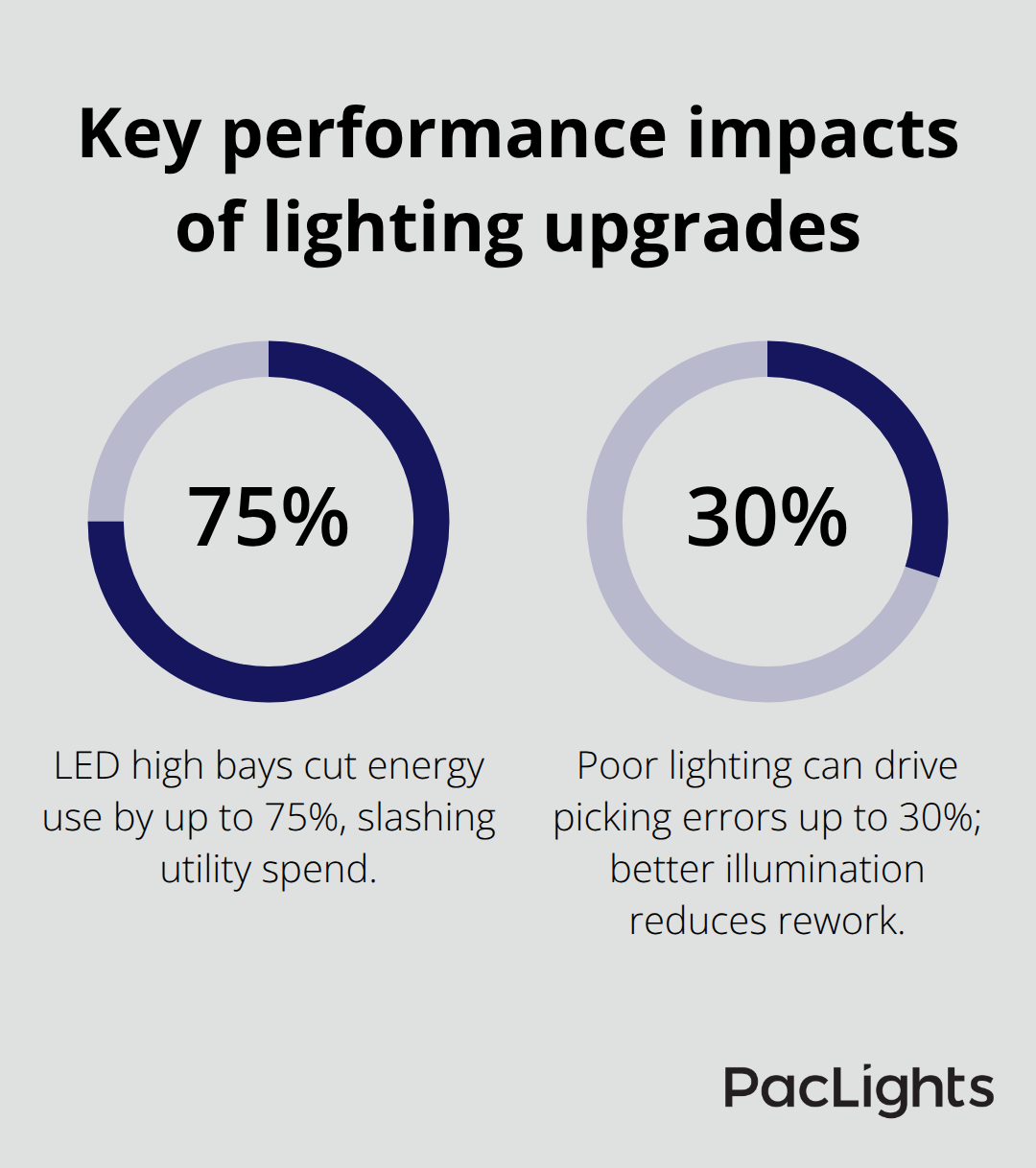
Beyond safety, worker accuracy drops dramatically in dim conditions. Picking errors increase by up to 30% when lighting falls below recommended levels, according to warehouse operations research. In a facility processing 1,000 orders daily, a 30% error rate means 300 mistakes that require rework, shipping delays, and customer complaints. Proper high bay lighting cuts these errors significantly because workers can see product codes, shelf labels, and potential hazards clearly.
Energy Consumption and Operating Costs
Energy consumption represents the third major impact. Traditional HID and fluorescent high bay fixtures consume 250-600 watts per unit and typically last 10,000-15,000 hours before replacement. Switching to LED high bays reduces energy use by up to 75% while delivering 50,000-100,000+ hour lifespans, according to Department of Energy data. A warehouse with 50 high bay fixtures running 24/7 can reduce annual energy costs by $15,000-$25,000 with LED conversion. LED fixtures also generate less heat, reducing cooling costs in climate-controlled facilities (a secondary benefit that compounds savings over time). These aren’t theoretical savings-they’re measurable reductions in your electricity bills starting month one.
Calculating Your True ROI
The combination of safety compliance, error prevention, and energy efficiency creates a direct path to profitability. Your next step involves assessing your current warehouse layout and understanding how ceiling height, aisle width, and fixture specifications work together to deliver the illumination your operation needs.
What Lighting Technology Works Best for Your Warehouse
The Hidden Cost of Outdated Fixtures
HID and fluorescent fixtures dominated warehouses for decades, but they’re becoming obsolete. Metal halide and high-pressure sodium bulbs consume 250-600 watts per fixture and burn out every 10,000-15,000 hours, forcing frequent maintenance cycles and replacement costs. Fluorescent high bays waste energy through heat loss and flicker, creating eye strain that reduces worker efficiency. These older technologies also generate excessive heat, driving up cooling expenses in climate-controlled facilities. A 50-fixture warehouse running HID lights 24/7 spends roughly $30,000-$40,000 annually on electricity alone, before factoring in labor for bulb replacements and ballast repairs. Most facility managers don’t realize they’re throwing money away every single month.
Why LED High Bays Outperform Older Technology
LED high bays eliminate this waste entirely. Modern LED fixtures deliver the same or better light output while consuming 60-310 watts depending on brightness requirements, cutting energy consumption by up to 75 percent according to Department of Energy benchmarks. A 50-fixture warehouse switching to LED saves $15,000-$25,000 annually in electricity costs. LED lifespans reach 50,000-100,000+ hours, meaning you replace fixtures every 5-7 years instead of annually. That translates to dramatically lower maintenance labor and zero emergency outages from unexpected bulb failures.
Customization Options That Traditional Fixtures Can’t Match
LED fixtures offer selectable color temperatures (4000K to 6000K) and beam angles (60° to 120°), allowing you to customize light distribution for specific aisle widths and rack heights without overshooting or undershooting illumination needs. This flexibility means you optimize coverage for your exact warehouse layout rather than accepting one-size-fits-all performance. Traditional fixtures lock you into fixed output and distribution patterns, wasting light in some areas while leaving others underlit.
Smart Controls That Multiply Your Savings
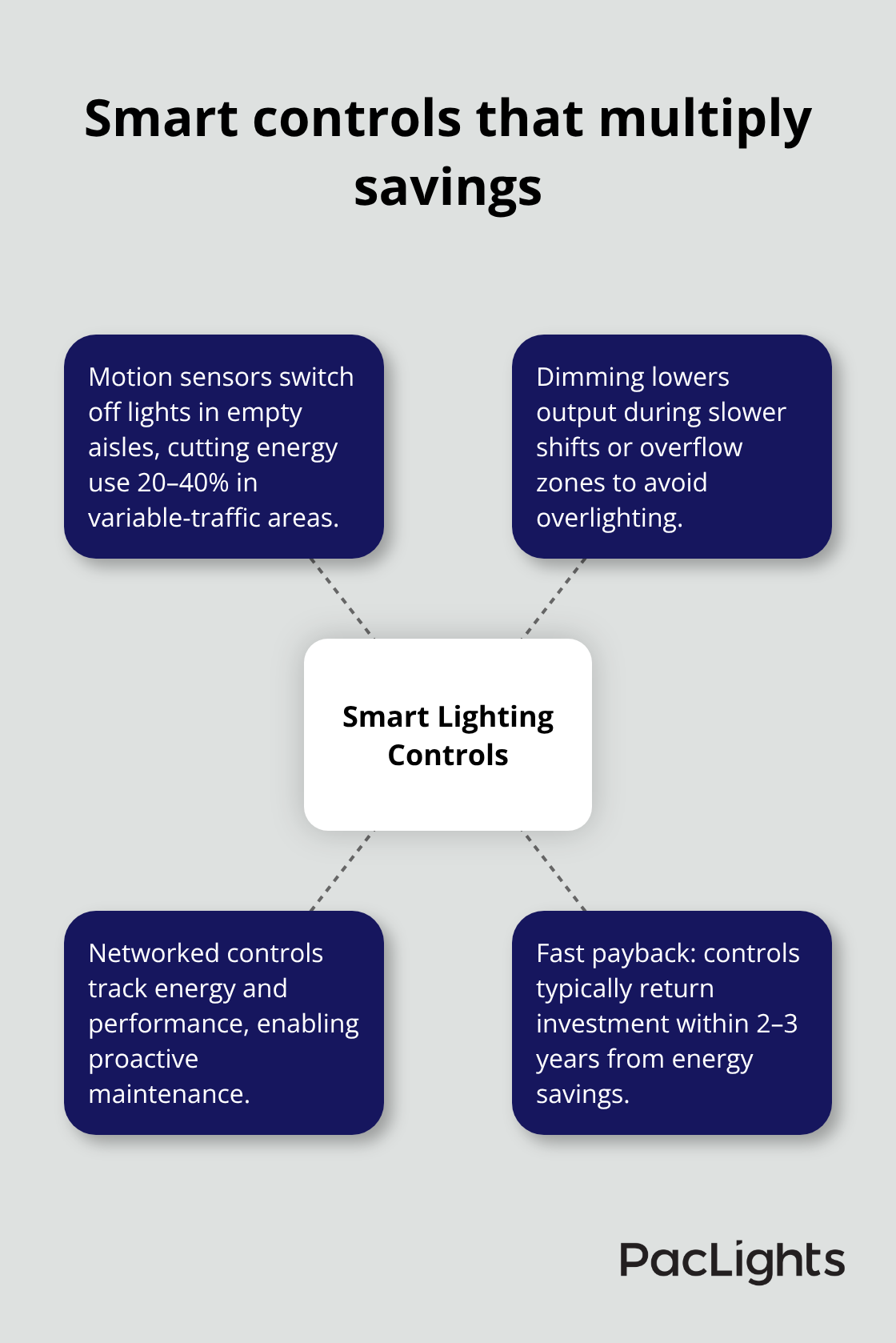
Motion sensors automatically turn off lights in unused aisles, reducing energy waste by 20-40 percent in facilities with variable traffic patterns. Dimming systems let you lower brightness during slower shifts or in overflow areas where full illumination isn’t required. Networked lighting controls provide real-time data on energy consumption and fixture performance, helping you identify maintenance issues before they become failures. These controls pay for themselves within 2-3 years through energy reduction alone.
Moving Forward With Your Lighting Upgrade
The choice is straightforward: LED with smart controls outperforms older technology on every metric that matters to your operation. Once you’ve decided on LED, the next critical step involves understanding your warehouse’s specific requirements-ceiling height, aisle configuration, and illumination targets all shape which fixtures and control strategies deliver the best results for your facility.
Sizing Your Warehouse for the Right Fixtures
Match Ceiling Height and Aisle Width to Fixture Selection
Start with ceiling height and aisle width because these two measurements determine everything else. Warehouses with ceilings between 15–25 feet require different fixtures than those reaching 35–45 feet. A 20-foot ceiling needs roughly 130 lumens per watt of fixture output to deliver adequate floor-level illumination, while a 40-foot ceiling demands higher lumen output or wider beam angles to compensate for distance. Measure your exact ceiling height first, then your aisle width.
If your aisles are narrow (under 12 feet), you need a focused beam angle around 60 degrees. Standard aisles between 12–20 feet work well with 90-degree beam angles. Wide aisles or open floor areas benefit from 120-degree distribution. This isn’t guesswork-these angles directly correlate to how light spreads as it travels down from the fixture. A 60-degree beam concentrates light in a tight pattern, minimizing spillover and wasted light on walls. A 120-degree beam spreads light broadly, covering more ground but potentially overshooting your actual work area.
Calculate Total Lumens Based on OSHA Standards
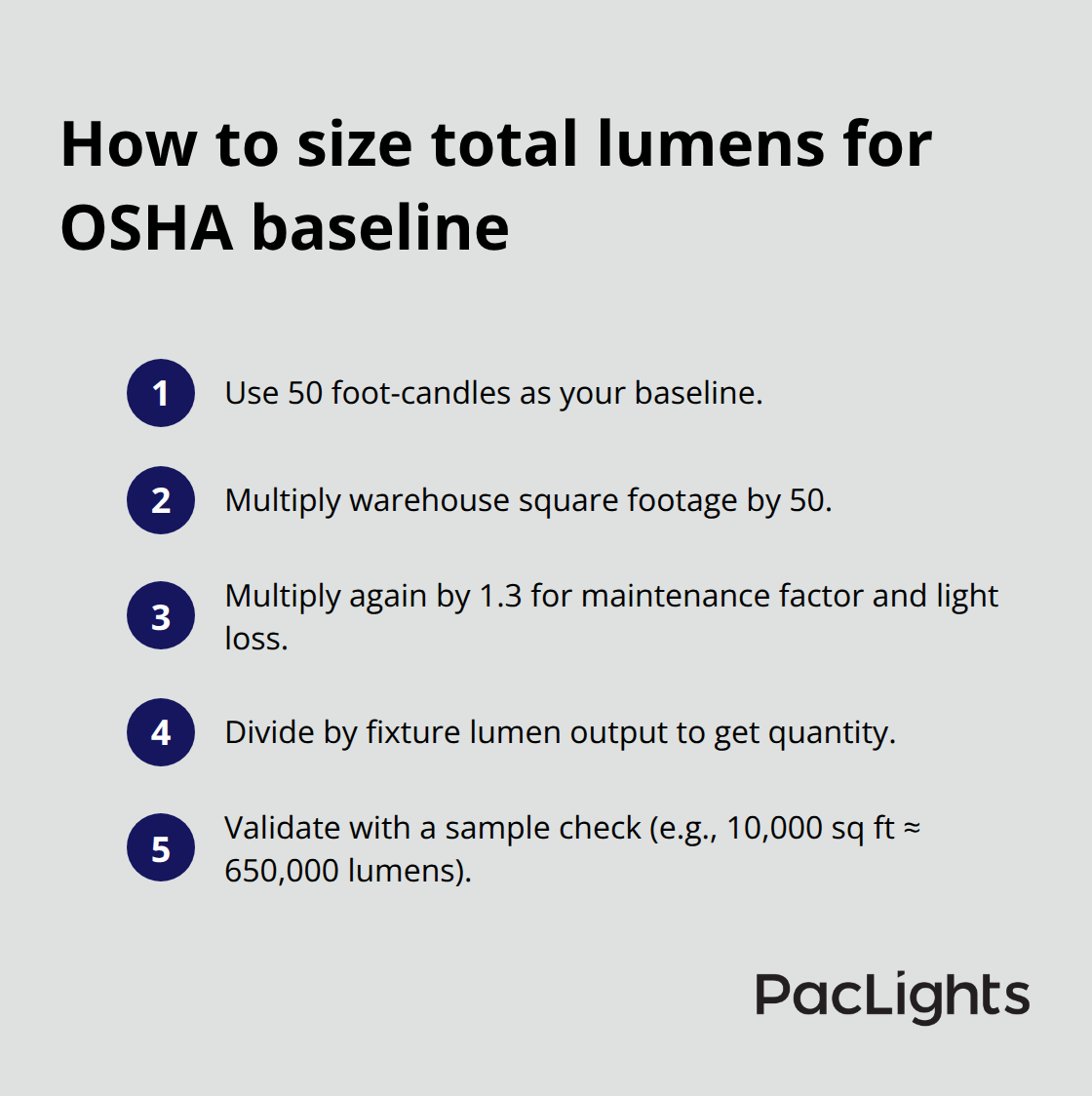
Calculate the total lumens your warehouse actually needs using OSHA’s 50 foot-candle minimum as your baseline. Multiply your warehouse square footage by 50, then multiply that result by 1.3 to account for maintenance factor and realistic light loss over time. A 10,000 square-foot warehouse needs roughly 650,000 lumens total. Divide this by the lumen output of your chosen fixture to determine quantity.
If you select a 40,000-lumen fixture, you need approximately 16 units.
This math prevents both under-lighting (where safety and productivity suffer) and over-lighting (where you waste energy on excess brightness). Many facilities install fixtures rated for maximum output in all areas, then run them at full brightness 24/7. Instead, pair medium-output fixtures with motion sensors and dimming controls. A 30,000-lumen fixture dimmed to 60 percent output during slower shifts consumes significantly less energy while maintaining adequate visibility.
Optimize Output With Smart Controls and Dimming
Professional lighting design accounts for your specific workflow patterns, staff density per shift, and task requirements. ROI assessments model different scenarios, showing you exactly how fixture selection and control strategies impact your annual operating costs. Motion sensors automatically turn off lights in unused aisles, reducing energy waste by 20–40 percent in facilities with variable traffic patterns. Dimming systems let you lower brightness during slower shifts or in overflow areas where full illumination isn’t required.
Networked lighting controls provide real-time data on energy consumption and fixture performance, helping you identify maintenance issues before they become failures. These controls pay for themselves within 2–3 years through energy reduction alone. The Department of Energy publishes fixture guidance that confirms spacing relationships and performance benchmarks for different warehouse configurations.
Hire Professionals to Verify Fixture Placement
Installation should never be rushed or attempted without proper engineering. Hire professionals who understand photometric design and can verify fixture spacing using industry-standard calculations. Poor installation placement creates dark spots in aisles, forcing workers to navigate shadows and increasing accident risk. A qualified installer measures your ceiling, accounts for obstruction from racks or structural elements, and positions fixtures to achieve uniform illumination across your entire work surface.
This upfront investment in professional design eliminates costly rework and ensures your lighting system performs as intended for 50,000–100,000+ hours of operation.
Final Thoughts
LED fixtures consume 75 percent less energy than traditional HID and fluorescent systems while lasting 5-7 times longer, translating to $15,000-$25,000 in annual savings for a 50-fixture warehouse. Motion sensors and dimming controls add another 20-40 percent energy reduction by eliminating waste in unused areas, and these savings compound year after year, creating a payback period of 2-3 years before the system becomes pure profit. Proper warehouse high bay lighting directly prevents workplace injuries, reduces picking errors by up to 30 percent, and improves worker morale by creating a safer, more visible work environment.
A single serious injury costs $40,000-$50,000 in direct expenses and lost productivity, yet adequate illumination eliminates this risk entirely while boosting order accuracy and fulfillment speed. Your specific warehouse layout-ceiling height, aisle configuration, and existing fixture conditions-shapes which solution delivers maximum ROI for your operation. Professional assessment of your facility determines exactly what you need and what you’ll save through an upgrade.
We at PacLights provide free lighting layout designs and ROI assessments to help you understand your facility’s requirements and potential savings. Our LED retrofit solutions and advanced lighting controls adapt to diverse industrial needs, whether you retrofit an existing system or build new. Contact us to schedule your facility assessment and transform your operation into a safer, more efficient, and more profitable facility.
Disclaimer: PacLights is not responsible for any actions taken based on the suggestions and information provided in this article, and readers should consult local building and electrical codes for proper guidance.