

The right lighting transforms how people work. Color quality in commercial downlights directly affects productivity, mood, and how accurately your team perceives details.
At PacLights, we’ve seen facilities waste thousands on fixtures that look bright but render colors poorly. This guide breaks down what actually matters when selecting downlights for your space.
What CRI Actually Means for Your Bottom Line
Color Rendering Index measures how accurately a light source displays colors compared to natural daylight or an ideal reference light. CRI uses a scale from 0 to 100, where 100 represents perfect color accuracy. Most commercial facilities operate with fixtures rated between CRI 80 and CRI 95+. The difference matters far more than most facility managers realize.
How CRI 80 Costs You Money
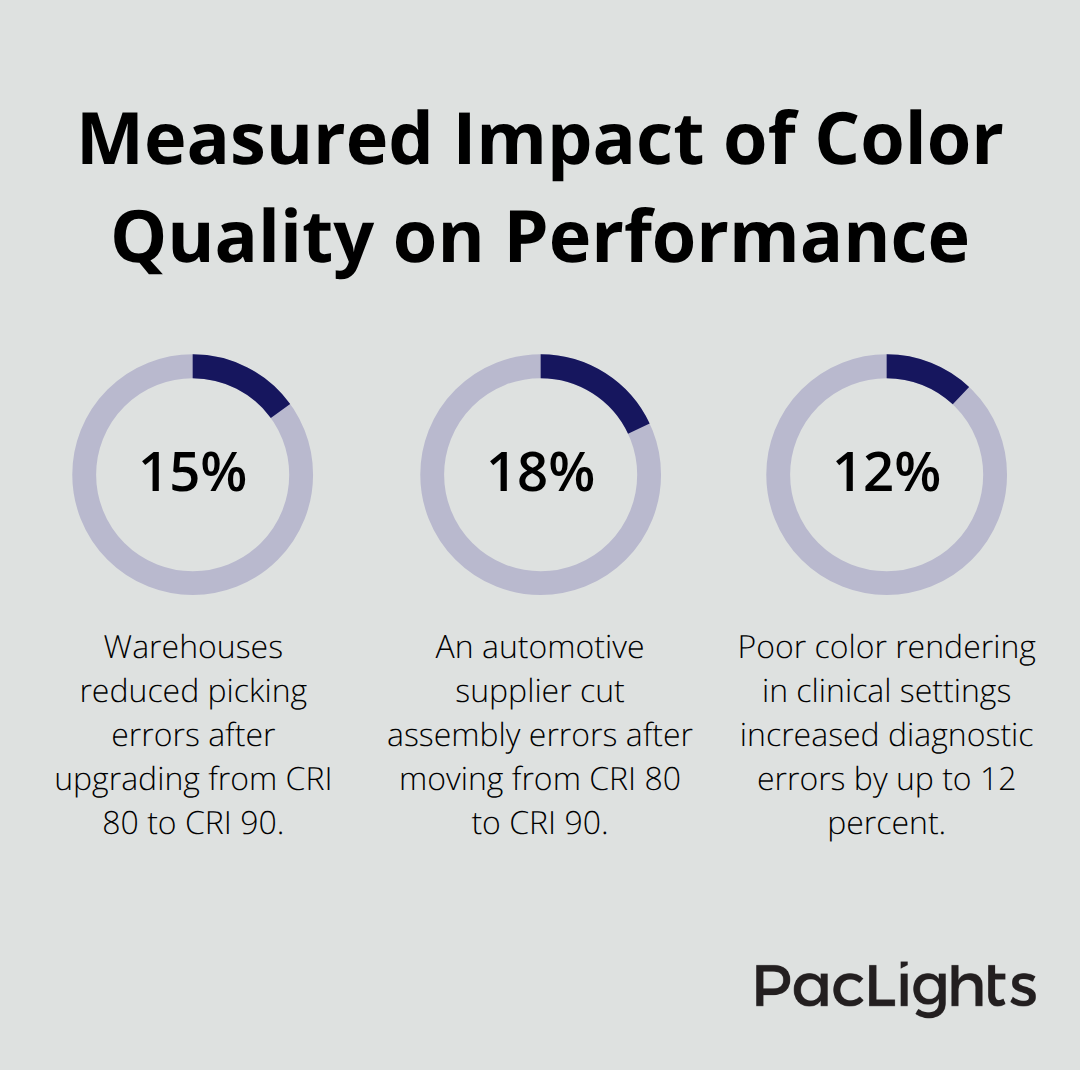
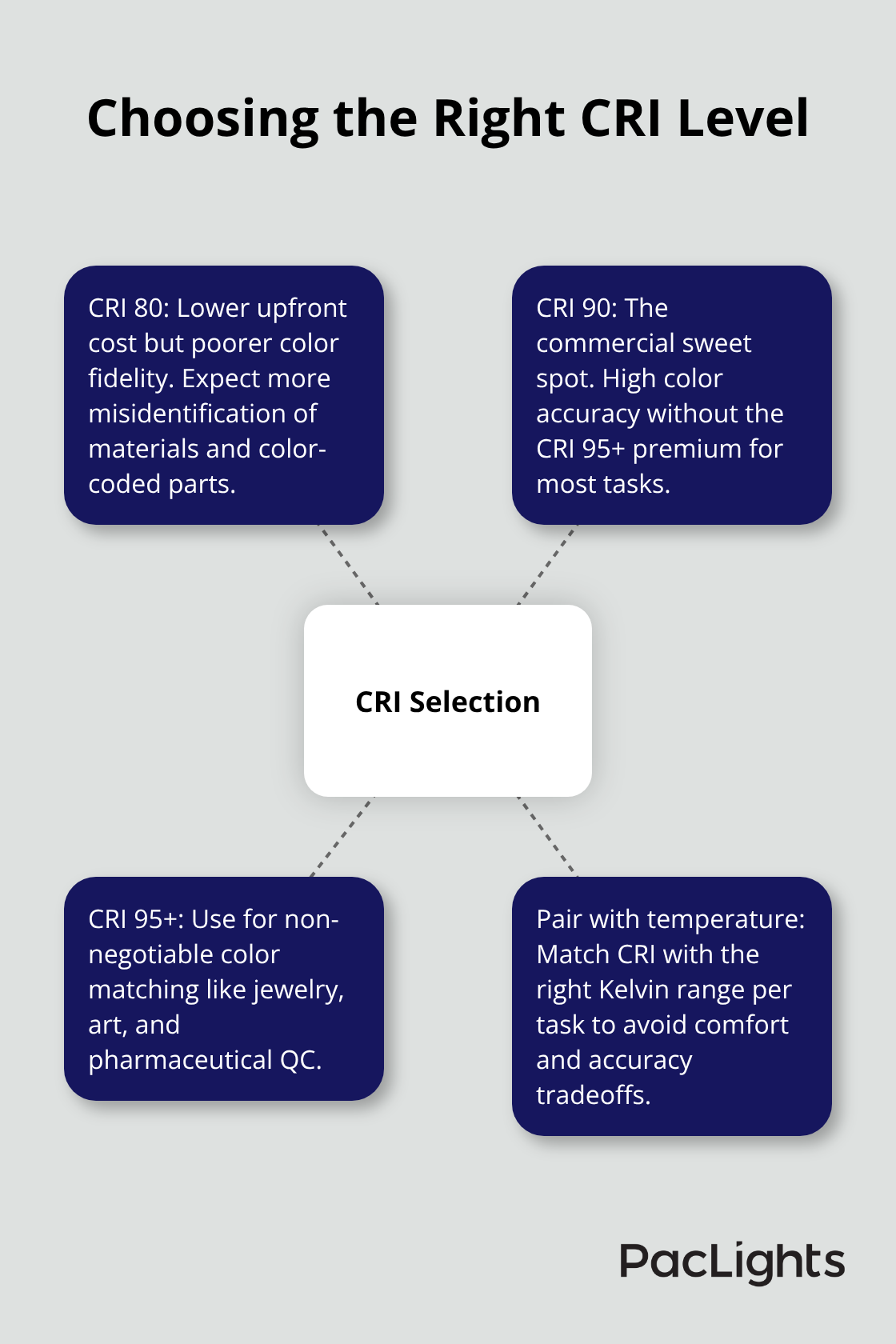
A CRI 80 fixture costs less upfront but forces your team to work under light that distorts reds, oranges, and skin tones by up to 20 percent. In retail environments, products look duller than they actually are. In healthcare settings, doctors and nurses struggle to detect subtle color variations in patient skin or lab samples. In manufacturing, workers misidentify material defects or color-coded components. Warehouses that upgraded from CRI 80 to CRI 90 downlights reduced picking errors by 15 percent. That improvement directly impacts labor costs and customer satisfaction.
Why CRI 90 Became the Commercial Standard
CRI 90 represents the practical sweet spot for most commercial operations. It renders colors with high accuracy without the premium price tag of CRI 95+. Studies from the Illuminating Engineering Society show that CRI 90 lighting improves visual comfort and reduces eye strain during extended work sessions. Task-intensive environments like offices, warehouses, and food processing facilities perform well at this level.
CRI 95+ makes sense only in specialized applications where color-matching accuracy is non-negotiable (jewelry stores, art galleries, pharmaceutical quality control labs). The cost premium for CRI 95+ typically runs 20 to 30 percent higher than CRI 90, but the accuracy gains matter only in those specific contexts. Most facilities waste money chasing unnecessary precision.
Color Temperature Works Hand in Hand with CRI
CRI and color temperature are separate but complementary specifications. CRI measures accuracy; color temperature measures warmth or coolness in Kelvin units. A fixture can have high CRI but different color temperatures. A 4000K neutral white downlight at CRI 90 renders colors accurately and feels neither warm nor cold. A 3000K warm white downlight at CRI 90 renders the same colors accurately but creates a warmer atmosphere.
This combination matters because selecting only one specification guarantees poor results. A facility might install high-CRI downlights but pair them with the wrong color temperature, creating an uncomfortable workspace that still undermines productivity. The practical approach requires evaluating both metrics together when specifying fixtures for your space. Color temperature then becomes your next critical decision point.
Color Temperature Shapes Workplace Comfort and Output
Color temperature determines whether your workspace feels energizing or exhausting, and it directly influences how your team performs. The Kelvin scale measures this quality, with lower numbers producing warmer light and higher numbers producing cooler light. Most facility managers treat color temperature as a cosmetic choice, but research shows it affects circadian rhythms, alertness, and task completion rates. Your selection should match the actual work happening in each zone, not a one-size-fits-all approach across your entire facility.
Warm White Light: When Comfort Trumps Precision
Warm white lighting between 2700K and 3000K creates a relaxed atmosphere that reduces stress hormones like cortisol according to studies from the American Medical Association. This range works well in break rooms, waiting areas, and spaces where employee comfort matters more than precision. However, installing warm white downlights in a data entry department or quality control area actively reduces productivity. Your team becomes drowsy under warm light during tasks requiring sustained focus.
Neutral White Light: The Productivity Standard
Neutral white lighting at 4000K to 5000K maintains alertness without creating the harsh, clinical feel of cooler temperatures. This middle ground performs exceptionally well in offices, warehouses, and manufacturing environments where workers spend eight-hour shifts. The Illuminating Engineering Society data confirms that 4000K lighting reduces eye strain compared to both warmer and cooler extremes during extended screen work. Many facilities that upgraded to 4000K neutral white downlights reported fewer fatigue-related errors within the first month.
Cool White Light: Precision at a Cost
Cool white lighting between 5000K and 6500K triggers alertness through blue light wavelengths that suppress melatonin production, making this range ideal for precision tasks, surgical suites, and inspection stations. Jewelry stores, pharmaceutical labs, and electronics assembly operations benefit from cool white because it sharpens visual acuity and color discrimination. The tradeoff is that cool white becomes uncomfortable after four to six hours of continuous exposure, causing headaches and eye fatigue. This means cool white works best in task-specific zones rather than general ambient lighting.
Layering Temperature Across Your Facility
The practical strategy involves layering different color temperatures throughout your facility-warm white in social areas, neutral white in primary workspaces, and cool white only where precision work demands it (break rooms, inspection stations, quality control labs).
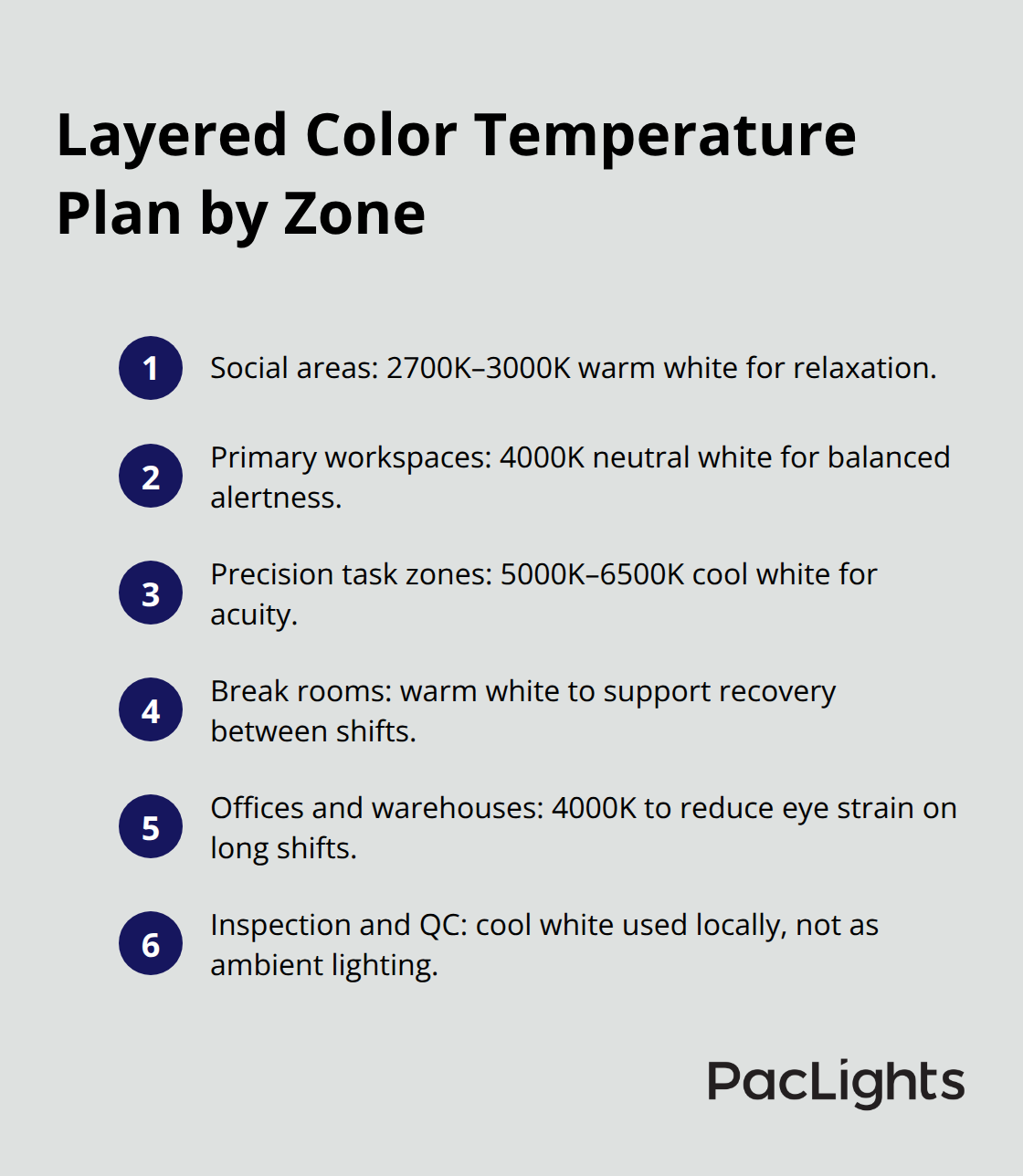
This approach costs more initially but eliminates the productivity drag and employee complaints that come from forcing everyone to work under a single color temperature. When you select downlights for each zone, you also need to consider how your industry and specific applications influence which color temperatures actually deliver results. The next section walks through those practical matching decisions.
Practical Considerations When Selecting Commercial Downlights
Match Color Specifications to Your Industry’s Visual Demands
Retail environments demand different color specifications than warehouses, and warehouses differ from healthcare facilities. A jewelry store needs CRI 95+ at 5000K to showcase products accurately, while a fulfillment center performs better with CRI 90 at 4000K because workers prioritize speed over color precision. Hospitals require CRI 90 minimum at 4000K because medical staff must distinguish subtle skin tone variations and lab sample colors accurately. A study from the Journal of the American Medical Association found that poor color rendering in clinical settings increased diagnostic errors by up to 12 percent. Supermarkets typically install CRI 90 at 3000K to 4000K because warm tones make produce and meat appear fresher, directly influencing purchase decisions.
Food processing facilities operate at CRI 90 and 4000K to identify contamination and quality defects during packaging. Manufacturing plants with color-coded inventory systems need CRI 90 minimum; one automotive supplier reported that upgrading from CRI 80 to CRI 90 downlights reduced assembly errors by 18 percent during their first quarter after installation. The practical approach requires identifying the specific visual tasks your team performs, then selecting CRI and color temperature accordingly rather than compromising across your entire facility.
Separate Energy Efficiency from Color Quality
Energy efficiency and color quality operate independently, meaning you do not sacrifice one for the other. LED downlights with CRI 90 or higher now consume 40 to 50 percent less energy than older fluorescent fixtures while delivering superior color accuracy, according to the U.S. Department of Energy. The real cost comparison involves total lifecycle expenses, not just purchase price. A CRI 90 LED downlight costs roughly 15 to 25 percent more upfront than CRI 80 alternatives but lasts 50,000 to 100,000 hours compared to 20,000 hours for older technology.
That means replacing fixtures less frequently and spending less on maintenance labor. When you factor in reduced picking errors, fewer quality control rejections, and lower employee turnover from improved working conditions, the ROI becomes obvious within 18 to 36 months for most commercial operations. Facilities that implemented advanced lighting controls reported 25 to 35 percent additional energy savings beyond the baseline LED efficiency gains.
Phase Your Upgrades by Zone and Priority
Budget constraints should never force you to accept poor color rendering. Instead, phase your facility upgrades by zone, installing premium color quality fixtures in high-priority areas first while maintaining adequate lighting in secondary spaces. This strategy allows you to capture immediate productivity gains where they matter most (production floors, inspection stations, retail displays) while spreading capital expenses across multiple budget cycles.
High-traffic areas and task-intensive zones generate the fastest ROI when upgraded first. Secondary spaces like storage areas or break rooms can operate with lower CRI specifications without impacting your bottom line. This tiered approach lets you demonstrate measurable results from your initial investment, which justifies subsequent phases to leadership and stakeholders.
Final Thoughts
Selecting commercial downlights color quality requires you to evaluate three interconnected factors: CRI rating, color temperature, and how both specifications match your facility’s actual work demands. CRI 90 delivers the practical accuracy most commercial operations need without the premium cost of CRI 95+, while color temperature determines whether your workspace supports productivity or undermines it. The combination of these metrics directly shapes your bottom line through reduced errors, fewer quality control rejections, and improved employee retention.
Superior color rendering pays for itself through measurable operational improvements. Facilities that upgraded from CRI 80 to CRI 90 downlights reduced picking errors by 15 percent and assembly mistakes by up to 18 percent. LED fixtures with high CRI now consume 40 to 50 percent less energy than older technology while lasting 50,000 to 100,000 hours, meaning lower maintenance costs and less frequent replacements.
When you phase upgrades by zone rather than accepting poor color quality across your entire facility, you install premium specifications in high-priority areas first-production floors, inspection stations, retail displays-where ROI appears fastest. Secondary spaces can operate with lower CRI ratings without impacting performance. Contact PacLights to explore fixtures designed for your specific operational needs and receive a free ROI assessment for your facility.
Disclaimer: PacLights is not responsible for any actions taken based on the suggestions and information provided in this article, and readers should consult local building and electrical codes for proper guidance.