

Warehouse lighting directly impacts productivity, safety, and operating costs. Poor layouts waste energy and create dark zones where accidents happen.
We at PacLights have helped hundreds of facilities fix these problems with practical warehouse lighting layout tips that actually work. This guide shows you exactly how to assess your space, design better layouts, and recover your investment through energy savings.
Understanding Your Warehouse Lighting Needs
Assess Your Current Lighting Conditions
Walk your warehouse at different times of day and note where operators squint, where forklifts slow down, and where accidents cluster. These observations matter more than any lighting standard because they reveal your real problems. Many facilities have uneven coverage with bright zones next to dead spots, which forces workers to move around to see properly. This inefficiency costs time and creates safety risks.
Measure the light levels in problem areas using a light meter app or a proper illuminance meter (which costs between $50 and $300). OSHA and the Illuminating Engineering Society recommend specific foot-candle levels for different tasks: general warehouse areas need 20–30 foot-candles, order picking requires 50–100 foot-candles, and fine assembly work demands 100–200 foot-candles. Your current setup probably exceeds these numbers in some spots while falling short in others, which means you overpay for uneven results.
Calculate Foot-Candle Requirements by Work Area
Map your warehouse by function and assign foot-candle targets to each zone. A receiving dock where workers read labels needs different lighting than a storage area with 20-foot ceilings. The inverse square law explains how brightness drops with distance from fixtures-doubling the distance reduces light by 75 percent. This is why high-bay fixtures positioned at 35 feet need much higher output than troffer lights at 9 feet.
Count your current fixtures and record their wattage and age. Older fixtures lose 20–30 percent of their output over 10 years due to dust and lamp degradation, so an aging system delivering 40 foot-candles today might have delivered 60 foot-candles when new. That means you likely waste energy to compensate for aging equipment.
Identify Energy Efficiency Opportunities
Energy efficiency opportunities hide in plain sight. Many warehouses run lights 24/7 even in rarely used storage sections or during daylight hours when windows provide free illumination. A 50,000 square foot warehouse with 400 fixtures running 24/7 at 100 watts each costs roughly $35,000 per year in electricity alone.
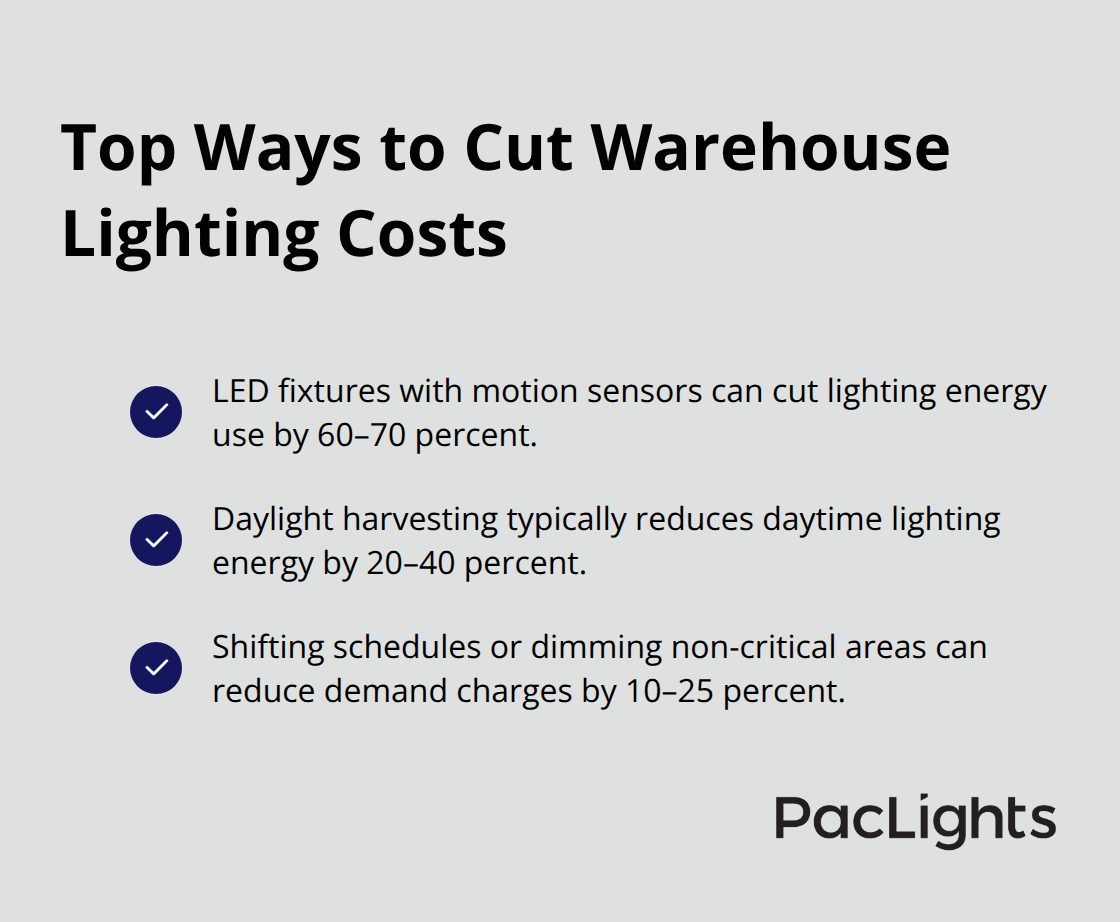
Switching to LED fixtures and adding motion sensors can cut this by 60–70 percent depending on your usage patterns. High-bay areas with infrequent activity are prime candidates for motion controls, while picking zones need constant light. Daylight harvesting systems reduce artificial lighting when natural light is sufficient, typically cutting daytime energy use by 20–40 percent in facilities with skylights or large windows.
Check your current utility bills for demand charges, which many warehouses pay but never optimize. Reducing peak demand by shifting lighting schedules or dimming non-critical areas can lower demand charges by 10–25 percent beyond energy savings. Once you understand what your warehouse actually needs, you can design a layout that delivers light where it matters most while eliminating waste.
Strategic Warehouse Lighting Layout Design
Measure Your Space Before You Position Fixtures
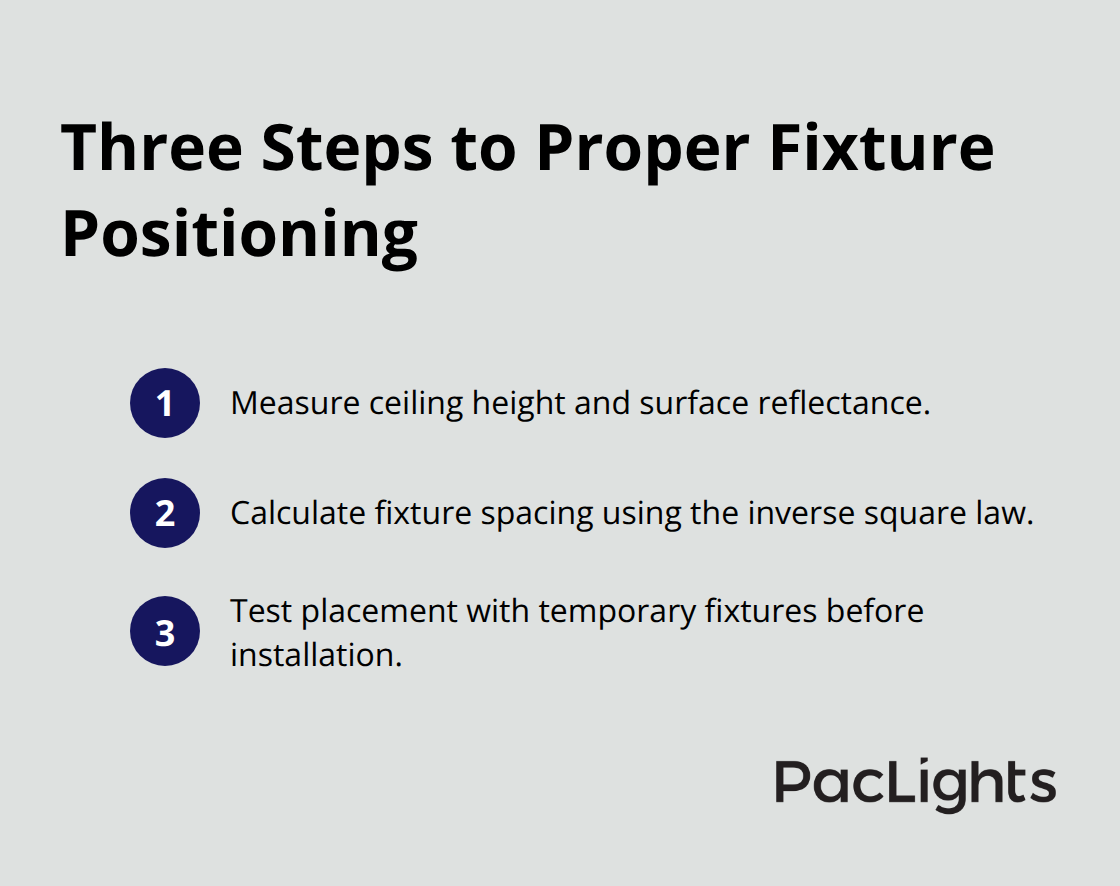
The biggest mistake warehouses make is treating fixture placement as an afterthought. Most facilities install lights on a grid pattern that looks clean on a blueprint but creates uneven coverage in reality. Proper positioning requires three concrete steps: measure your ceiling height and reflectance, calculate fixture spacing using the inverse square law, and physically test placement before committing to installation.
Start with your ceiling height and the reflectance of walls and floors. A warehouse with white walls and light-colored concrete reflects 60–70 percent of light back into the space, while dark walls and stained concrete reflect only 20–30 percent. This matters enormously because it affects how many fixtures you actually need. The Illuminating Engineering Society publishes specific spacing formulas for high-bay fixtures that account for these variables.
Space High-Bay Fixtures Correctly
For a 35-foot ceiling with standard reflectance, high-bay fixtures spaced 40–50 feet apart typically deliver even coverage, but spacing them at 60 feet creates dark zones between fixtures. Closer spacing costs more upfront but eliminates shadows where accidents happen and where workers waste time adjusting position to see properly. Test your layout with temporary fixtures or mobile LED units before permanent installation to confirm foot-candle levels across your entire work area, not just in isolated spots.
Combine High-Bays With Task Lighting
High-bay fixtures should never be your only light source in active work zones. Pairing high-bays with task lighting at lower heights creates the even coverage that actually boosts productivity. A picking area with only high-bays at 35 feet delivers 50–70 foot-candles overhead but creates deep shadows on shelving and pallets below, forcing workers to use phone flashlights or move items to brighter spots. Adding troffer lights or linear strips at 10–12 feet eliminates those shadows and improves picking speed by 10–15 percent according to research from the American Society of Interior Designers. The combination costs more initially but pays for itself through faster throughput and fewer picking errors.
Zone Your Warehouse by Function
Separate your warehouse into functional zones and light each one independently rather than trying to achieve uniform brightness everywhere. Storage areas with infrequent access need only 10–20 foot-candles, receiving docks with label reading need 50–75 foot-candles, and detailed assembly stations need 100–200 foot-candles. Zoning lets you size fixtures appropriately for each task instead of over-lighting the entire facility.
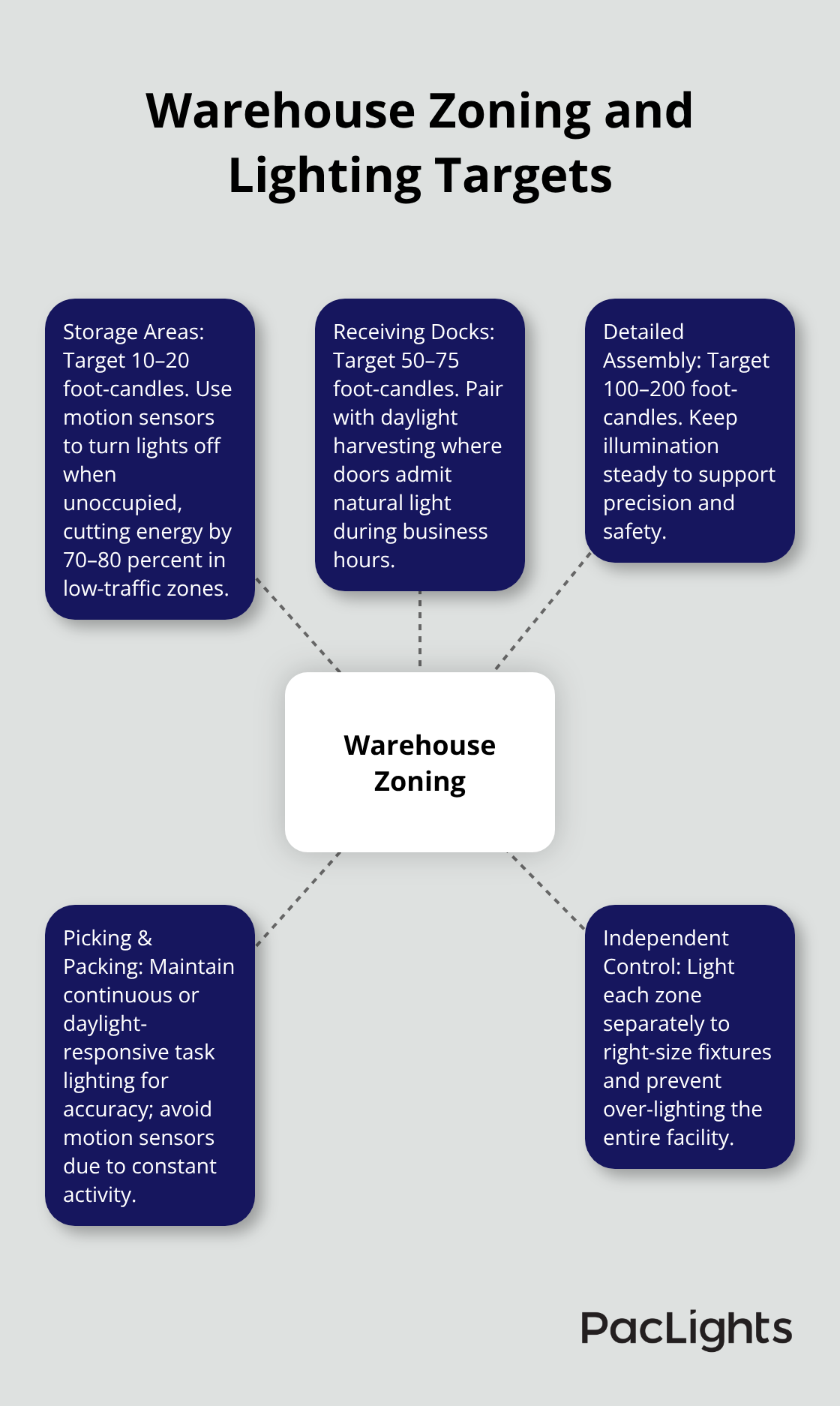
Install motion sensors in low-traffic storage zones so lights turn off automatically when no one is present, cutting energy use in those areas by 70–80 percent. Keep task lighting in picking and packing zones on continuous or daylight-responsive controls instead of motion sensors, since constant illumination is essential for safety and accuracy in high-activity areas. Once you establish your zoning strategy and fixture positions, the next step involves adding the controls that transform a static layout into a dynamic system that adapts to real warehouse conditions.
Advanced Controls and Energy Savings
Motion Sensors Cut Energy Waste in Low-Traffic Areas
Motion sensors stop wasting money on lights that run when no one needs them. They cut energy use by 70–80 percent in low-traffic storage zones because they turn lights off automatically after detecting no movement for 5–15 minutes, depending on your settings. Storage areas and bathrooms benefit most from motion sensors since they have unpredictable occupancy patterns. However, picking zones need constant light because workers move continuously and motion sensors create dangerous flicker that slows work and increases errors.
Daylight Harvesting Reduces Daytime Energy Costs
Daylight harvesting systems reduce artificial lighting when natural light is sufficient, typically cutting daytime energy use by 20–40 percent in facilities with skylights or large windows. Install daylight harvesting in receiving docks and shipping areas where large doors let in natural light during business hours. This approach works best in zones where natural light availability changes throughout the day and where workers can tolerate slight variations in total brightness.
Networked Lighting Controls Enable Real-Time Optimization
Networked lighting controls let you monitor and adjust every fixture from a central system. These controls show real-time energy use, detect when fixtures fail, and allow you to dim non-critical areas during peak demand periods when utility rates spike. A 50,000 square foot warehouse can reduce peak demand by 10–25 percent by shifting lighting schedules or dimming storage zones during high-rate hours, cutting demand charges beyond basic energy savings.
The investment in controls typically ranges from $8,000 to $25,000 depending on facility size and complexity, but the payback period averages 2–4 years through energy savings alone. PacLights offers lighting controls with optional daylight and motion features, plus advanced networked lighting controls specifically designed for industrial facilities. These systems allow you to make adjustments without hiring an electrician for every change.
Calculate ROI and Prioritize High-Impact Zones
Calculate your ROI by measuring current electricity costs, estimating the percentage reduction from controls and fixture upgrades, then dividing total project cost by annual savings. A facility spending $35,000 annually on warehouse lighting that cuts consumption by 60 percent saves $21,000 per year, recovering a $20,000 control system investment in just over one year. Demand charge reductions often add another $2,000–$5,000 in annual savings depending on your utility rate structure.
Start with a lighting audit that identifies your highest-consumption areas and worst-performing fixtures, then prioritize controls in those zones first. This staged approach lets you recover costs faster while building the case for full-facility upgrades. PacLights provides free lighting layout designs and ROI assessments to help you identify which zones will deliver the fastest payback on your investment.
Final Thoughts
Proper warehouse lighting layout tips transform how your facility operates by combining three core strategies: assessing your actual needs, designing fixture positions that eliminate shadows, and installing controls that adapt to real conditions. These approaches work together to cut energy waste while improving safety and productivity, and most warehouses recover their investment within 2–4 years through lower electricity bills and reduced demand charges. Start with a lighting audit of your highest-consumption areas-receiving docks, picking zones, or storage sections where motion sensors and daylight harvesting can cut energy use by 60–70 percent.
Better lighting reduces workplace accidents by eliminating dark zones where injuries happen, and workers move faster and make fewer errors when they can see properly. Your facility also reduces its carbon footprint by cutting energy consumption, which matters to customers and employees who care about environmental impact. Measure your current foot-candle levels, calculate what your space actually needs based on work tasks, then compare that to what you’re currently paying for-the gap between those numbers is your opportunity.
We at PacLights help facilities implement warehouse lighting layout strategies through free lighting design assessments and ROI calculations tailored to your specific space. Our high-bay fixtures, troffer lights, linear strips, and specialty lighting options all feature optional motion and daylight controls, plus advanced networked lighting controls that let you optimize energy use in real time. Visit PacLights to request your free lighting layout design today.
Disclaimer: PacLights is not responsible for any actions taken based on the suggestions and information provided in this article, and readers should consult local building and electrical codes for proper guidance.