

Warehouse retrofit ideas don’t have to drain your budget. At PacLights, we’ve seen facilities cut energy costs by 50 percent or more through smart upgrades.
The good news is that most retrofits pay for themselves within months. We’ll walk you through the best strategies to transform your warehouse into a lean, efficient operation.
How LED Retrofits Cut Your Energy Bills Fast
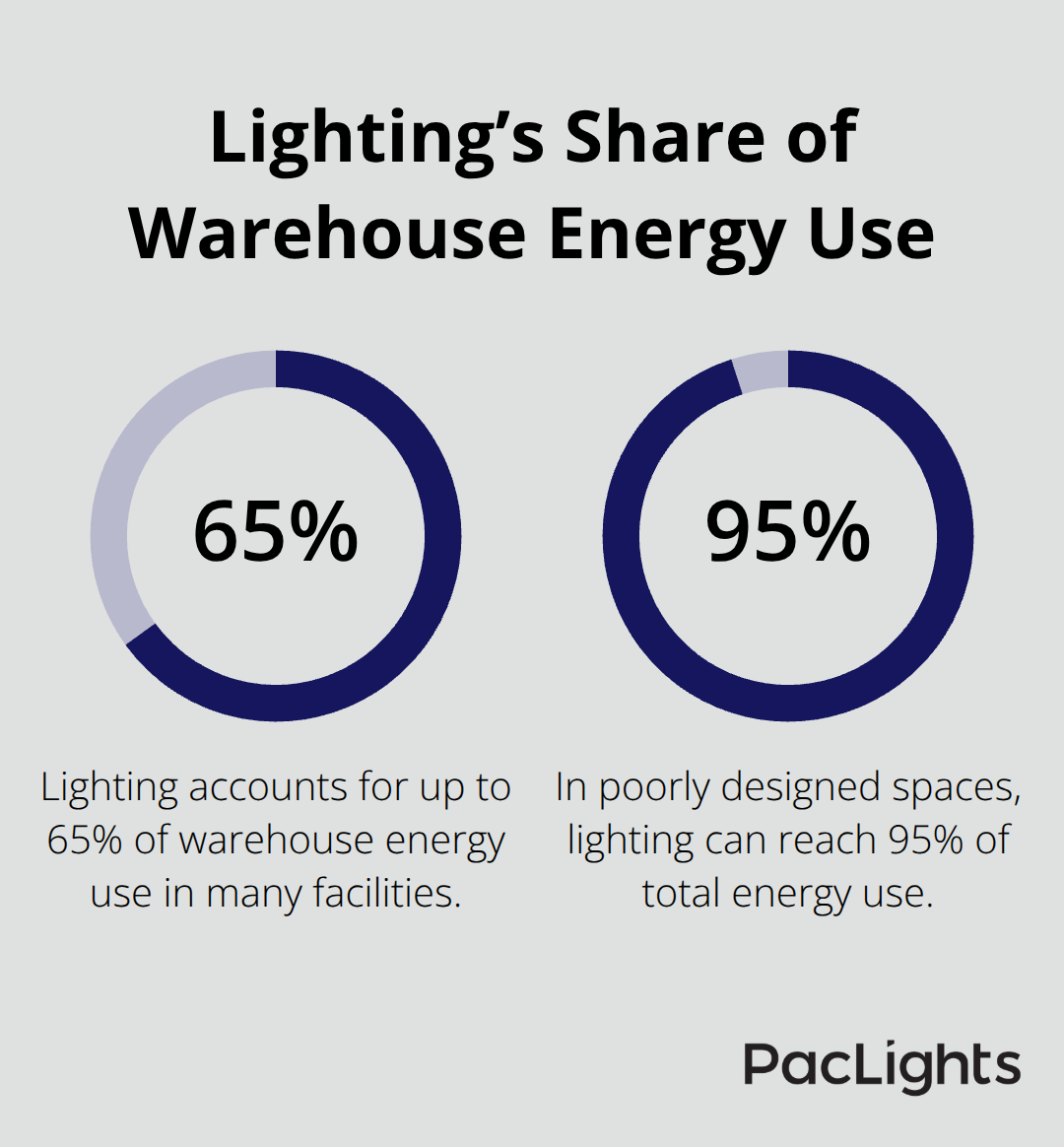
LED warehouse lighting cuts energy consumption by 50 to 75 percent compared to older high-bay and metal halide systems. A warehouse running 100,000 watts of traditional lighting drops to 30,000 watts with LED high bays, saving approximately $33,600 annually at $0.12 per kilowatt-hour. That’s real money hitting your bottom line immediately. The Carbon Trust found that lighting accounts for up to 65 percent of warehouse energy use in many facilities, sometimes reaching 95 percent in poorly designed spaces. This means your lighting retrofit is the single biggest lever you have to cut costs.
Fixture options for high-bay areas, aisles, offices, and exterior zones prevent wasted watts on the wrong application.
Calculate Your True Baseline Before You Start
Start with an honest inventory of what you’re running now. Count your fixture types, note their wattages, measure your ceiling heights, and pull twelve months of electricity bills. A 100,000-square-foot warehouse with 400-watt metal halide fixtures running 16 hours daily tells a different story than a 24/7 operation. The burn hours matter enormously because they compound your annual savings. A photometric study or professional design translates your space dimensions into exact fixture counts and placement, which prevents over-lighting common areas and under-lighting critical zones. This step costs little and protects your ROI. Federal tax incentives and utility rebates cover 60 to 100 percent of upgrade costs. The 179D deduction allows up to $1.88 per square foot for qualifying LED upgrades as of 2023, and utility rebates varied by region but averaged around $127 per high-bay fixture in 2023 programs. Pre-approval from your utility matters before you order because post-install inspection windows are strict. One distributor spent $55,000 on a retrofit and received $42,000 back in rebates and savings, cutting the net cost dramatically. Your payback period typically ranges from 18 months to 3 years, with many warehouses recovering their investment in under two years.
Maintenance Savings Extend Your Timeline
LED fixtures last 50,000 to 100,000 hours-roughly 5 to 11 years depending on operation intensity. Traditional high-intensity discharge bulbs last 10,000 to 20,000 hours and require frequent replacement, climbing ladders, and downtime. Your maintenance crew stops replacing burned-out fixtures constantly, freeing labor for higher-value work. Zone your retrofit strategy: high bays for open floor areas deliver 60 to 70 percent energy savings versus 400-watt metal halide; linear high bays work for aisles; LED tubes for offices save 40 to 60 percent and cost $15 to $35 per tube. Wall packs in exterior and dock areas cut energy use by 50 to 65 percent.
Plan Your Installation to Protect Operations
Schedule installations during low-activity periods or phase them zone-by-zone for 24/7 operations to protect productivity. A turnkey retrofit partner manages material staging and crew coordination, reducing complexity and protecting your operation from disruption. Once your LED retrofit is complete, smart controls and automation take efficiency even further by eliminating wasted light in empty areas and adjusting brightness in real time.
Smart Controls Turn Wasted Light Into Savings
Motion Sensors Eliminate Energy Waste in Low-Traffic Areas
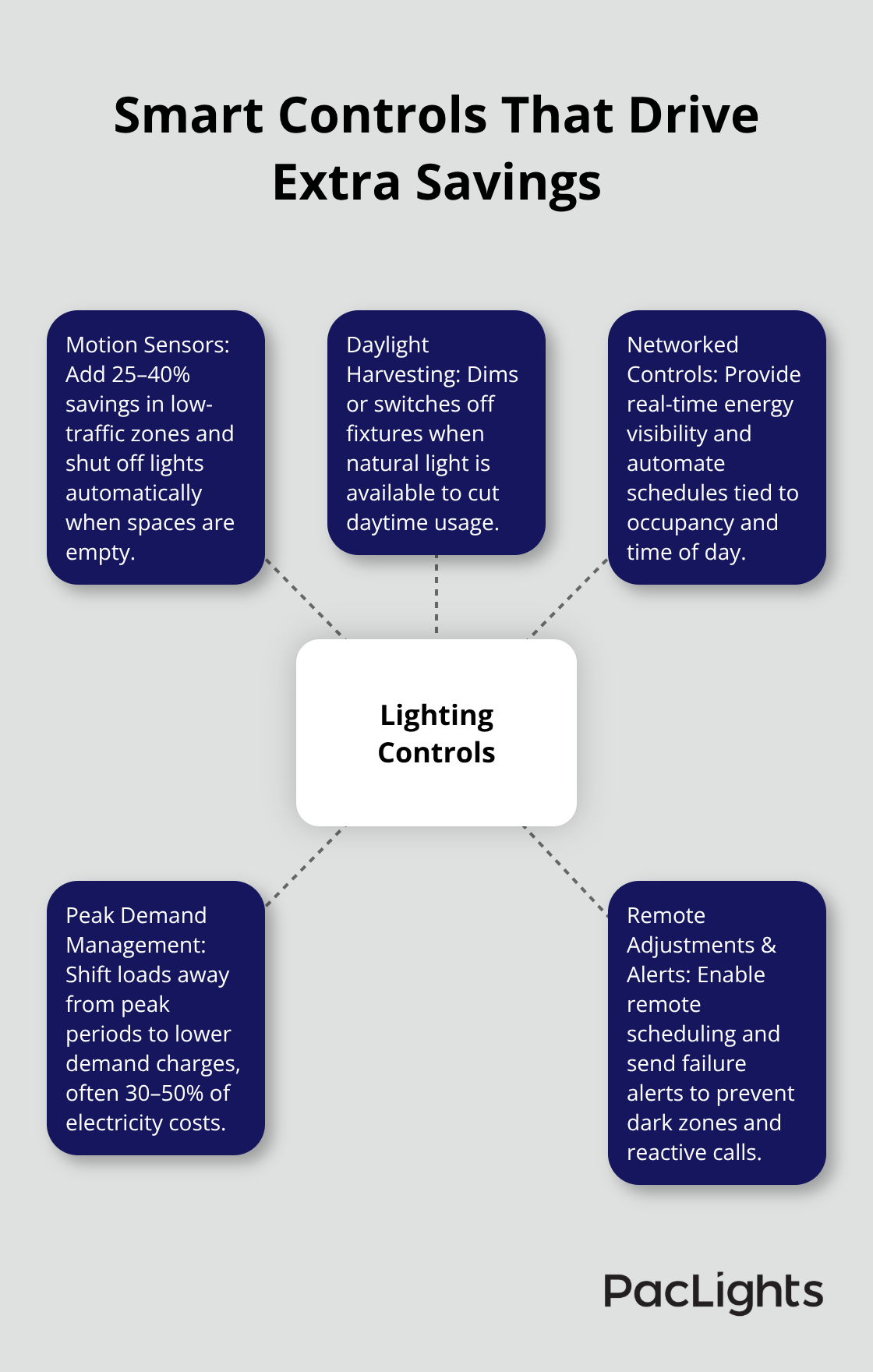
Motion sensors and daylight harvesting add 25 to 40 percent more savings on top of your LED efficiency gains. Motion sensors work best in low-traffic zones like bathrooms, storage areas, hallways, and emergency exits where lights run needlessly during shifts. A warehouse with multiple back rooms, loading dock offices, or maintenance areas wastes hundreds of kilowatt-hours annually on empty spaces. These sensors detect occupancy and switch lights off automatically when workers leave, preventing the common problem of lights staying on in rarely used zones throughout your shift.
Daylight Harvesting Reduces Artificial Lighting Dependence
Daylight harvesting dims or switches off artificial lighting when natural light floods through skylights, windows, or translucent panels. This approach cuts reliance on artificial sources during daylight hours and works best in facilities with significant roof exposure or clerestory windows. South-facing or east-facing glazing maximizes the effect because these orientations capture the most consistent natural light throughout the day. Your warehouse reduces electricity consumption without sacrificing visibility or worker safety.
Networked Controls Provide Real-Time Energy Management
Networked lighting controls provide real-time visibility into energy consumption across your entire operation and enable automated brightness scheduling tied to occupancy patterns and time-of-day demand. These systems send maintenance alerts when fixtures fail, preventing dark zones and reducing reactive service calls. You adjust lighting schedules remotely without sending technicians into the field, and you spot energy anomalies before they inflate your bills. A warehouse running zone-based controls can shift lighting loads away from peak-demand periods, lowering demand charges that often account for 30 to 50 percent of total electricity costs.
Implementation Strategy for Maximum Impact
Install motion sensors in zones that run irregular schedules and pair daylight harvesting with south-facing or east-facing glazing for maximum effect. Deploy networked controls in facilities with multiple zones, high ceilings, or 24/7 operations where manual adjustments fail. PacLights offers lighting fixtures with optional daylight and motion control features, plus advanced networked lighting controls designed to work seamlessly with your LED retrofit. These controls eliminate guesswork from energy management and work across your entire facility. Beyond lighting controls, your warehouse can capture even greater savings through HVAC upgrades and insulation improvements that address the second-largest energy drain in most facilities.
Beyond Lighting: HVAC and Building Envelope Upgrades Pay Off Fast
Thermostat Settings and Insulation Drive Heating Savings
Heating and cooling typically rank second only to lighting in warehouse energy consumption, yet many facilities waste thousands annually through poor insulation and inefficient thermostats. Heating costs rise approximately 8 percent for every degree you raise the thermostat, which means dropping your target from 18°C to 16°C cuts heating energy substantially without affecting worker safety or product integrity. The biggest heat losses come from air leaks around doors, windows, and roof penetrations, followed by losses through uninsulated floors and deteriorating roof panels.
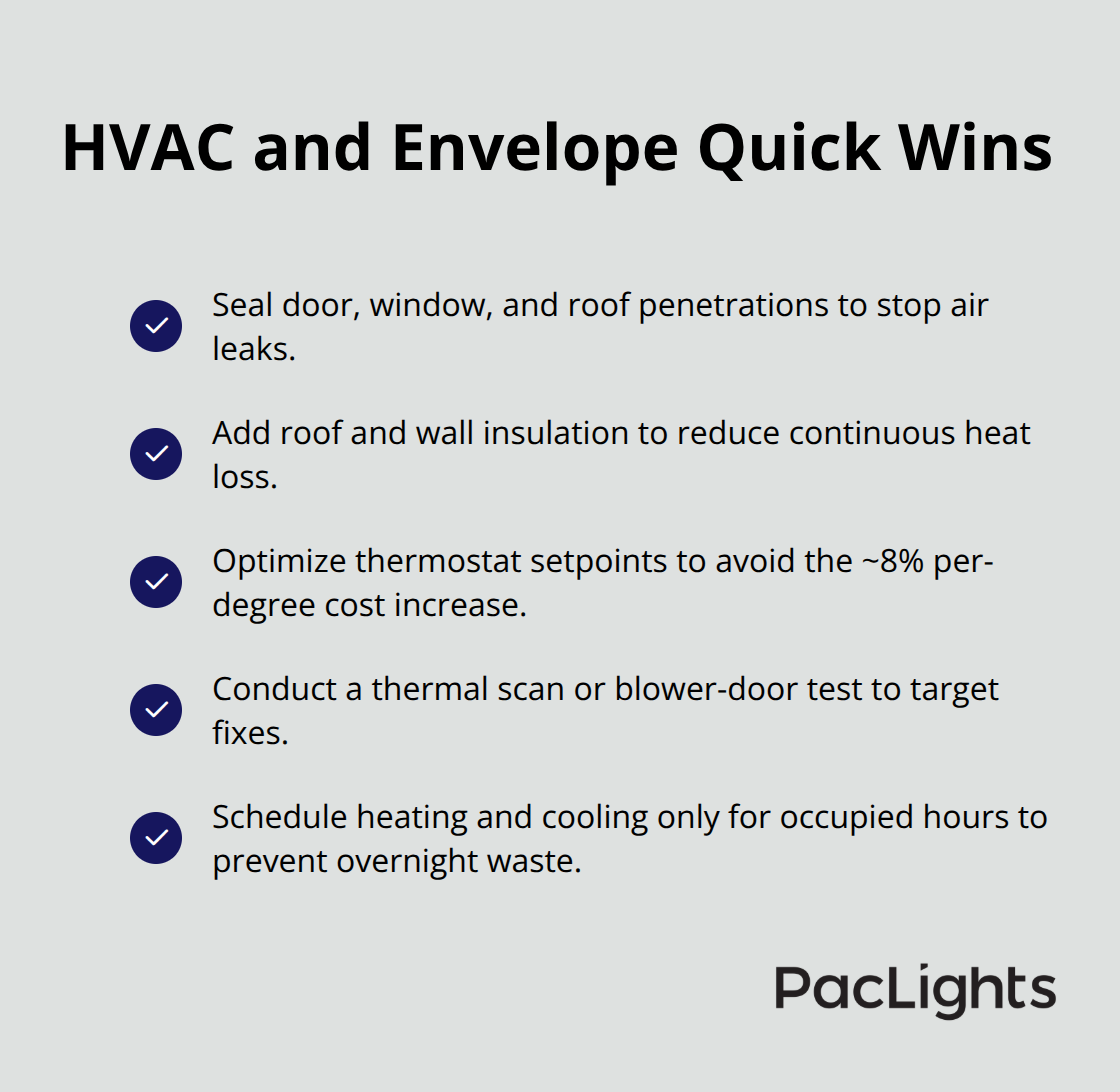
A thermal scan or blower-door test identifies these weak points before you invest in upgrades. Insulation improvements and airtightness repairs often deliver faster payback than expected because heating runs continuously during cold months.
Eliminate Unnecessary Cooling and Ventilation Waste
Many warehouses lose money through unnecessary cooling or air conditioning that doubles energy consumption compared to naturally ventilated buildings. Stratification fans move warm air down from the ceiling to occupied zones, eliminating the need to heat entire spaces unnecessarily. Turn off heating and cooling after the last shift to prevent overnight waste that accumulates across the year. This simple discipline prevents energy drain during unoccupied hours and compounds savings month after month.
Reflective Surfaces Amplify Your LED Investment
Light-colored flooring and wall coatings bounce illumination across the space, reducing the fixture count needed to meet visibility standards and cutting energy consumption further. This approach works especially well in warehouses with high ceilings where light dissipates before reaching work areas. Reflective surfaces require no electrical load and work immediately once installed, making them a cost-effective complement to your LED retrofit.
Solar Panels Create Long-Term Energy Independence
Solar panels on warehouse rooftops represent the long-term energy independence strategy that compounds savings year after year. The UK solar market is expected to double warehouse rooftop capacity in coming years as costs fall and grid electricity prices rise, making solar a financial hedge against future rate increases. A typical warehouse roof provides 5,000 to 15,000 square meters of unshaded surface, which translates to substantial generation capacity. Solar paired with battery storage or grid-tied systems eliminates peak-demand charges during daylight hours when your facility runs hardest. The upfront investment is higher than LED retrofits, but government incentives and solar-as-a-service arrangements make this option accessible for mid-sized operations.
Integrate HVAC, Reflective Surfaces, and Solar for Maximum Impact
These three upgrades-HVAC optimization, reflective coatings, and solar generation-address the full energy picture beyond lighting and move your facility toward long-term cost stability. HVAC improvements cut your second-largest energy expense, reflective coatings amplify lighting efficiency without additional cost, and solar panels hedge against rising electricity rates while reducing demand charges during peak hours.
Final Thoughts
Your warehouse retrofit ideas deliver measurable savings across lighting, controls, heating, and long-term energy independence. LED upgrades cut energy consumption by 50 to 75 percent and recover costs within 18 to 36 months through federal tax incentives and utility rebates that cover 60 to 100 percent of upgrade expenses. Motion sensors and daylight harvesting add another 25 to 40 percent in savings on top of LED efficiency, while HVAC optimization and reflective surfaces address the second-largest energy drain without major capital investment. Solar panels represent your hedge against rising electricity rates and eliminate peak-demand charges during daylight hours when your facility operates hardest.
Most warehouse retrofit projects follow a phased approach that protects your operations while delivering quick wins. Start with LED lighting in high-traffic zones where burn hours are highest, then layer in motion sensors and networked controls to eliminate waste in low-traffic areas. HVAC improvements and reflective coatings require minimal disruption and pay back quickly, while solar installation comes last as your long-term energy independence strategy.
Contact PacLights for a free lighting layout design and ROI assessment tailored to your warehouse. We provide energy-efficient fixtures with optional daylight and motion control features, plus advanced networked lighting controls that work seamlessly across your entire facility. Our team helps you prioritize retrofit investments based on your specific energy consumption patterns and budget constraints, so your first dollar spent delivers the fastest payback.
Disclaimer: PacLights is not responsible for any actions taken based on the suggestions and information provided in this article, and readers should consult local building and electrical codes for proper guidance.