

Warehouse aisle lighting is one of the most overlooked factors in facility operations. Yet poor visibility directly causes worker injuries, picking errors, and wasted time searching for products.
At PacLights, we’ve seen firsthand how the right lighting transforms warehouse safety and productivity. This guide shows you exactly how to assess your current setup and implement upgrades that pay for themselves.
Why Aisle Lighting Directly Impacts Your Bottom Line
Safety and Regulatory Compliance
Poor aisle visibility is not a minor facility issue-it’s a safety and financial problem that compounds daily. OSHA 1926.56 requires a minimum of 5 foot-candles in indoor storage areas while work is in progress, yet many facilities operate well below this baseline. The real damage happens when lighting falls short of operational needs. The National Safety Council reported 347 manufacturing fatalities and 490,000 preventable injuries in 2021, with inadequate visibility contributing to forklift collisions, pedestrian accidents, and falls from improperly lit aisles.
How Poor Lighting Destroys Picking Accuracy
Facilities with dim or uneven aisle lighting see picking errors increase significantly because workers struggle to read barcodes and locate products on elevated shelves. When vertical illumination on rack faces is weak, accuracy drops measurably. Forklift operators working in shadowed aisles face blind spots that create collision hazards. Motion sensors and poor fixture placement leave dark zones where workers must slow down or stop to identify inventory. The cost of a single picking error-rework, customer returns, delayed shipments-often exceeds $50 per incident. Over a year, a 500-person warehouse with even a 2% error rate loses thousands in operational waste.
Speed and Worker Performance Depend on Light Quality
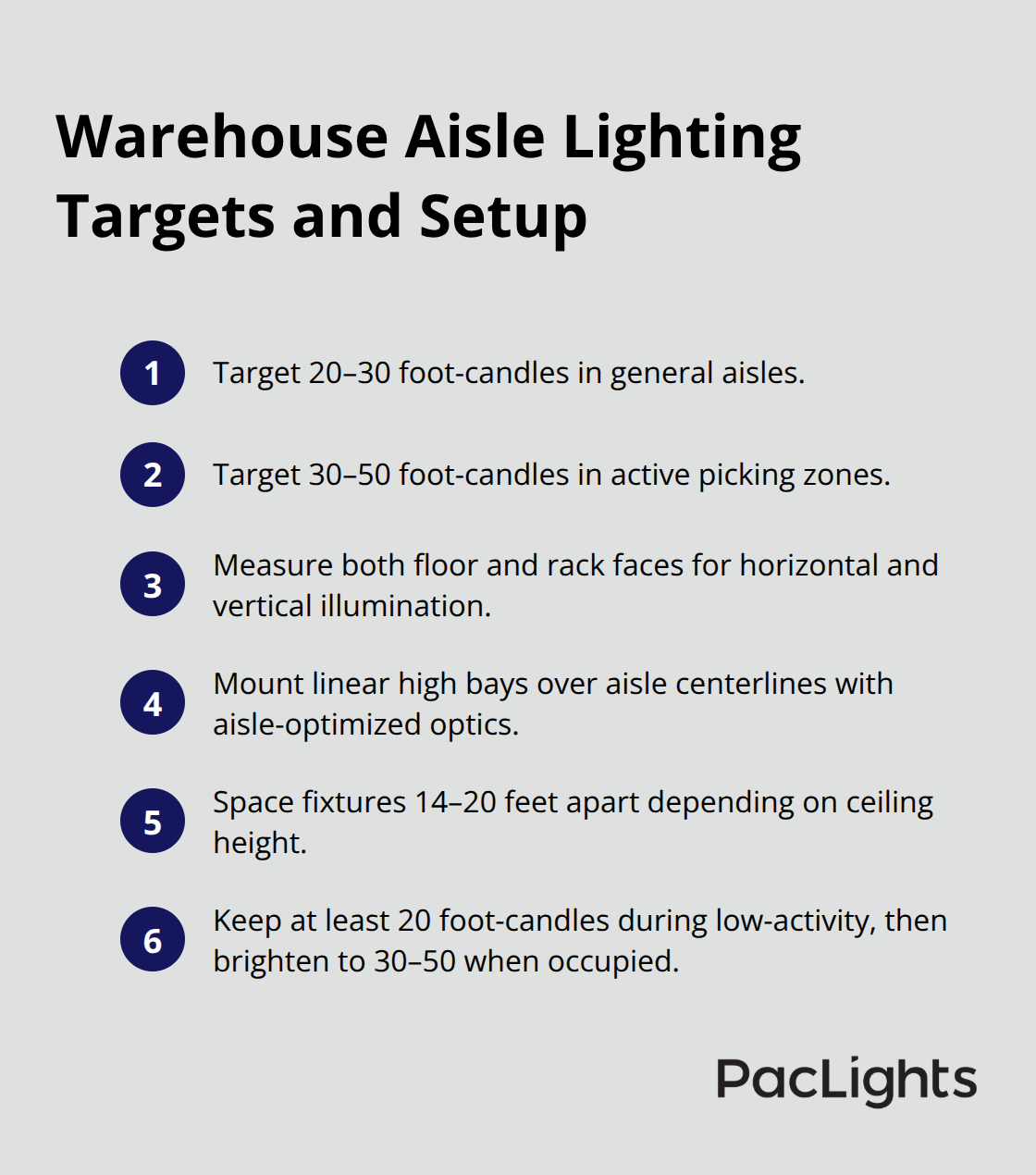
Proper aisle lighting isn’t about meeting minimum codes; it’s about enabling your team to work at full speed safely. When horizontal and vertical illumination are both optimized, picking accuracy improves noticeably because workers can read labels and barcode numbers without squinting or repositioning pallets. We recommend targeting 20–30 foot-candles for general warehouse aisles and 30–50 foot-candles for active picking zones, measured across both the floor and rack faces. This requires linear high bay fixtures positioned directly over aisle centerlines with aisle-optimized optics that direct light down aisles and across shelving-not wide-beam fixtures that spill light above racks and create glare.
The Hidden Cost of Worker Fatigue
Employee fatigue drops when lighting is consistent and flicker-free, which LED systems provide naturally. Warehouse workers operating under poor lighting report higher eye strain, reduced alertness, and faster exhaustion, all of which slow throughput and increase safety risks. Turnover also improves in well-lit facilities because workers perceive their environment as safer and more professional (and feel less physically drained at shift’s end). This combination of speed, accuracy, and retention directly translates to lower labor costs and higher productivity per shift. The next section explores the specific lighting solutions that deliver these results.
Choosing the Right Fixtures for Your Warehouse Aisles
Linear High Bays Deliver Superior Aisle Performance
Linear high bay fixtures outperform UFO high bays in warehouse aisles because they direct light in a controlled rectangular pattern (typically 60×110° or 50×90°) that minimizes glare and maximizes vertical illumination on rack faces where workers read labels and scan barcodes. UFO high bays work better in open storage areas and loading docks where broad, even coverage matters more than precision, but placing them above narrow aisles wastes energy and creates hot spots. Linear high bays mounted directly over aisle centerlines with consistent 14–20 foot spacing (depending on ceiling height and mounting position) deliver the optical control that aisles demand. On a 20-foot ceiling, one 150W LED linear high bay covers roughly 400–600 square feet, which helps determine fixture spacing without over-lighting. For ceilings taller than 30 feet, move to 200W or higher wattage units to maintain the same foot-candle targets across both floor and vertical surfaces.
Why Aisle-Optimized Optics Matter
Aisle-optimized optics are non-negotiable because standard wide-beam fixtures mounted above tall racking create shadows along the floor and leave rack faces under-lit, forcing workers to move pallets or reposition themselves to see product details. The cost difference between standard and aisle-optimized fixtures is minimal compared to the picking accuracy gains and safety improvements you’ll see immediately. These specialized optics direct light precisely where you need it-down aisles and across shelving-rather than wasting lumens above racks where they contribute nothing to worker visibility or safety.
Strategic Sensor Deployment Captures Energy Without Sacrificing Safety
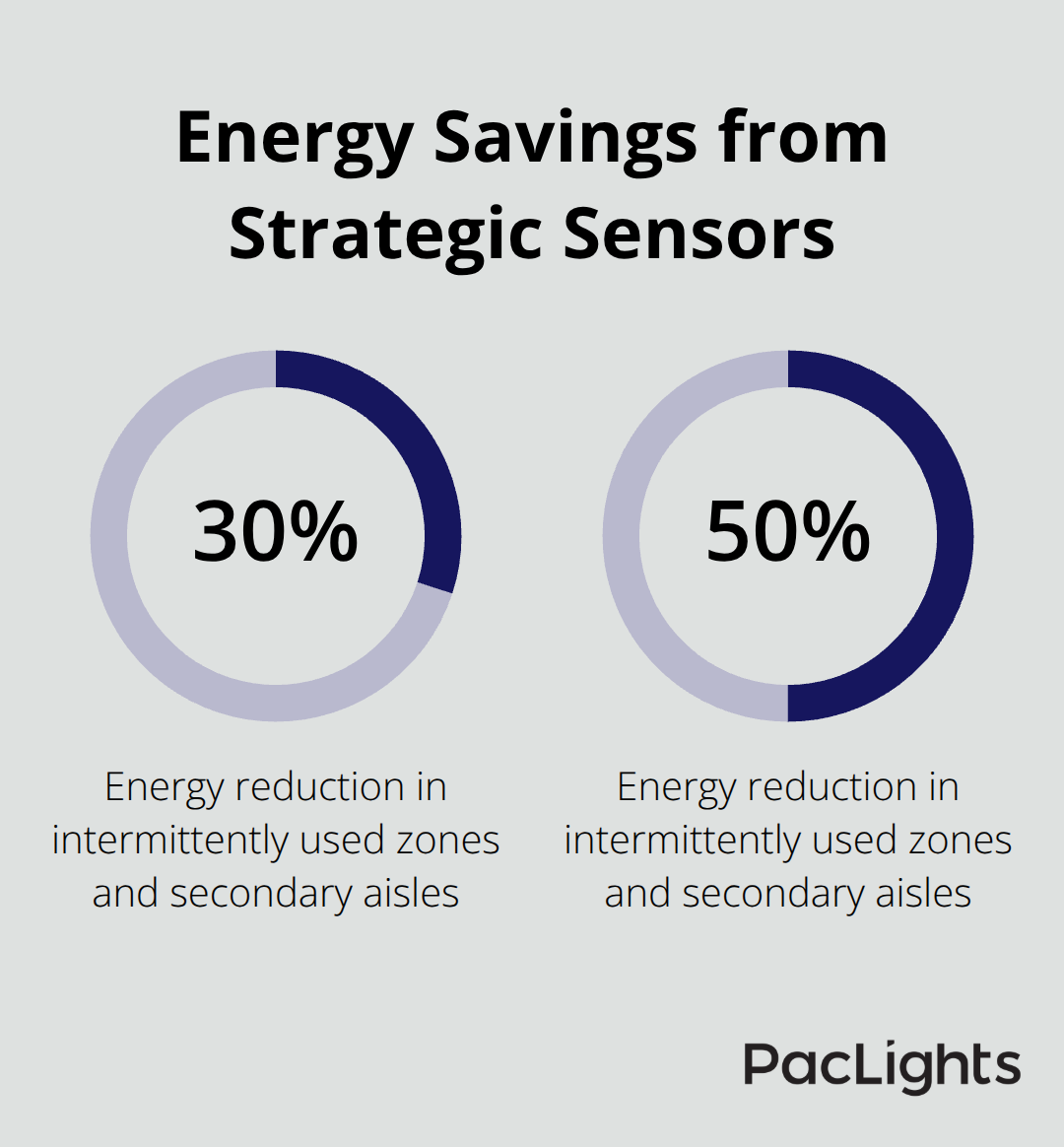
Motion sensors and daylight harvesting controls should be deployed strategically, not uniformly across all aisles. Installing occupancy sensors in intermittently used zones and secondary aisles reduces energy consumption by 30–50% depending on usage patterns, but aggressive dimming in active picking zones backfires by reducing visibility and slowing workers. Pair motion controls with dimmable LED fixtures set to maintain at least 20 foot-candles during low-activity periods, then brighten to 30–50 foot-candles when motion is detected in high-traffic aisles.
This approach captures energy savings without compromising safety or productivity.
Color Temperature and Photometric Planning
Daylight sensors work well in warehouses with skylights or large windows, automatically reducing fixture output when natural light supplements your system. Color temperature matters here too: 5000K is the standard for warehouse aisles because it supports clear barcode visibility and keeps workers alert without the eye strain that comes from overly warm 3000K lighting. A proper photometric study determines fixture placement and control zones before you purchase anything, accounting for your final rack layout, ceiling height, and aisle width to avoid costly mistakes and dark spots that undermine all your other safety investments. With the right fixtures and controls in place, your next step is calculating the financial impact of these upgrades and planning your retrofit strategy.
How to Plan and Execute Your Warehouse Lighting Upgrade
Measure Your Current Aisle Lighting Accurately
Start with a handheld light meter and walk each aisle at floor level and at mid-shelf height (roughly 6 feet) to identify where foot-candles drop below 20. Mark dark zones on a facility map. Most warehouses find 30-40% of aisles fall short of operational minimums because fixtures sit too far apart, mount too high, or lack aisle-optimized optics. Once you have actual numbers, compare them to your operational requirements: general picking aisles need 20-30 foot-candles, active zones need 30-50, and high-accuracy inventory areas need 40 or higher. The gap between current and target tells you exactly which aisles to prioritize.
Facilities with tall racking (18+ feet) almost always discover vertical illumination problems first, since standard wide-beam fixtures leave rack faces in shadow even when floor brightness appears adequate. This is why photometric analysis matters more than rough estimates. A proper lighting layout study accounts for your exact ceiling height, final rack configuration, aisle width, and fixture spacing before you spend a dollar on hardware.
Use Photometric Studies to Eliminate Guesswork
A photometric study models your specific setup and predicts foot-candle distribution across both horizontal and vertical surfaces. This analysis prevents costly mistakes and dark spots that undermine all your other safety investments. Professional lighting providers offer free photometric layouts that account for your facility’s unique dimensions and operational needs, giving you confidence in fixture placement and quantity before purchase.
Calculate Your Financial Return on LED Upgrades
LED fixtures consume 60-70% less energy than traditional HID systems. On a 20-foot ceiling with consistent 14-foot fixture spacing, a 150W LED linear high bay replaces multiple older units while delivering superior light quality. Operating a 50,000-square-foot warehouse 16 hours daily for 250 days annually, switching to LED aisle lighting saves roughly 15,000-20,000 kWh per year depending on your current fixture types and local electricity rates. At an average U.S. industrial rate of $0.12 per kWh, that translates to $1,800-$2,400 in annual energy costs avoided.
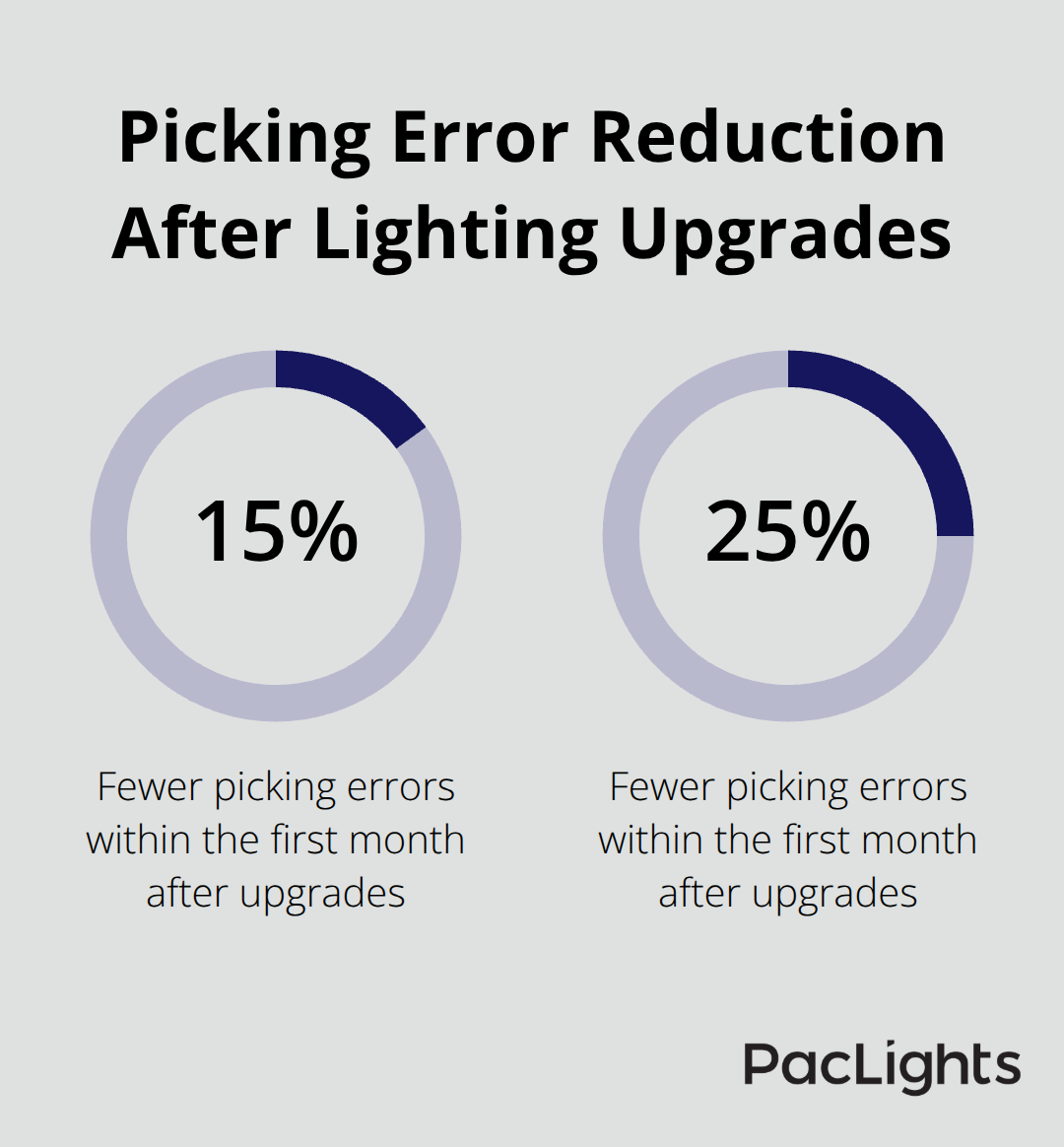
LED fixtures last 50,000 hours or longer, meaning you replace them once every 8-10 years versus every 2-3 years for HID. This eliminates frequent relamping labor and ladder time that creates fall hazards. A picking error costs roughly $50-$100 per incident when you factor in rework, customer returns, and shipping delays. Facilities that upgrade to proper aisle lighting typically reduce picking errors by 15-25% within the first month because workers read barcodes and shelf labels without squinting or repositioning inventory.
Quantify Error Reduction and Payback Timelines
A 500-person warehouse with a 2% error rate commits roughly 10 errors daily, or 2,500 annually. Even a conservative 15% reduction saves 375 errors yearly, worth $18,750-$37,500. Most LED retrofit projects for warehouse aisles cost $8,000-$15,000 per 10,000 square feet depending on ceiling height and fixture density, meaning payback occurs within 6-12 months when you combine energy savings and error reduction.
Motion sensors deployed in secondary aisles and intermittent-use zones add another 30-50% energy savings without compromising safety in active picking areas. This further shortens payback timelines and maximizes your return on the initial investment.
Final Thoughts
Warehouse aisle lighting directly determines whether your facility operates safely and profitably. Proper illumination reduces picking errors by 15–25%, cuts worker injuries, and improves retention by creating an environment where employees feel secure and capable. These gains compound daily across your entire operation, translating to measurable financial returns that justify the investment immediately.
The financial case for upgrading to LED warehouse aisle lighting is straightforward. Energy savings alone deliver $1,800–$2,400 annually in a 50,000-square-foot warehouse, while error reduction worth $18,750–$37,500 per year makes payback happen within 6–12 months. LED fixtures lasting 50,000 hours eliminate the frequent relamping that drains maintenance budgets and creates fall hazards, and motion sensors deployed strategically in secondary aisles capture another 30–50% in energy savings without compromising safety in active zones.
Contact PacLights for a free photometric layout that accounts for your exact ceiling height, rack configuration, and aisle width. This analysis eliminates guesswork and shows precisely which fixtures you need, where to place them, and what your payback timeline looks like. We at PacLights offer LED retrofit solutions and ROI assessments designed specifically for warehouses like yours.
Disclaimer: PacLights is not responsible for any actions taken based on the suggestions and information provided in this article, and readers should consult local building and electrical codes for proper guidance.