

Warehouse LED fixtures have transformed how industrial facilities manage lighting costs and energy consumption. Most warehouses still rely on older technology that wastes significant electricity and requires frequent maintenance.
At PacLights, we’ve helped hundreds of facilities cut their lighting expenses by 40–60% through strategic LED upgrades. This guide shows you exactly how to achieve measurable savings while improving safety and operational control.
How Much Can You Actually Save on Energy with LED Warehouse Lighting?
LED warehouse lighting cuts energy consumption by 50–75% compared to metal halide and HPS systems, according to the U.S. Department of Energy. For a facility running 16 hours daily, that translates to real money. A 50,000-square-foot warehouse replacing 400W metal halide fixtures with modern LED equivalents typically saves $15,000–$25,000 annually in electricity alone. The math is straightforward: if your current system draws 150 kilowatts and LED cuts that to 50 kilowatts, you save 100 kW per operating hour. At an average industrial rate of $0.12 per kilowatt-hour, that equals $12 per hour in electricity savings. Over a year of typical warehouse operations, those hours add up fast.
Maintenance Costs Drop Dramatically
LED fixtures last 50,000–100,000 hours compared to 25,000 hours for metal halide and 15,000 hours for fluorescent. This means you replace fixtures far less often, and when you do, you avoid the labor-intensive process of climbing into tall ceilings. One facility reduced their maintenance budget by 90% after switching to LED high bays. They moved from replacing fixtures every 18 months to every five years. That’s not just electricity savings-it eliminates the cost of replacement parts, technician time, and operational downtime.
Payback Happens Faster Than You Think
The payback period typically ranges from 12–24 months for most warehouses, with facilities operating longer shifts sometimes hitting payback in under 12 months. After payback, you run your lighting system on savings alone. Utility rebates and incentives often cover $25–$100 per fixture, offsetting 20–40% of your upfront project costs. Many utility programs require documentation, which lighting specialists can help facilitate. The lifecycle cost advantage extends 7–10 years beyond payback, making LED not just a cost-cutting measure but a strategic investment in operational efficiency.
What Happens Next
These energy and maintenance savings form the foundation of your ROI, but the real competitive advantage comes from choosing the right fixture types for your specific warehouse layout and ceiling height.
Choosing the Right LED Fixture for Your Warehouse Layout
High Bay Lights for Open Floor Areas
High bay lights dominate warehouse ceilings for good reason: they deliver concentrated illumination across open floor areas where traditional fixtures would require far more units. UFO high bays work best in spaces with minimal obstructions, projecting 15,000–72,150 lumens depending on wattage and model specifications. For a 20-foot ceiling covering general storage, one 150W high bay fixture handles roughly 400–600 square feet. Move to 30-foot ceilings and you need fixtures rated at 200W or higher to maintain adequate floor-level brightness. The ExsaBay XLE High Bay achieves up to 150 lumens per watt, meaning you get more light output while consuming less power than older alternatives.
Beam angle significantly affects your fixture layout: a 90-degree beam concentrates light more tightly, while a 120-degree beam spreads coverage wider, changing how many fixtures you actually need. Most warehouses target 30 foot-candles for general operations, though picking areas require 50 foot-candles and receiving docks need 20–30 foot-candles.
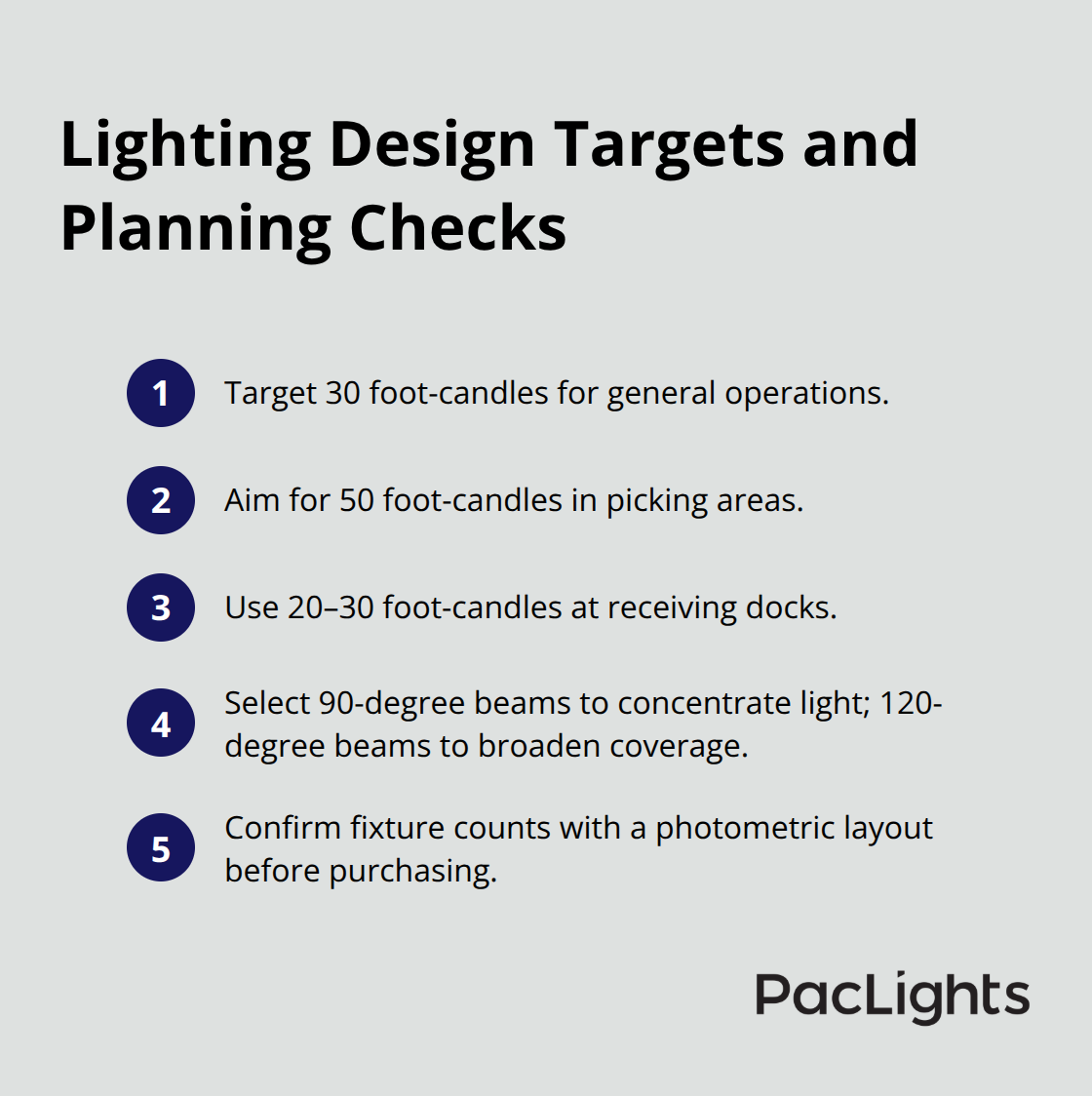
A photometric layout-not a guess-determines your exact fixture count and spacing before you purchase anything.
Linear High Bays for Racked Storage Aisles
Linear high bays excel in racked storage aisles where you need uniform light running the length of rows. These fixtures deliver consistent illumination along storage walls, making labels and inventory codes readable at height without creating the hot spots and dark patches that single high bays often produce. For ceiling heights between 15 and 25 feet in active picking zones, linear fixtures spaced 14–20 feet apart prevent shadows between units.
Flat Panel Lights and Color Temperature Considerations
Flat panel lights belong in office areas and administrative spaces within the warehouse, not in high-ceiling industrial zones. They work at standard ceiling heights of 8–10 feet and require about 40–60 lumens per square foot, with 4000K color temperature providing neutral white light that reduces eye strain during extended shifts. Color temperature deserves your attention across all fixture types: 5000K delivers the clarity and alertness most warehouses need for safety and productivity, while 4000K offers a softer alternative if your facility operates long shifts where brightness can cause fatigue. Avoid 5700K or higher unless quality inspection demands it.
Cold Storage and Specialized Environments
Cold storage environments present their own challenge-standard LED fixtures can fail in freezing conditions, so you need vapor-tight fixtures rated IP65 or higher that prevent condensation and maintain output reliability from -20°F to 120°F. These specialized fixtures protect your investment and ensure consistent performance across temperature fluctuations that would compromise standard equipment.
The right fixture choice depends entirely on ceiling height, aisle configuration, and task requirements. Photometric planning prevents expensive mistakes and ensures you pay only for the fixtures you genuinely need. Once you select the appropriate fixtures for your layout, the next step involves optimizing their performance through advanced controls and sensors that adapt to your actual occupancy patterns and daylight conditions.
Advanced Controls and Sensors That Stop Energy Waste
Motion Sensors Cut Energy Use in Low-Traffic Zones
Motion sensors represent the fastest way to stop wasting money on empty spaces. Most warehouses light aisles and storage areas around the clock, even when no one works there. A motion sensor cuts energy use by 30–50% in low-traffic zones by dimming or shutting off fixtures when movement stops. In a 50,000-square-foot facility with 16-hour daily operation, that 40% reduction equals roughly $4,800 in annual savings on top of your baseline LED efficiency gains.
Occupancy sensors work best in spaces with predictable traffic patterns: receiving docks, break rooms, and secondary aisles where workers visit intermittently rather than continuously. Microwave sensors detect motion through light barriers and work reliably in freezing conditions, making them ideal for cold storage where standard infrared sensors fail.
Installation and Configuration Determine Real-World Performance
The critical mistake most facilities make is installing sensors without adjusting sensitivity and time delays. A 5-minute delay in a picking area wastes energy; a 30-second delay in a loading dock causes workers to stand in darkness. Sensor placement matters equally-mount them at 8–12 feet high on aisle ends or corners, not directly overhead where people block detection. Test your sensor configuration in actual operations before finalizing installation, because improper setup creates frustration and gets disabled by staff.
Daylight Harvesting Adds Another Layer of Savings
Daylight harvesting uses photosensors to dim or disable artificial lighting when natural light provides adequate illumination, delivering an additional 40–60% energy savings beyond base LED efficiency. This works best in warehouses with skylights, monitor roof windows, or dock areas receiving direct sun. The technology struggles in deep interior zones where daylight never penetrates, so target it strategically to spaces that actually receive sun.
Networked Controls Optimize Performance Across Your Entire Facility
Networked lighting controls integrate motion sensors, daylight data, and real-time occupancy information into a centralized system that adjusts fixture output zone by zone. Rather than a simple on-off sensor, networked systems dim to 30% output in partially occupied aisles and ramp to full brightness only when activity increases. A facility using networked controls with motion and daylight harvesting can achieve total energy reductions exceeding 60% beyond baseline LED consumption.
The payback calculation changes dramatically: instead of 12–24 months for fixtures alone, networked systems often pay for themselves in 18–30 months when you factor in installation complexity. PacLights offers motion and daylight control options integrated into fixture designs, plus advanced networked lighting control systems that work across your entire facility, enabling real-time management and monitoring without expensive rewiring.
Final Thoughts
LED warehouse fixtures cut your energy consumption by 50–75% while reducing maintenance costs by up to 90%, delivering payback in 12–24 months for most facilities. A 50,000-square-foot warehouse saves $15,000–$25,000 annually in electricity alone, with motion sensors and daylight harvesting pushing total savings past 60% in many cases. Modern controls transform lighting from a static cost center into an active efficiency tool that adapts to your actual operations rather than running on a fixed schedule.
The real competitive edge comes from matching your specific warehouse layout, ceiling height, and task requirements to the right fixture types and control strategy. Generic approaches leave money on the table, but a customized design prevents overspecifying fixtures you don’t need while maximizing the performance of every unit you install. We at PacLights offer free lighting layout designs and ROI assessments that show you exactly what you’ll save before you commit to anything.
Contact PacLights to schedule your customized lighting assessment and discover how much your facility can actually save.
Disclaimer: PacLights is not responsible for any actions taken based on the suggestions and information provided in this article, and readers should consult local building and electrical codes for proper guidance.