

Ceiling height is shrinking in modern buildings, yet lighting demands keep growing. A low profile flush downlight solves this problem by delivering powerful illumination in tight spaces without sacrificing style.
At PacLights, we’ve seen firsthand how the right lighting transforms facility operations. This guide shows you why these compact fixtures matter and how to choose them for your building.
Why Low Profile Fixtures Deliver Real Value in Modern Buildings
Low profile flush downlights address three concrete problems that facility managers face every day. First, modern buildings often have limited plenum space above suspended ceilings, especially in renovations and retrofits where traditional recessed housings create structural headaches. The HALO HLB Slim Low-Glare Canless LED Downlights exemplify this solution-they install at just 1/2 inch thick with no housing required, allowing direct-to-ceiling mounting that preserves valuable attic clearance. Second, these fixtures deliver measurable aesthetic results.
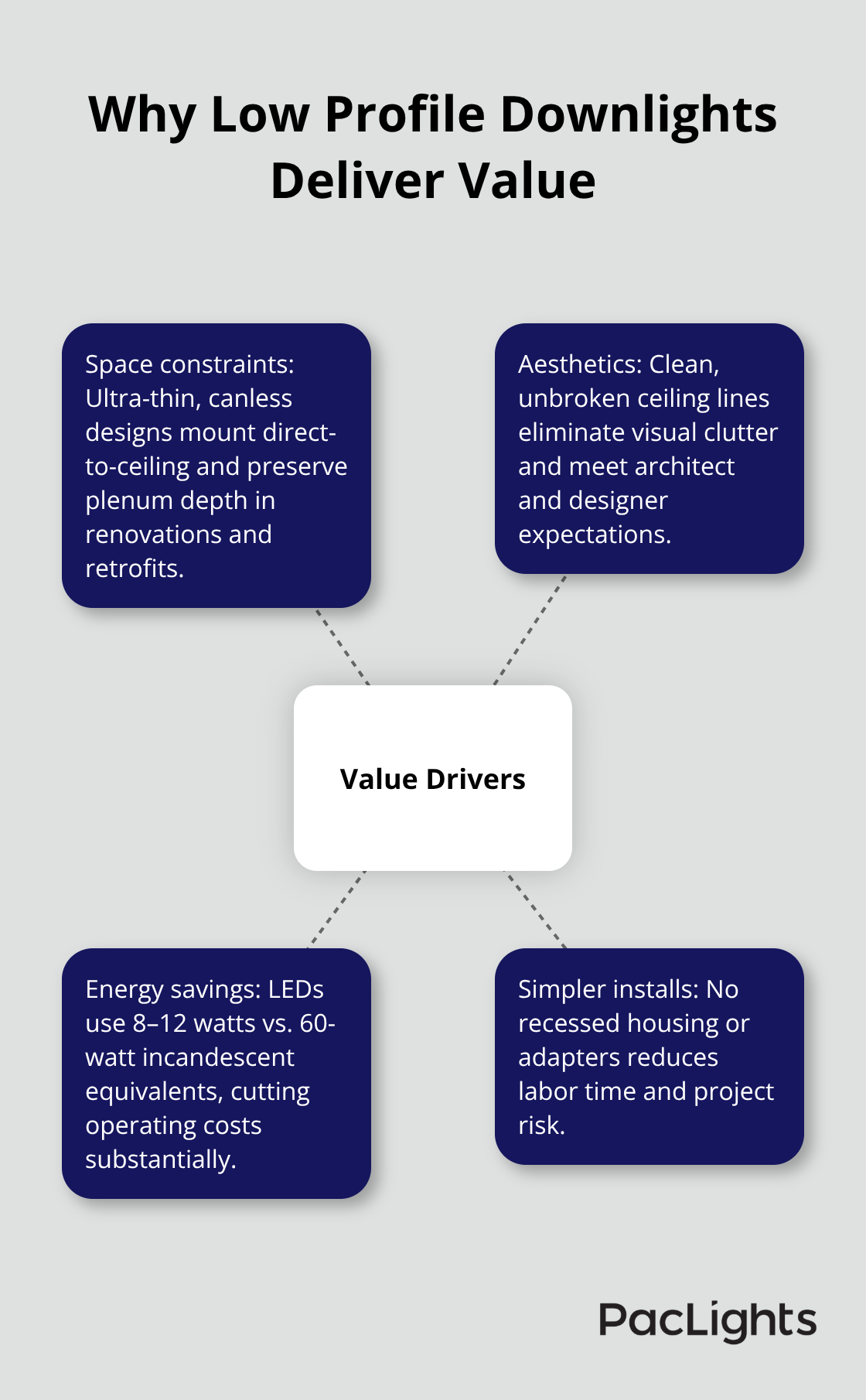
A clean, unbroken ceiling line without protruding trim or visible hardware creates the visual continuity that architects and designers demand. Third, the energy performance matters financially. LED downlights consume 8–12 watts compared to 60 watts for incandescent equivalents, delivering roughly 24,000 watt-hours of annual savings for a typical 20-fixture kitchen running 5 hours daily, translating to $240–$300 in electricity cost reduction per year.
Fitting Into Tight Spaces Without Compromise
Plenum depth represents the overlooked constraint in older buildings and modern construction with low ceilings. The MicroEdge Ultra-Thin variant installs through ceilings with as little as 1.5 inches of plenum height, expanding retrofit options that would otherwise require structural modifications. This matters because attic work adds thousands to project costs and extends timelines. The canless design also simplifies installation-it eliminates the need for housing compatibility checks and adapter fittings. Field-selectable color temperatures from 2700K to 5000K let you adjust ambiance without swapping fixtures, a flexibility that integrated LED solutions often lack. For a 1959-era home or any building where planning ahead matters, this adaptability prevents costly fixture replacement if lighting needs change.
Performance That Justifies the Investment
The numbers speak clearly. Rated for approximately 50,000 hours of operation with a 5-year warranty, these fixtures reduce maintenance labor and replacement frequency dramatically compared to traditional bulbs lasting 1,000–2,000 hours. ENERGY STAR certification confirms efficiency standards, and 90+ CRI ensures accurate color rendering for design details, textiles, and artwork. Motion sensors paired with these fixtures reduce energy use by 70–80% in corridors and fluctuating-occupancy spaces, according to facility management benchmarks. Dimmable options supporting both 5% phase-cut and 0-10V dimming enable integration with existing control systems, meaning your lighting investment works within current infrastructure rather than demanding system overhauls.
Where These Fixtures Make the Biggest Difference
Different spaces demand different lighting strategies, and low profile fixtures adapt to each one. Retail environments benefit from flexible positioning and adjustable beam angles that highlight merchandise without excessive heat output. Office buildings require uniform, flicker-free lighting that supports productivity over long workdays-these fixtures deliver that consistency. Hospitality and residential settings gain from the aesthetic advantage of a seamless ceiling combined with dimmable warmth that creates inviting spaces. The real question becomes not whether low profile fixtures work, but which applications in your facility will see the fastest return on investment.
Where Low Profile Downlights Deliver the Strongest Results
Retail Environments: Highlighting Merchandise Without Compromise
Retail environments demand lighting that highlights merchandise without creating heat or glare that damages products or exhausts customers. Low profile fixtures excel here because their low-glare lenses and adjustable beam angles let you target specific displays while maintaining comfortable ambient lighting. A 4000–5000K color temperature combined with 90+ CRI renders product colors accurately, which matters enormously for apparel, cosmetics, and food displays where color fidelity drives purchase decisions. Space these fixtures 6–8 feet apart with 2,500–3,500 lumens per unit to create the flexibility to adjust brightness zones independently, allowing you to dim slower-moving sections and brighten high-traffic areas. Motion sensors reduce energy consumption by 70–80% in stockrooms and back-of-house spaces where occupancy fluctuates throughout the day.
Office Buildings: Supporting Sustained Focus and Productivity
Office buildings require a completely different approach. Uniform, flicker-free lighting at 3,500–4000K supports sustained focus during long workdays and prevents the eye fatigue that dim or inconsistent lighting causes. Space fixtures 8–10 feet apart with 2,500–3,500 lumens per fixture to maintain this consistency across open plans and private offices. The dimmable capability matters here too because employees near windows benefit from reduced artificial light during daylight hours, cutting energy waste without sacrificing visibility. Field-selectable color temperature prevents the need for multiple fixture SKUs during design phases, simplifying procurement and installation timelines.
Hospitality and Residential Applications: Creating Inviting Spaces
Hospitality and residential applications prioritize the visual cleanliness that low profile fixtures provide, combined with warmth that inviting spaces demand. Hotels use 2700–3000K fixtures with dimming to create flexible spaces that shift from bright morning functionality to ambient evening comfort. Residential kitchens need 18–24 inch spacing over counters with 3,000+ lumens per fixture at 4000K for food preparation clarity, while dining areas benefit from the same fixtures dimmed to 2700K for relaxed meals. Bedrooms perform best with 1,500–2,000 lumens at 2700–3000K positioned 3–4 feet from walls, creating restful environments without harsh shadows.
Bathrooms: Durability Meets Moisture Resistance
Bathrooms require moisture-resistant fixtures with UL Damp or UL Wet ratings, centered over vanities with 4–6 feet spacing and 1,500–2,000 lumens at 3000–4000K. The durability advantage becomes clear here because bathroom humidity accelerates degradation in standard fixtures, while these fixtures maintain performance across decades of daily moisture exposure. The canless design in these spaces preserves the seamless ceiling aesthetic that architects specify, avoiding the visual clutter of traditional recessed trim. Installation timelines matter financially in hospitality projects where downtime costs money. The ultra-thin variant installs through ceilings with as little as 1.5 inches of plenum height, eliminating the structural modifications that add weeks to renovation schedules.
Making Installation Decisions That Fit Your Timeline
The speed at which you complete a lighting retrofit directly impacts your bottom line. Low profile fixtures reduce installation complexity compared to traditional recessed housings, which means your team spends less time in the ceiling and more time on other priorities. Whether you’re upgrading a retail location, modernizing an office, or renovating a hospitality property, the choice between standard and ultra-thin variants shapes both your immediate project timeline and your long-term maintenance burden. The next section examines how to evaluate these options against your specific facility constraints and performance requirements.
Installation, Maintenance, and Long-Term Performance
Fast Installation That Respects Your Timeline
Low profile flush downlights require far less structural intervention than traditional recessed housings, which means your project timeline and budget stay intact. The canless design eliminates housing compatibility checks, adapter fittings, and attic floor modifications that typically add weeks and thousands of dollars to retrofit projects. Standard hole cutouts work with retention springs, making installation straightforward for experienced electricians. The real advantage emerges when plenum depth is limited: the MicroEdge Ultra-Thin variant installs through ceilings with as little as 1.5 inches of clearance, a specification that matters enormously in older buildings or modern construction with tight mechanical spaces. Remote driver placement provides flexibility in complex ceiling layouts where running wiring directly to each fixture would create clutter or require additional holes. Before installation, verify your ceiling type-drywall, plaster, or suspended tile-because installation methods differ slightly, but all are faster than traditional recessed work. Ensure adequate attic clearance above the cutout and confirm that your electrical panel has capacity for the load. If you lack confidence in wiring or ceiling work, hire a licensed electrician because improper installation voids warranties and creates fire hazards.
Minimal Maintenance Across Decades
Maintenance becomes nearly invisible with these fixtures because their 50,000-hour lifespan eliminates the bulb-replacement cycles that drain labor budgets. Incandescent bulbs last 1,000–2,000 hours while halogen bulbs reach 3,000–5,000 hours; the difference compounds quickly across a building. A 20-fixture kitchen replacing incandescent bulbs annually costs roughly 20 replacement cycles per year; low profile LED fixtures reduce that to zero replacements across a decade. Dust the lens periodically to maintain light output, but that task takes minutes per fixture. The IC-rated, air-tight design reduces HVAC load by minimizing air leakage between conditioned and unconditioned spaces, a benefit that lowers cooling costs in warm months and heating costs in cold months. Proper installation, regular cleaning, and attention to environmental factors all contribute to the longevity of these fixtures.
Smart Controls and System Integration
Dimmable fixtures supporting both 5% phase-cut and 0-10V dimming integrate directly into existing control systems, eliminating expensive system overhauls. Smart lighting controls enable remote brightness and color temperature adjustment across your entire facility without rewiring, allowing you to optimize energy use based on occupancy and daylight availability. ENERGY STAR certification confirms these fixtures meet rigorous efficiency standards, and the 5-year warranty protects your investment against premature failure.
Durability in Harsh Environments
Wet-location ratings make these fixtures suitable for bathrooms, showers, and covered outdoor spaces where moisture would degrade standard fixtures, extending their useful life in harsh environments. The low-heat output reduces fire risk, and many models include thermal protection or auto shut-off features that safeguard against overheating. Their recessed installation minimizes bump hazards and makes them safer for busy or high-traffic spaces (retail floors, hospitals, schools) where safety matters as much as performance.
Final Thoughts
Low profile flush downlights solve three persistent problems that facility managers face: space constraints, aesthetic demands, and energy costs. These fixtures install in tight plenum spaces without structural modifications, deliver seamless ceiling lines that architects specify, and cut electricity consumption by 80% compared to incandescent bulbs. A 20-fixture kitchen saves $240–$300 annually in energy costs alone, while the 50,000-hour lifespan eliminates the labor burden of frequent bulb replacements.
Installation timelines matter financially because every week of downtime costs money. The canless design eliminates housing compatibility checks and attic floor modifications that add weeks to projects, and the MicroEdge Ultra-Thin variant installs through ceilings with as little as 1.5 inches of plenum height. Dimmable options supporting 5% phase-cut and 0-10V dimming integrate directly into existing control systems without expensive overhauls, transforming retrofit feasibility in older buildings and modern spaces alike.
We at PacLights offer lighting fixtures tailored to your facility’s specific needs, including low profile flush downlight options with optional motion control and advanced lighting controls that optimize energy use. Our free lighting layout designs and ROI assessments help you make informed decisions before purchasing. The investment in quality fixtures pays for itself through energy savings, reduced maintenance labor, and the operational flexibility that modern buildings demand.
Disclaimer: PacLights is not responsible for any actions taken based on the suggestions and information provided in this article, and readers should consult local building and electrical codes for proper guidance.