

Flush mount downlights are everywhere-offices, homes, retail stores-yet most people have no idea what separates a good installation from a mediocre one. At PacLights, we’ve seen countless projects where the wrong fixture choice or poor installation setup left clients disappointed with their lighting results.
This guide walks you through the real numbers: lumens output, energy consumption, color quality, and how your specific space affects performance. You’ll learn what actually matters when selecting and installing these fixtures.
Key Performance Metrics for Flush Mount Downlights
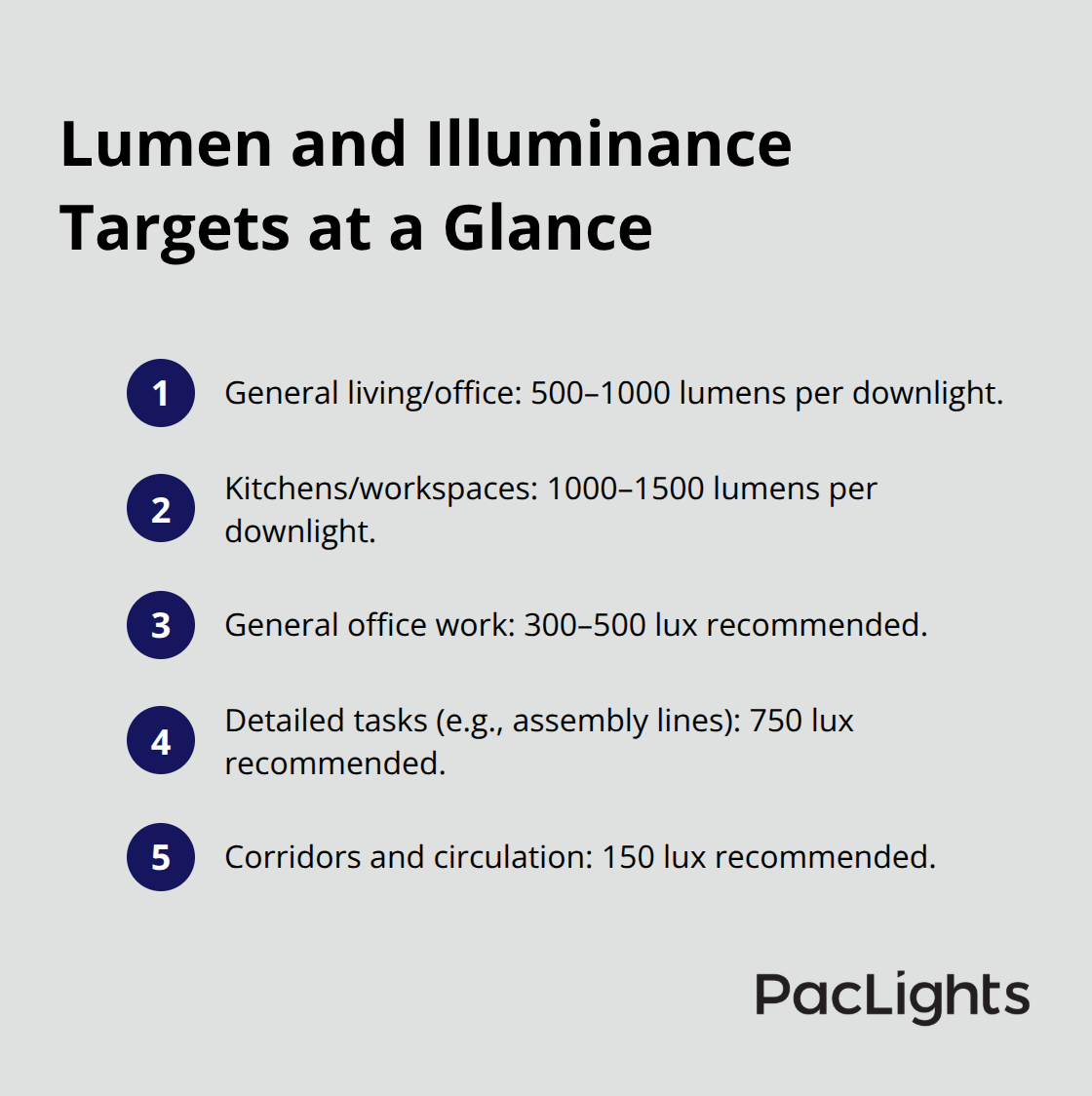
Lumen output tells you brightness, but it’s meaningless without understanding how that light spreads across your space. A 1000-lumen downlight with a narrow 20-degree beam creates intense spotlighting, while the same lumens spread across 60 degrees produces softer ambient lighting. Real-world performance depends on matching lumen output to room size and ceiling height. For general living or office areas, try 500 to 1000 lumens per downlight; kitchens and workspaces often need 1000 to 1500 lumens depending on task requirements. The Illuminating Engineering Society provides specific illuminance standards: 300 to 500 lux for general office work, 750 lux for detailed tasks like assembly lines, and 150 lux for corridors and circulation areas.
Beam Angle Controls Light Distribution
Beam angle selection directly impacts whether you get even coverage or hotspots. A 40 to 60-degree beam works for general ambient lighting, while 20 to 30-degree beams excel at accent lighting or highlighting specific features. Test your spacing with a simple flashlight at fixture height to observe how beam patterns overlap and whether shadows appear at different times of day. This practical approach reveals whether your layout delivers the performance you expect before installation begins.
Color Temperature and Rendering Index Shape Perception
Color temperature affects mood and perceived brightness more than lumen numbers alone. Warm white at 2700 to 3000K feels comfortable in homes and hospitality spaces, while 4000 to 5000K cooler temperatures suit offices where alertness matters. However, color rendering index (CRI) separates adequate lighting from excellent lighting. A CRI of 90 or higher preserves true colors in textiles, skin tones, and artwork; anything below 80 CRI makes whites look dull and colors appear washed out.
Kitchens, bathrooms, and retail spaces absolutely require CRI 90 or higher because poor color rendering frustrates customers and homeowners. Industrial and warehouse facilities benefit from high CRI too-manufacturing quality control and defect detection improve significantly when workers see accurate colors under proper lighting.
Thermal Management Determines Long-Term Efficiency
LED flush mounts reach 120 lumens per watt in premium designs, delivering 60 to 70 percent energy savings compared to older metal halide or fluorescent fixtures. However, poor thermal management kills these benefits. LEDs lose brightness as temperature rises; a fixture running hot delivers fewer lumens over time and burns out faster. Aluminum heat sinks and robust mounting systems keep operating temperatures optimal, preserving rated brightness throughout the fixture’s 50,000-hour lifespan.
Sealed construction protects internals from dust and moisture, preventing unexpected failures that spike maintenance costs. When comparing products, check the thermal design specifications-not just the wattage consumed. A well-engineered 30-watt downlight outperforms a poorly designed 25-watt unit because consistent heat dissipation maintains full lumen output and color stability. Understanding these performance metrics prepares you to evaluate how different fixtures will actually perform in your specific installation environment.
How Flush Mount Downlights Perform Across Different Spaces
Office Environments Support Productivity and Accuracy
Office environments demand consistent, flicker-free lighting that supports productivity without causing eye strain. A commercial office retrofit replacing harsh fluorescents with daylight-mimicking LEDs at 4000K typically reduces energy costs by over 30 percent while improving worker alertness and accuracy. The key is spacing fixtures at roughly one-third of ceiling height from walls; in a standard 2.7-meter office ceiling, this means 0.85 meters from perimeter walls and 1.35 meters between fixtures. Task lighting positioned 10 to 15 centimeters from desk edges prevents shadows on work surfaces, and CRI 90 fixtures ensure documents and colors appear true.
The Illuminating Engineering Society standards guide these spacing choices, and proper thermal design keeps fixtures delivering rated lumens across their entire 50,000-hour lifespan without dimming or color shift. Hospitality lobbies benefit from warm 2700K ambient lighting layered with cooler accent fixtures highlighting architectural features, while guest corridors need 60-degree beam angles and 150 lux illuminance for safe navigation.
Retail Spaces Highlight Products and Drive Sales
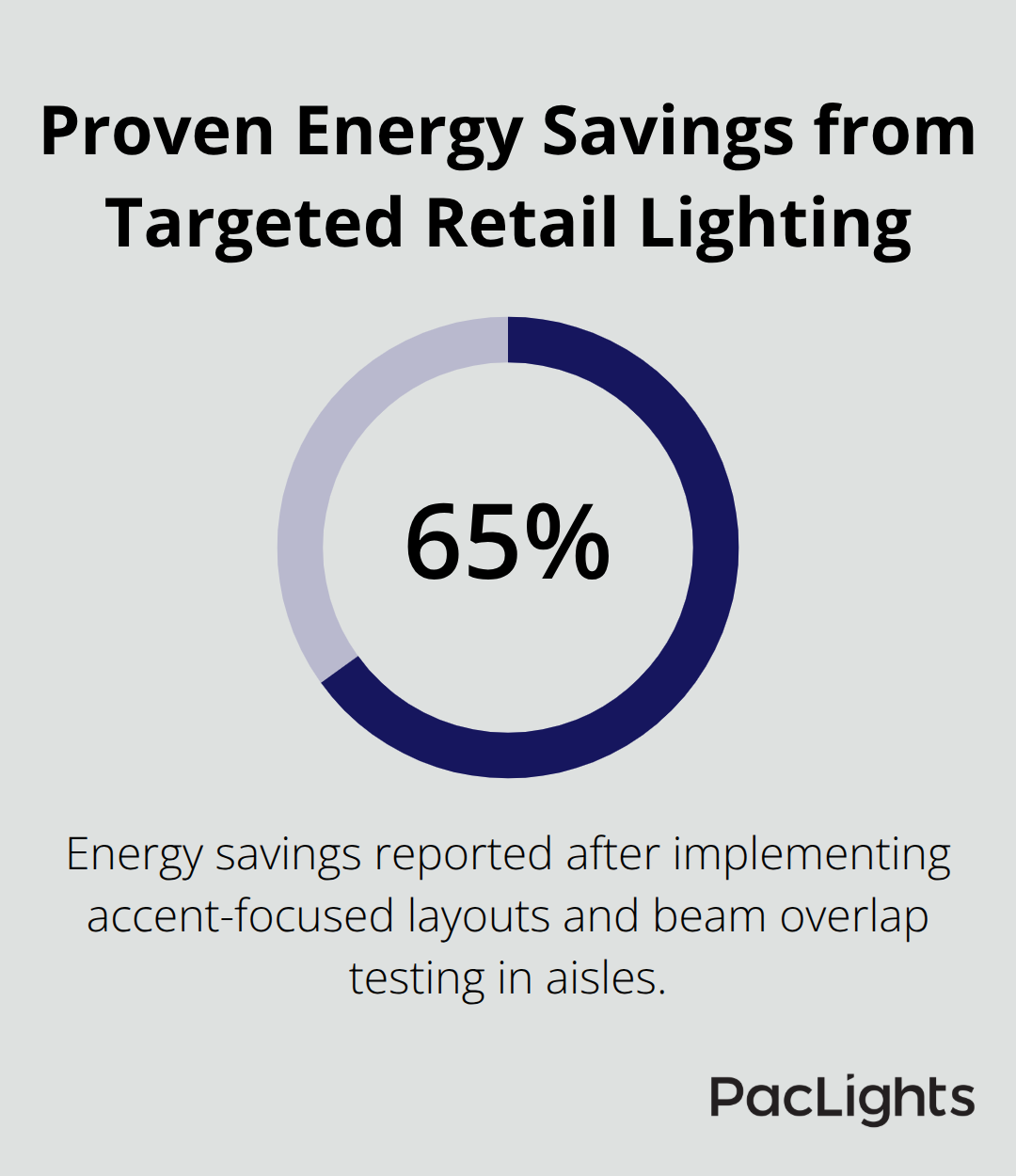
Retail installations strategically position 20 to 30-degree accent downlights to highlight product displays, creating focal points that boost customer engagement and sales while cluster ambient lighting fills shadows. Beam overlap testing with a flashlight at fixture height prevents harsh hotspots that make merchandise look unflattering. A warehouse retrofit implementing this approach reported 65 percent energy savings and improved lighting uniformity across storage aisles.
High CRI fixtures (90 or above) render product colors accurately, which directly influences purchasing decisions. Poor color rendering makes merchandise appear washed out and unappealing, driving customers away regardless of product quality.
Residential Kitchens and Living Spaces Require Layered Lighting
Residential kitchens and workspaces require 1000 to 1500 lumens per downlight with CRI 90 or higher to render food colors and skin tones accurately. Living rooms work well with 500 to 1000 lumens at warm 2700K temperatures that create inviting atmospheres. Moisture-prone zones like bathrooms demand IP-rated downlights to protect against water ingress, and dimmable options let homeowners adjust brightness from bright task lighting to soft relaxation modes.
In all three settings, aluminum heat sinks and sealed construction resist dust and moisture, reducing unexpected failures that interrupt operations and spike maintenance labor costs far beyond the fixture price. These thermal and protective features determine whether your installation delivers consistent performance year after year or requires costly repairs and replacements.
The performance expectations you’ve learned here apply across every installation type, but selecting the right fixture for your specific space requires understanding one more critical factor: how your room’s physical characteristics interact with downlight design.
How Room Characteristics Shape Downlight Performance
Ceiling Height and Room Dimensions Set Spacing Requirements
Your ceiling height and room dimensions determine fixture spacing, lumen requirements, and beam angle selection before you install anything. A 2.4-meter residential ceiling needs fixtures spaced roughly 1.2 meters apart with 0.75 meters clearance from walls, while a 3.0-meter commercial space requires 1.5-meter spacing and 0.9-meter wall distance. These proportions maintain even light distribution and prevent gaps or overlapping hotspots. Calculate your specific spacing by dividing ceiling height by three, then use that distance from walls and between fixtures as your baseline.
Measure your room length and width, note doorways and permanent fixtures, then sketch fixture locations on a floor plan. Run a physical test before committing: position a flashlight at your proposed fixture height and observe how beam patterns overlap at different room locations, checking for dark corners or harsh bright spots at eye level. This walkthrough reveals whether your spacing delivers the performance you expect or needs adjustment.
Surface Reflectance Multiplies Light Effectiveness
Surface reflectance directly impacts how much light actually reaches work surfaces and occupants. White ceilings reflect 80 to 90 percent of light, while dark gray or black ceilings absorb 20 to 40 percent. This difference means a 1000-lumen downlight in a white-ceiling space effectively delivers more usable light than the same fixture in a dark-ceiling room. Paint color matters too: warm beige walls reflect more light than charcoal or deep blue.
When planning your layout, increase lumen output by 20 to 30 percent if your ceiling or walls are darker than medium gray. Industrial facilities often have concrete or metal surfaces that reflect poorly, requiring higher-output fixtures or tighter spacing to achieve the same illuminance standards. The Illuminating Engineering Society standards account for these reflectance differences when calculating proper illuminance levels for your specific environment.
Thermal Management Preserves Brightness Over Time
Thermal management separates fixtures that maintain brightness from those that dim and fail prematurely. LEDs lose 0.5 to 1 percent of brightness for every degree Celsius above 25 degrees, so a fixture running at 70 degrees delivers noticeably less light than one held at 40 degrees. Aluminum heat sinks transfer internal heat away from LED chips, preserving lumen output and extending lifespan beyond the rated 50,000 hours.
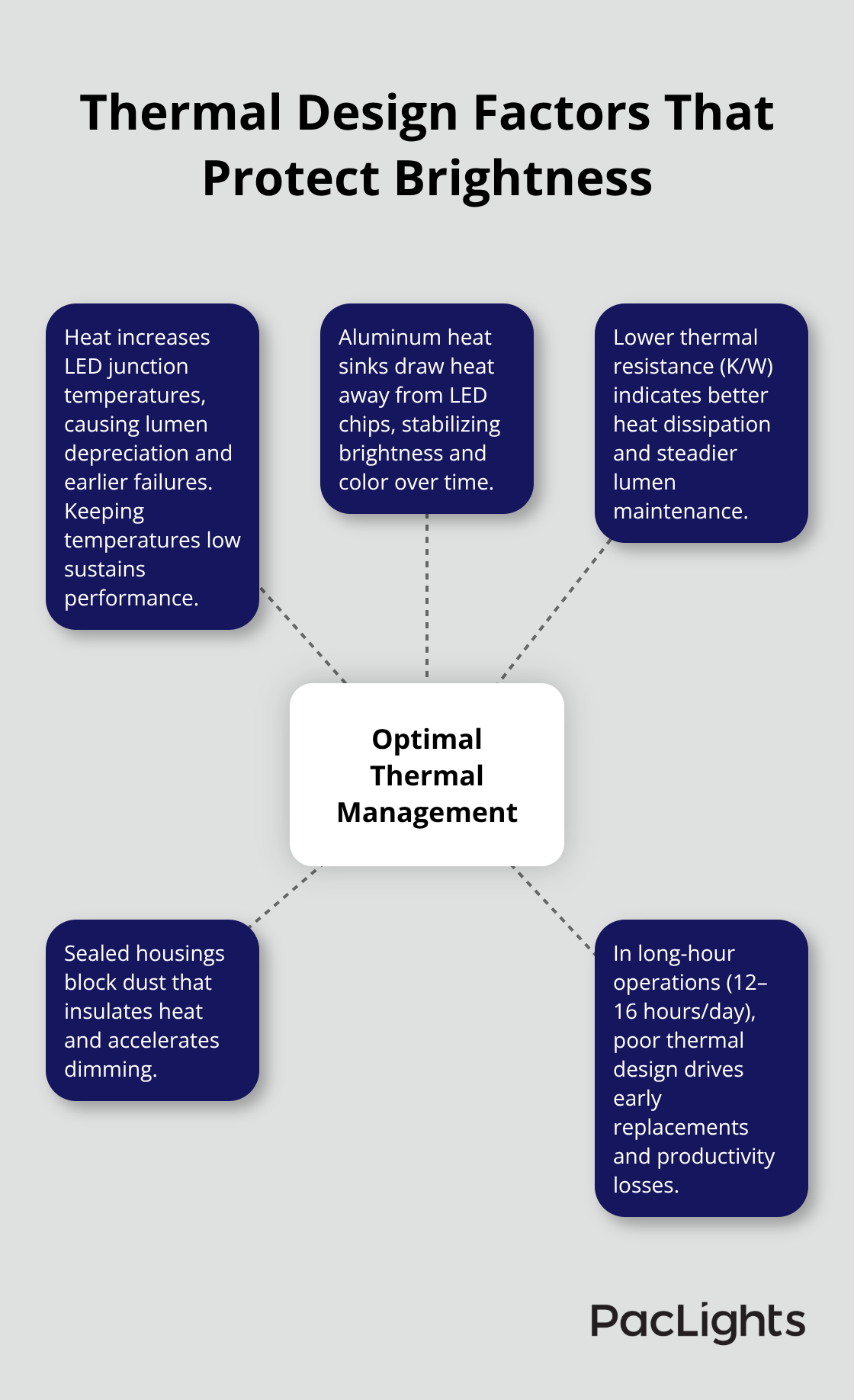
Check product specifications for thermal resistance values measured in Kelvin per watt; lower numbers indicate superior heat dissipation. Sealed metal housings protect against dust buildup, which insulates heat and accelerates brightness loss. In warehouses or manufacturing facilities where fixtures run 12 to 16 hours daily, poor thermal design costs thousands in premature replacements and reduced productivity from inadequate lighting.
Final Thoughts
Real-world flush mount downlight performance hinges on matching fixture specifications to your specific space and maintaining proper thermal management throughout the fixture’s lifespan. The metrics covered here-lumens output, beam angle, color temperature, CRI, and thermal design-directly determine whether your installation delivers consistent brightness, accurate colors, and reliable operation for decades. Selecting the right fixture requires honest assessment of your room dimensions, ceiling height, surface reflectance, and intended use.
Long-term ROI depends on thermal design and sealed construction more than initial purchase price. A premium fixture with superior heat dissipation maintains full brightness across 50,000 hours while a cheaper alternative dims progressively and requires premature replacement. Over a decade, the energy savings from 60 to 70 percent efficiency gains, combined with reduced maintenance labor and fewer replacements, typically recover your investment within three to five years.
We at PacLights understand that flush mount downlight performance extends beyond specifications-it’s about delivering reliable illumination that supports your operations and reduces costs year after year. Our team offers free lighting layout designs and ROI assessments to help you select fixtures matched to your space and calculate realistic long-term savings. Whether you’re retrofitting an existing facility or designing new construction, proper fixture selection and installation setup determine whether your lighting investment performs as expected.
Disclaimer: PacLights is not responsible for any actions taken based on the suggestions and information provided in this article, and readers should consult local building and electrical codes for proper guidance.