

Industrial facilities lose money every day with outdated lighting. Energy bills climb, workers struggle to see properly, and fixtures break down constantly.
Cylinder ceiling light fixtures solve these problems with smart design and reliable performance. We at PacLights built this guide to show you exactly how to upgrade your facility’s lighting system and cut costs while improving safety.
Why Modern Lighting Matters for Your Bottom Line
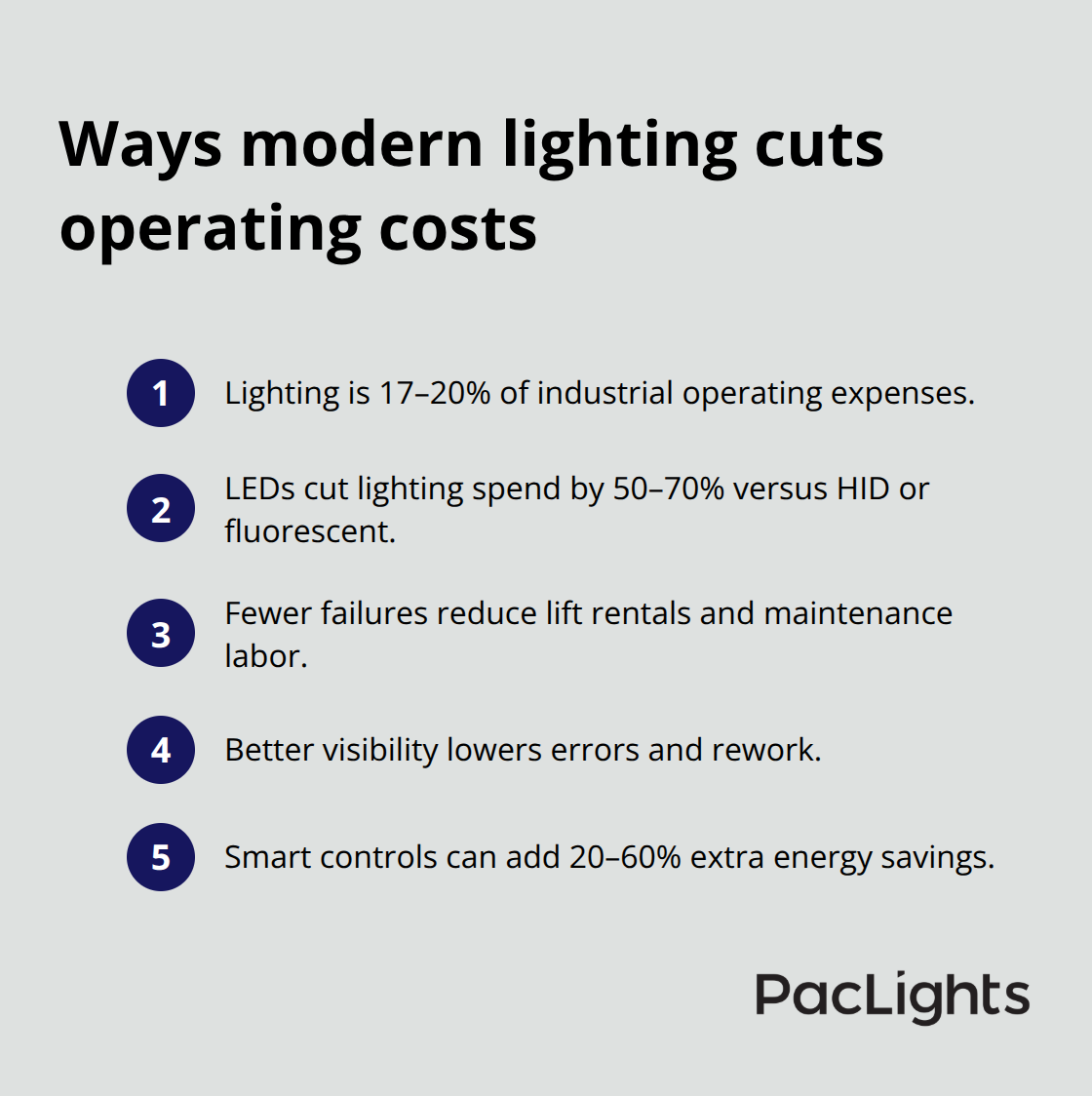
Energy costs drain industrial facility budgets faster than most managers realize. According to the U.S. Department of Energy, lighting accounts for 17 to 20 percent of operating expenses in industrial facilities, making it one of the largest controllable cost categories. A 100,000-square-foot warehouse running 24/7 with older HID or fluorescent fixtures spends $50,000 to $80,000 annually on lighting alone. Switching to LED cylinder ceiling light fixtures cuts that number by 50 to 70 percent, translating to real savings that hit your bottom line immediately.
The Hidden Cost of Equipment Failures
Outdated fixtures fail constantly and replacement becomes expensive. Replacing burned-out bulbs in high-ceiling spaces requires equipment rental, scheduled downtime, and labor costs that compound over months and years. LED cylinder fixtures rated for 50,000 hours or more eliminate most replacement cycles entirely, freeing maintenance crews to focus on production instead of climbing ladders.
How Poor Lighting Affects Worker Performance
Worker productivity plummets under inadequate lighting. Eye strain, headaches, and fatigue from poor visibility increase error rates on assembly lines, in quality control stations, and during precision tasks. Industrial spaces with uneven lighting create shadows around machinery and walkways, raising accident risk and slowing work pace.
Proper illumination at 30 foot-candles for general industrial work, as recommended by the Illuminating Engineering Society, requires fixtures with good optics and directional output. Cylinder fixtures with well-designed diffusers reduce glare while delivering uniform light across work surfaces, eliminating the dead zones that force workers to adjust their position or squint.
Safety Improvements Deliver Measurable Returns
A single preventable accident in a manufacturing facility costs $40,000 to $100,000 in medical bills, lost productivity, and regulatory fines. Upgrading lighting stands as one of the fastest ways to improve safety without major facility redesigns. Proper illumination prevents accidents before they happen, protecting your workforce and your financial performance simultaneously.
The connection between lighting quality and operational results is direct and measurable. Facilities that address lighting deficiencies see immediate improvements in both safety metrics and production output, which sets the stage for understanding what makes cylinder fixtures the right choice for your specific needs.
What Makes Cylinder Fixtures Stand Out in Industrial Settings
Cylinder ceiling fixtures outperform traditional lighting solutions because they deliver practical advantages that directly impact your facility’s operations and expenses. The compact cylindrical design fits into tight ceiling spaces where bulky fixtures simply will not work, giving you flexibility in retrofits and new installations without expensive structural modifications. A standard warehouse with 25-foot ceilings and limited headroom can accommodate cylinder pendants suspended on short chains or rods, whereas recessed or bulky high-bay fixtures demand more vertical clearance. The directional output of cylinder fixtures concentrates light exactly where work happens instead of scattering it across empty space, which means you achieve the 30 foot-candles recommended by the Illuminating Engineering Society using fewer total fixtures and lower wattage. When fixtures are properly spaced at roughly one fixture per 600 to 800 square feet in a typical warehouse, the optics and diffusers eliminate glare and dark zones that plague older HID or fluorescent systems, directly reducing the eye strain and positioning adjustments workers otherwise make constantly throughout shifts.
Durability That Survives Harsh Conditions
Industrial-grade cylinder fixtures handle the punishment that standard commercial lighting cannot tolerate. Fixtures rated IP65 or higher resist moisture and dust ingress, making them suitable for washdown areas, high-humidity storage zones, and facilities exposed to airborne particles from manufacturing processes. Stainless steel options and powder-coated aluminum finishes withstand corrosion in aggressive environments, with quality powder coats lasting 10 to 15 years compared to cheaper finishes that degrade in 2 to 3 years.
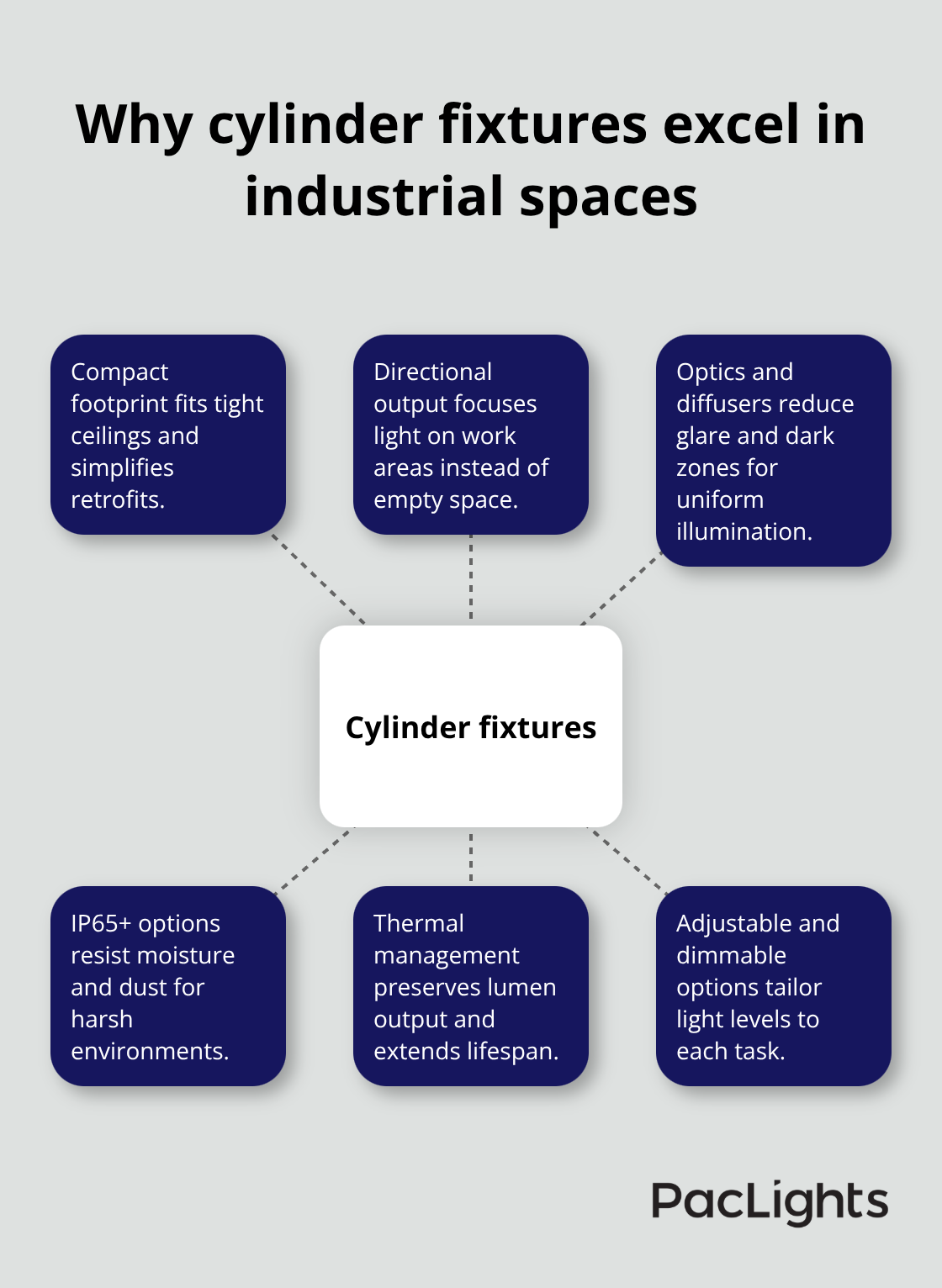
The thermal management built into LED cylinder fixtures preserves lumen output and extends lifespan well beyond the 50,000-hour rating, protecting your investment during the 5- to 10-year ownership cycle where energy savings and reduced maintenance costs compound significantly.
Flexibility for Task-Specific Lighting
Adjustable housings in cylinder fixtures direct light onto workstations, assembly lines, and machinery without requiring complete relocation or rewiring. Color temperature options from 3000K for warm ambient lighting to 5000K for precision tasks give you control over worker alertness and visual accuracy on quality control stations. Dimmable options and smart controls allow you to adapt brightness based on task demands and time of day, cutting energy consumption further when full illumination is unnecessary. Motion sensors and daylight harvesting paired with LED technology deliver 20 to 60 percent additional savings, according to the U.S. Department of Energy, which means your facility can optimize performance while reducing operational strain.
The practical advantages of cylinder fixtures-compact design, durability, and task-specific flexibility-establish them as the foundation for modern industrial lighting. Understanding these core strengths prepares you to evaluate your specific facility needs and select the right fixtures for your operation.
Selecting the Right Fixture for Your Space
Start with ceiling height because it determines fixture type and spacing. Facilities with ceilings below 20 feet work best with flush-mount or short-pendant cylinder fixtures, while spaces above 25 feet benefit from longer pendant suspensions that position light closer to work surfaces. The Illuminating Engineering Society recommends a spacing-to-mounting-height ratio of 1.0 or less, meaning a 30-foot ceiling should have fixtures spaced roughly 30 feet apart. A typical 100-by-200-foot warehouse with 30-foot ceilings requires approximately 60 to 80 cylinder pendants spaced about 25 feet apart to achieve the 30 foot-candles needed for general industrial work. Measure your actual ceiling height, account for any obstructions like ductwork or sprinkler lines, and factor in whether you need clearance for machinery movement or personnel access. If your facility has sloped or irregular ceilings, specify adjustable mounting kits that accommodate these variations without sacrificing light distribution.
Calculate Lumens for Your Specific Tasks
Next, calculate lumens based on the specific task and area size. Assembly work and quality control stations demand 50 to 75 foot-candles, while general storage and corridors function adequately at 20 to 30 foot-candles. Multiply your target foot-candles by the square footage of each zone, then divide by the lumens per fixture to determine how many units you need. Modern LED cylinder fixtures deliver 100 or more lumens per watt, and a 150-watt model typically produces 15,000 lumens, making them far more efficient than older 400-watt metal halide fixtures that generate similar output with triple the energy consumption.
Match Color Temperature to Task Requirements
Color temperature matters for task accuracy: 4000K to 5000K supports high-contrast work where precision matters, while 3000K to 3500K suits general assembly and break areas. Try a color rendering index of 80 or higher, as recommended by ENERGY STAR, to ensure workers see true colors and detect defects reliably. This specification protects your quality control processes and reduces errors that cost time and materials.
Compare Total Cost of Ownership Over Five to Ten Years
LED cylinder fixtures cut energy consumption by 50 to 70 percent compared with HID lamps, according to the U.S. Department of Energy, which translates to roughly $30,000 to $60,000 in annual savings for a large industrial facility. Compare the total cost of ownership over five to ten years, not just the upfront price. A 150-watt LED cylinder fixture costs more initially than an older 400-watt metal halide unit, but the LED fixture runs cooler, lasts 50,000 hours or longer, and requires far fewer maintenance visits. At 24/7 operation, a 50,000-hour lifespan means roughly five to six years between replacements, eliminating the constant bulb changes that plague older systems.
Account for Labor and Maintenance Costs
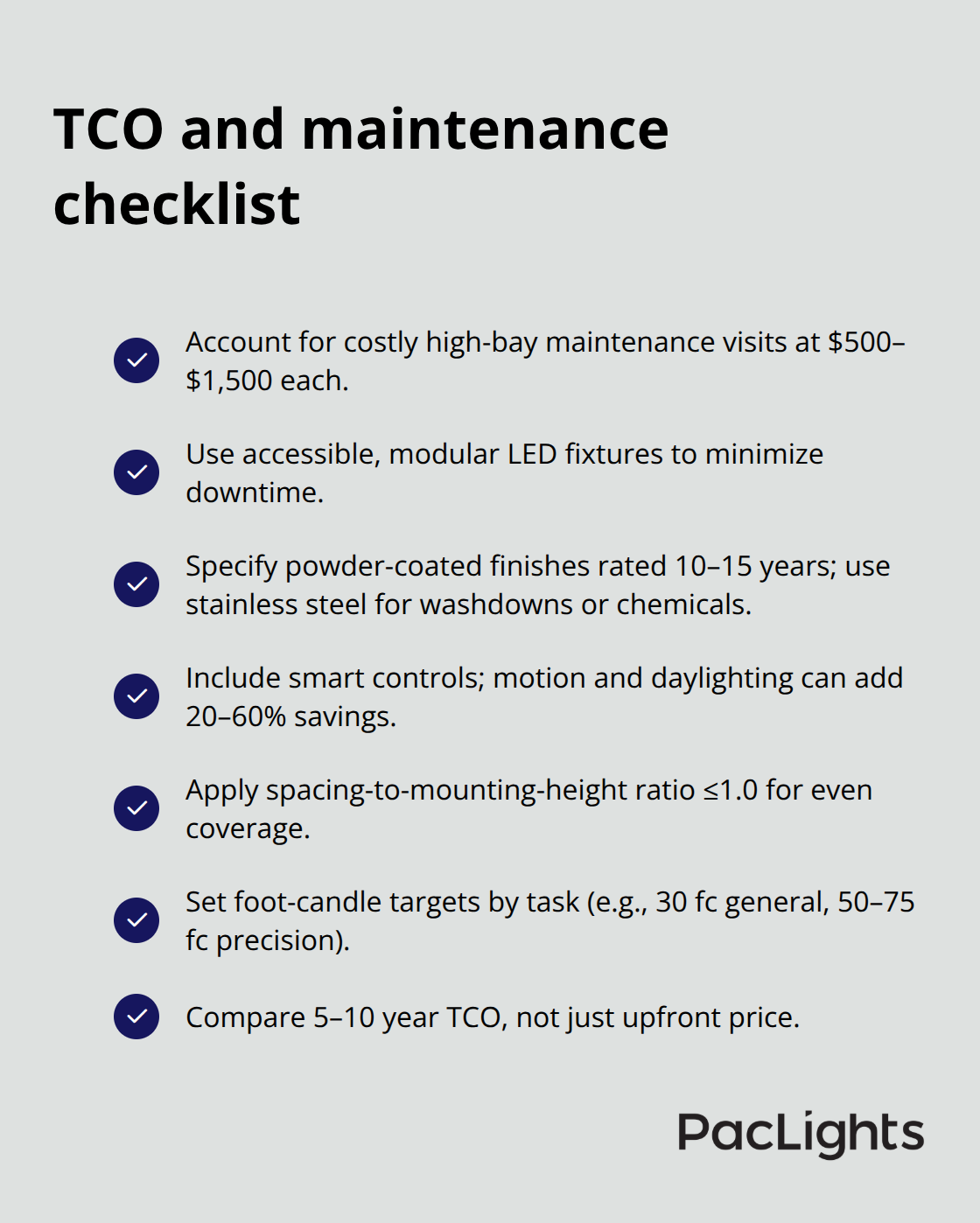
Factor in labor costs for climbing high-bay spaces: each maintenance visit costs $500 to $1,500 when you account for equipment rental, scheduling delays, and production interruptions. LED fixtures with accessible wiring compartments and modular components minimize downtime during the rare maintenance events that do occur. Specify industrial-grade construction with powder-coated finishes rated to last 10 to 15 years in harsh conditions, and request stainless steel components if your facility involves washdowns or chemical exposure. Smart controls including motion sensors and daylight harvesting can reduce energy consumption an additional 20 to 60 percent, according to the U.S. Department of Energy, so include these options in your cost analysis.
PacLights offers free lighting layout designs and ROI assessments that calculate your exact savings based on your facility’s operating hours, current energy rates, and upgrade costs, helping you make decisions grounded in real numbers rather than estimates.
Final Thoughts
Cylinder ceiling light fixtures deliver measurable improvements across safety, energy consumption, and operational costs. The 50 to 70 percent energy reduction compared with HID lamps translates directly into thousands of dollars saved annually, while the 50,000-hour lifespan eliminates constant maintenance cycles that drain labor budgets. Workers benefit from uniform illumination that reduces eye strain and improves accuracy on precision tasks, which compounds into fewer errors and faster production cycles.
A facility spending $50,000 to $80,000 annually on outdated lighting recovers that investment within two to three years through energy savings alone, then pockets the remaining savings for the next five to ten years of operation. When you factor in reduced maintenance labor, fewer equipment rentals for high-ceiling work, and improved worker productivity, the return accelerates significantly. Start by evaluating your current lighting system-measure illumination levels in key work areas, document how often fixtures fail, and calculate your annual spending on energy and maintenance.
We at PacLights specialize in helping industrial facilities make this transition with precision and deliver customized cylinder ceiling light fixture solutions tailored to your specific ceiling height, task requirements, and environmental conditions. Our team provides free lighting layout designs and ROI assessments that show your exact savings based on your facility’s operating hours, current energy rates, and upgrade costs. Contact us today to schedule your facility assessment and discover how much you can save.
Disclaimer: PacLights is not responsible for any actions taken based on the suggestions and information provided in this article, and readers should consult local building and electrical codes for proper guidance.