

Commercial spaces demand lighting that works as hard as your business does. Recessed flush mount lights deliver exactly that-a polished look paired with reliable, even illumination across any room.
At PacLights, we’ve seen firsthand how the right fixture choice impacts both aesthetics and your bottom line. This guide walks you through why these lights matter and how to implement them effectively.
Why Recessed Flush Mounts Outperform Other Commercial Fixtures
The Aesthetic Advantage of Flush Design
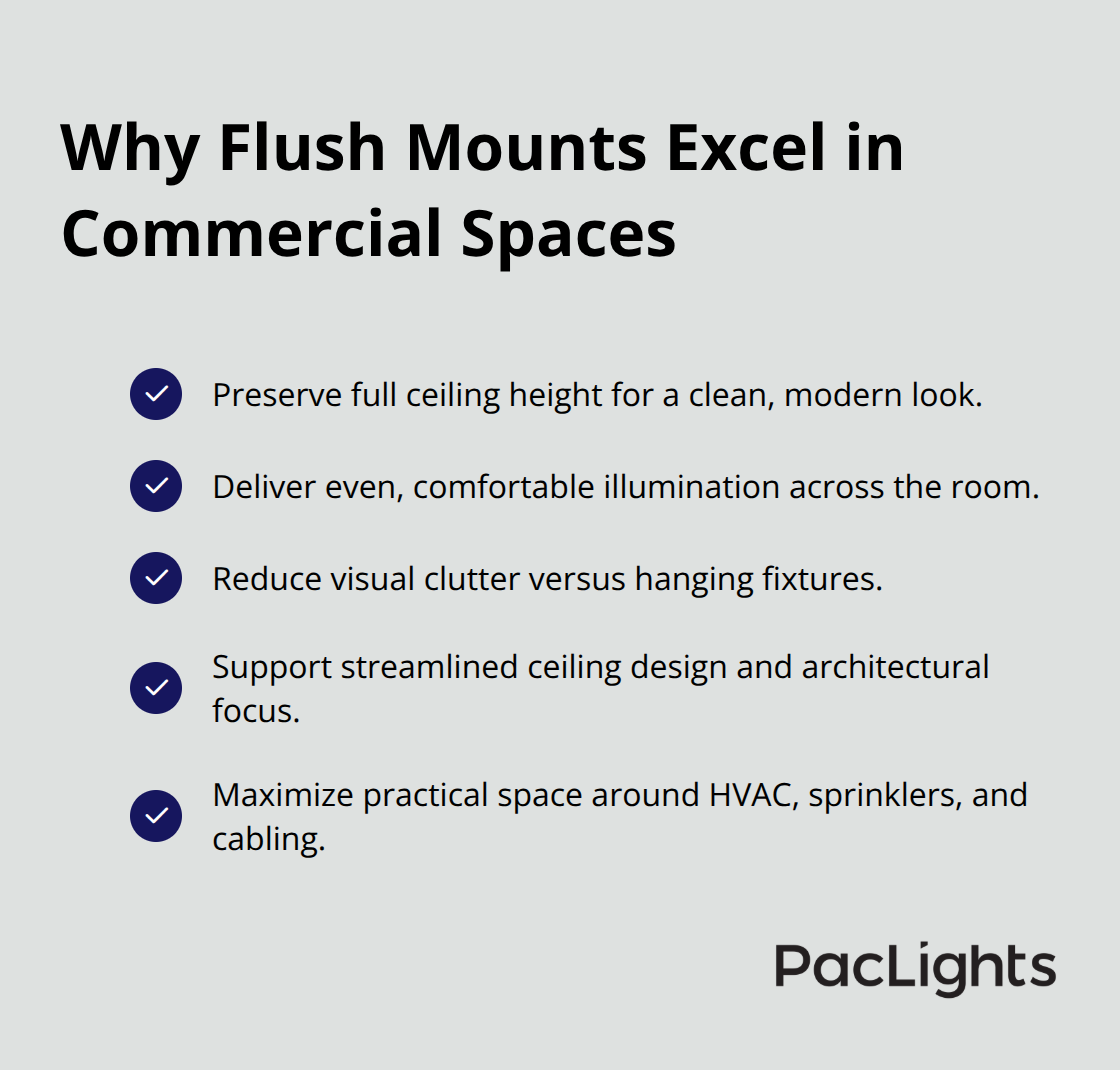
Recessed flush mount lights sit flush against the ceiling plane with zero visible gap, delivering the clean architectural lines that modern commercial spaces demand. Unlike semi-flush or pendant fixtures that hang below the ceiling and consume valuable headroom, flush mounts maintain your full ceiling height while projecting a polished, intentional aesthetic. This matters in commercial settings where every inch of vertical space affects how a room feels and functions. A 10-foot ceiling with a pendant fixture dropping 12 inches effectively becomes a 9-foot ceiling in perception and usable space. Flush mounts eliminate that problem entirely.
The visual payoff is substantial: offices, retail showrooms, and hospitality spaces with flush mount lighting feel more refined and contemporary than those relying on surface-mounted or pendant alternatives. The seamless integration also simplifies ceiling design, allowing structural elements and architectural details to take center stage rather than competing with visible fixture hardware.
Superior Light Distribution in Commercial Settings
LED recessed fixtures typically deliver 600–1000 lumens per unit while consuming only 9–15 watts, according to Department of Energy data, matching the brightness of 60-watt incandescent bulbs with a fraction of the energy draw. Proper spacing prevents the dark spots and glare hotspots that plague poorly planned installations. For a 10-by-12-foot office, spacing fixtures roughly 4–6 feet apart horizontally creates even coverage without shadows or bright patches.
The Illuminating Engineering Society provides specific photometric guidelines for spacing based on ceiling height and room dimensions, ensuring your layout achieves uniform illumination across the entire floor. This technical precision translates to workspaces where employees experience consistent, comfortable light throughout the day.
Practical Space Efficiency for Commercial Ceilings
Low ceilings-common in commercial retrofits-benefit tremendously from flush mounts because they maintain clearance for HVAC ducts, sprinkler systems, and cable runs that typically crowd commercial ceilings. A 9-foot ceiling with properly spaced 6-inch recessed fixtures delivers strong, even light without the visual clutter of hanging elements. This combination of clean aesthetics, predictable light distribution, and practical space efficiency makes flush mounts the superior choice for commercial environments where function and appearance must work together.
The next section examines how these fixtures translate into measurable energy savings and long-term cost reductions for your operation.
Energy Efficiency and Cost Savings with Recessed Flush Mount Lights
LED Technology Reduces Energy Consumption
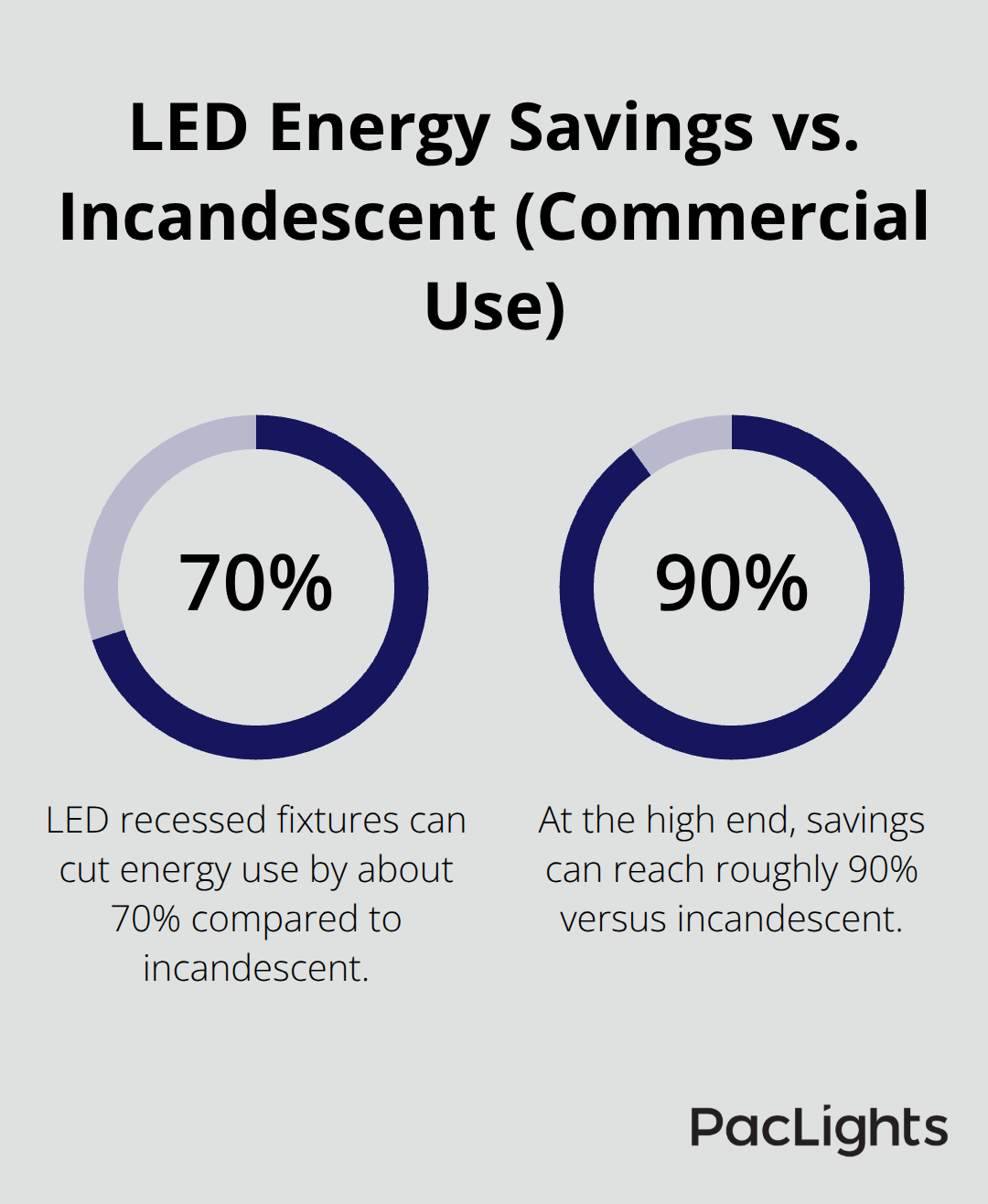
LED recessed fixtures consume 70–90% less energy than incandescent equivalents, according to the Department of Energy and ENERGY STAR data. For a commercial space running 10 fixtures for 12 hours daily, switching from 60-watt incandescent to 12-watt LED recessed units cuts annual energy consumption by roughly 17,500 kilowatt-hours. At an average commercial electricity rate of $0.12 per kWh, that translates to $2,100 in annual savings per 10 fixtures. Scale this across a 2,000-square-foot office or retail space with 40–50 fixtures, and the math becomes compelling: annual utility reductions easily exceed $8,000–$10,000.
These numbers assume standard operating hours; spaces with longer hours or higher local rates see even steeper savings.
Lower Maintenance Requirements and Lifespan Benefits
LED recessed lights last 25,000–50,000 hours before significant lumen depreciation occurs. In practical terms, a fixture running 12 hours daily lasts 5–11 years without replacement. Incandescent bulbs demand replacement every 1,000–2,000 hours, forcing frequent maintenance cycles that disrupt operations and accumulate labor costs. Commercial facilities with high ceilings face additional expenses: accessing fixtures for bulb changes requires scissor lifts or ladders, multiplying both material and personnel costs. LED fixtures eliminate this burden almost entirely. A 5,000-square-foot commercial space might spend $500–$800 annually on bulb replacements with traditional fixtures; LED recessed systems reduce that to near zero for a decade. When you factor in labor time, facility disruption, and inventory management, the maintenance advantage extends well beyond the bulb cost itself.
ROI Potential Through Reduced Utility Bills
Upfront costs for LED recessed fixtures run higher than outdated alternatives, but payback timelines prove short in commercial settings. A typical retrofit installing 50 fixtures costs $3,000–$5,000 in materials and labor. Combined energy and maintenance savings of $8,000–$10,000 annually mean full ROI occurs within 6–8 months. After that point, every month delivers pure operational savings. Over a 10-year period, a modest retrofit generates $75,000–$95,000 in cumulative savings. This financial reality explains why forward-thinking commercial operators prioritize fixture upgrades: the numbers aren’t theoretical-they’re verifiable line-item reductions on utility bills and maintenance budgets.
The financial case for LED recessed fixtures is clear, but successful implementation requires careful attention to how you plan and install these systems. The next section covers the technical decisions that determine whether your installation delivers those projected savings and performs reliably for years to come.
Installation Considerations and Best Practices
Ceiling Type and Structural Requirements
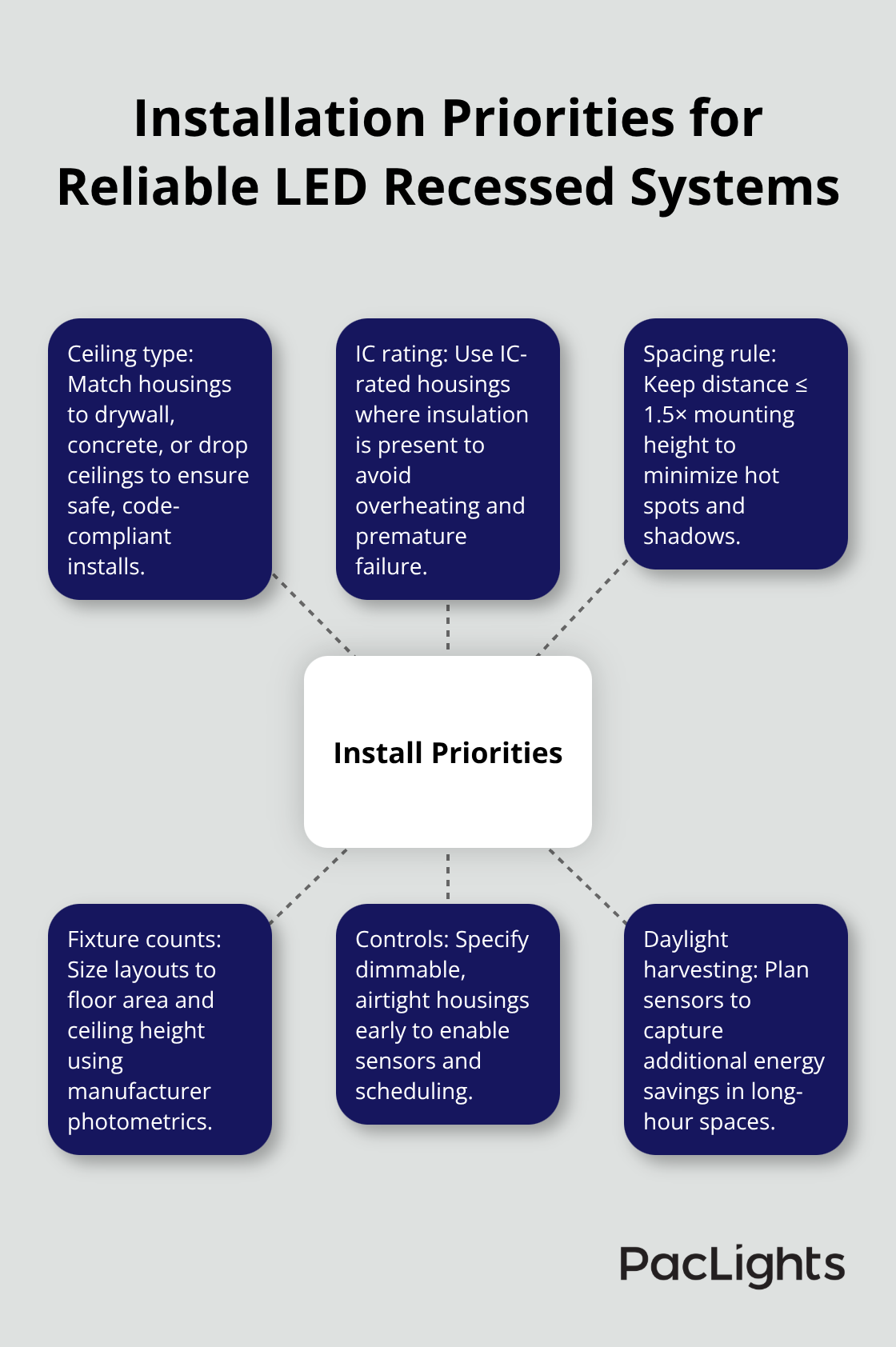
Successful recessed flush mount installations start with understanding your ceiling structure. Drywall ceilings with accessible joists allow standard housing installation, but concrete or drop-ceiling systems require different approaches entirely. Concrete decks demand concrete-rated housings with proper anchoring systems, adding $50–$100 per fixture compared to standard options. Drop ceilings present a unique challenge: flush mounts sit within the tile plane, so you need remodeling housings designed specifically for that application. These cost roughly $30–$60 more per unit than new-construction housings but eliminate the need for structural reinforcement. Confirm your ceiling type with your facilities team before ordering any fixtures. A commercial retrofit that assumes standard framing but encounters concrete decking mid-project becomes expensive quickly.
Insulation contact ratings matter significantly. If your ceiling cavity contains thermal insulation, you must use IC-rated housings or risk overheating and shortened fixture life. Non-IC fixtures in insulated ceilings can fail within 2–3 years, negating your energy savings entirely. Check your building plans or have an electrician inspect the cavity before finalizing your fixture specifications.
Spacing and Layout Planning
Spacing determines whether your installation delivers even light or creates visible hot spots and shadows. The Illuminating Engineering Society provides specific spacing formulas based on ceiling height and room dimensions, but the practical rule is straightforward: never exceed a distance equal to 1.5 times your fixture height above the work plane. For a 9-foot ceiling with standard 4-inch fixtures, spacing should not exceed 13–14 feet between units. For 6-inch fixtures, you can stretch to 16–18 feet. These numbers assume standard 2700K–3000K warm white color temperature; if you use cooler 4000K or 5000K temperatures for task-heavy spaces like warehouses, tighter spacing prevents perceived darkness in outer areas.
A 10,000-square-foot retail floor typically needs 60–80 fixtures depending on ceiling height and product display requirements. Test layouts using photometric data from your fixture manufacturer, not guesswork. Most commercial LED manufacturers provide free layout tools that show exactly where light falls and at what intensity.
Integration with Lighting Control Systems
Control system integration should happen at the planning stage, not after installation. If you plan to add occupancy sensors or daylight harvesting later, specify airtight dimmable housings now. Retrofit dimming retrofits cost 40–60% more than installing dimmable fixtures during initial construction. For commercial spaces running 12+ hours daily, daylight harvesting alone recovers 10–20% of your annual lighting energy consumption according to ENERGY STAR data.
Smart dimmers from manufacturers like Lutron Caseta or Leviton allow centralized scheduling, meaning you can dim fixtures by zone during low-occupancy periods or reduce output when natural light is sufficient. This layered control approach transforms your recessed flush mount system into a dynamic energy management tool that adapts to actual usage patterns rather than fixed schedules.
Final Thoughts
Recessed flush mount lights solve the core problem that plagues most commercial spaces: the need for polished aesthetics without sacrificing function or budget. These fixtures deliver clean architectural lines, even light distribution, and measurable cost reductions that compound over years of operation. The 70–90% energy savings compared to incandescent systems, combined with 25,000–50,000 hour lifespans, create financial outcomes that justify the upfront investment within months rather than years.
Modern commercial lighting strategy increasingly centers on systems that adapt to actual usage patterns rather than fixed schedules. Recessed flush mount lights paired with occupancy sensors and daylight harvesting controls transform your ceiling into an active energy management tool. This approach aligns with how forward-thinking facilities operate today: capturing savings through intelligent automation rather than relying on manual adjustments or outdated fixture technology.
At PacLights, we understand that commercial lighting decisions involve balancing performance, appearance, and financial reality. We offer energy-efficient recessed downlights and advanced lighting controls designed specifically for facilities like yours, plus free lighting layout designs and ROI assessments to guide your investment decisions. Contact PacLights to explore how recessed flush mount lighting can work for your operation and get a customized analysis of your potential savings.
Disclaimer: PacLights is not responsible for any actions taken based on the suggestions and information provided in this article, and readers should consult local building and electrical codes for proper guidance.