

Selecting the right interior building lights transforms any commercial space from functional to exceptional. Poor lighting choices lead to higher energy costs, reduced productivity, and maintenance headaches.
We at PacLights see businesses struggle with this decision daily. The key lies in matching fixture types, efficiency ratings, and control features to your specific space requirements.
Which Interior Fixture Type Fits Your Commercial Space
High Bay Solutions for Warehouses and Manufacturing
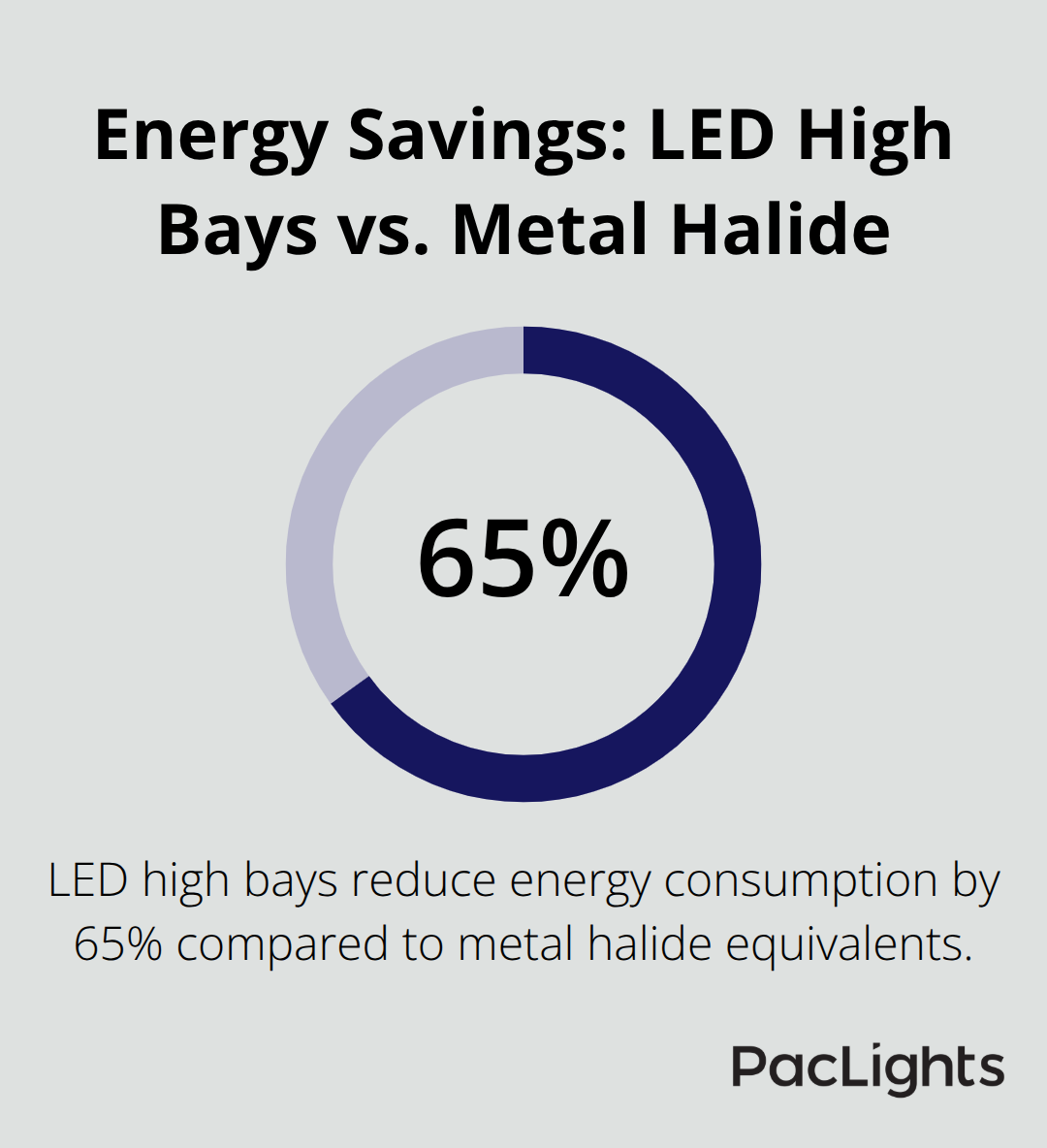
High bay lights handle spaces with ceiling heights above 20 feet where standard fixtures fail to deliver adequate illumination. These powerful units produce 15,000 to 40,000 lumens and mount at heights from 20 to 40 feet. Warehouses typically require 30-50 foot-candles for general storage areas, while manufacturing floors need 50-100 foot-candles for detailed work. LED high bays consume 65% less energy than metal halide equivalents while they provide superior light distribution patterns that eliminate dark spots between aisles.
Office Environments with Troffers and Flat Panels
Troffers integrate seamlessly into standard drop ceiling grids, which makes them the dominant choice for office environments with 8 to 12-foot ceilings. A 2×4 foot troffer produces 3,000 to 5,000 lumens and covers approximately 64 square feet of workspace. LED panel lights offer a sleeker profile with edge-lit technology that distributes light evenly across the entire surface. Office spaces require 30-50 foot-candles for general tasks and 75-100 foot-candles for detailed computer work. Modern LED panels last 50,000 hours compared to 20,000 hours for fluorescent tubes (a 150% improvement), which reduces maintenance costs by 60%.
Recessed Downlights for Clean Aesthetics
Recessed lights work effectively in retail spaces, corridors, and reception areas where clean aesthetics matter most. These fixtures mount flush with the ceiling and typically produce 1,000 to 3,000 lumens per unit. The flush installation creates unobstructed sightlines while it provides focused illumination for specific areas or tasks.
Linear Strip Lights for Continuous Applications
Linear strip lights excel in continuous runs along hallways, under cabinets, or accent applications. Strip lights consume only 8-12 watts per foot while they deliver consistent illumination without gaps or shadows that plague individual fixtures. These versatile fixtures adapt to various mounting configurations (surface, recessed, or suspended) and connect end-to-end for seamless light distribution.
Once you understand which fixture types match your space requirements, the next step involves evaluating the technical specifications that determine performance and operating costs.
Key Factors to Consider When Selecting Interior Lights
Calculate Your Space Requirements First
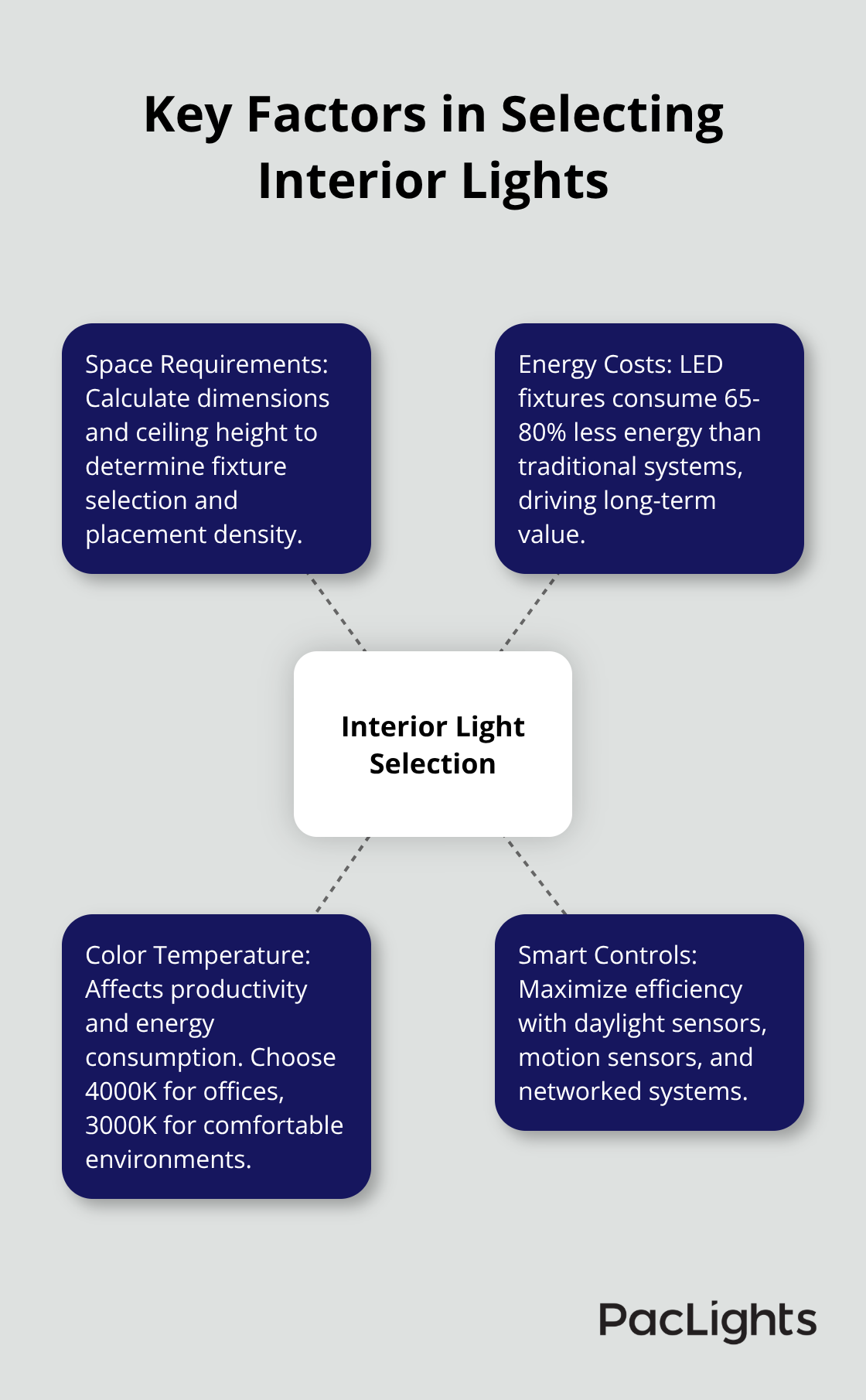
Space dimensions and ceiling height directly determine fixture selection and placement density. Rooms with 8-foot ceilings require different solutions than 20-foot warehouse spaces. The Illuminating Engineering Society establishes that offices need 30-50 foot-candles for general tasks, while manufacturing areas require 50-100 foot-candles. A 1,000 square foot office with 10-foot ceilings needs approximately 30,000-50,000 total lumens distributed across multiple fixtures. Higher ceilings above 15 feet demand fixtures with narrower beam angles to concentrate light effectively at floor level, which prevents light loss and maintains required illumination levels.
Energy Costs Drive Long-Term Value
LED fixtures consume 65-80% less energy than traditional fluorescent or metal halide systems while they deliver superior performance. A 400-watt metal halide high bay costs approximately $175 annually to operate at $0.10 per kWh, while a 150-watt LED equivalent costs only $65 annually (a $110 annual savings per fixture). The 50,000-hour lifespan of quality LED fixtures eliminates frequent bulb replacements that plague fluorescent systems every 20,000 hours.
Color Temperature Impacts Performance and Costs
Color temperature selection affects productivity and energy consumption simultaneously. Offices perform best with 4000K lights for alertness, while 3000K creates comfortable environments in break rooms and reception areas. Cooler temperatures above 5000K increase energy draw without productivity benefits in most commercial applications. Warmer temperatures below 3000K reduce alertness in task-oriented environments.
Smart Controls Maximize Efficiency Returns
Daylight sensors reduce energy consumption by 20-40% in perimeter zones with natural light availability. Motion sensors in storage areas and corridors cut energy use by another 30-50% during unoccupied periods. Networked controls allow zone-based management that adapts to occupancy patterns and saves 15-25% compared to standard switches (making them essential for large facilities).
These technical specifications form the foundation for smart fixture selection, but advanced control features can multiply your efficiency gains and operational flexibility.
Advanced Features That Enhance Interior Lighting Performance
Daylight Sensors Cut Energy Bills by 40%
Daylight sensors automatically dim or shut off fixtures when natural light meets illumination requirements. These systems deliver energy savings of 20-40% in perimeter zones according to the Department of Energy. Photocells respond within 30 seconds to changing conditions and work most effectively in spaces with windows that face south or west. Warehouses with skylights see the highest returns and often reduce daytime lighting loads by 50% during peak sun hours. The sensors cost $50-150 per zone but pay for themselves within 18 months through reduced electricity consumption.
Motion Detection Eliminates Waste in Unoccupied Areas
Motion sensors slash energy consumption by 30-50% in storage areas, corridors, and conference rooms where occupancy varies throughout the day. Advanced occupancy sensors detect movement up to 2,000 square feet and maintain lights for 10-30 minutes after the last detected motion. The California Energy Commission reports that motion controls reduce annual lighting energy use by 35% in office buildings. Dual-technology sensors combine infrared and microwave detection to eliminate false triggers that frustrate users and reduce energy savings.
Networked Controls Deliver Building-Wide Intelligence
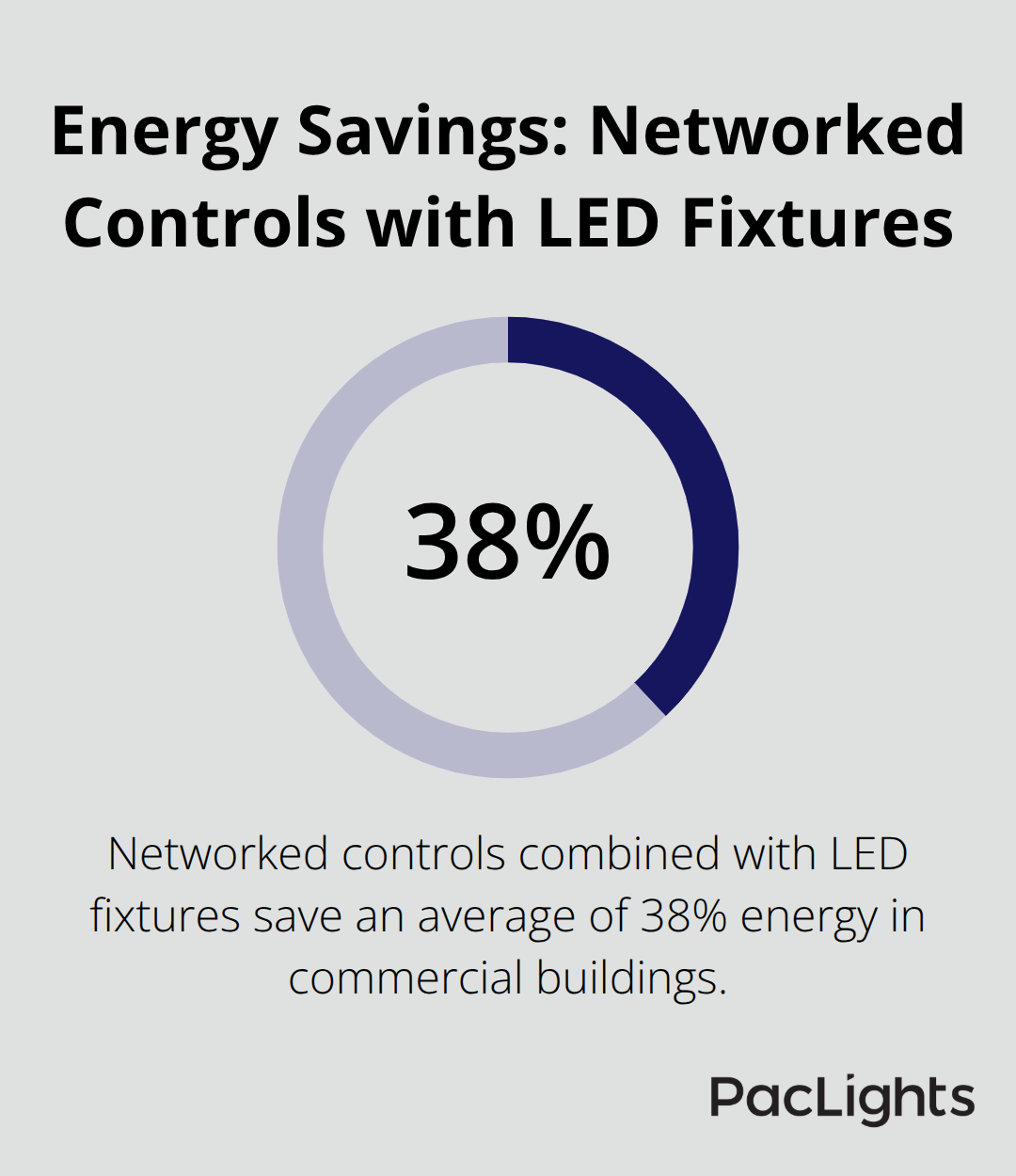
Networked lighting systems connect fixtures through wireless protocols or power line communication. These systems enable zone-based control that adapts to real occupancy patterns. The systems reduce energy consumption by 15-25% compared to standard switches while they provide detailed usage data for facility management decisions. The National Electrical Manufacturers Association confirms that networked controls in commercial buildings achieve average energy savings of 38% when combined with LED fixtures.
Dimming Capabilities Maximize Flexibility
Dimming controls allow precise light level adjustments that match task requirements and save additional energy. Modern LED fixtures with 0-10V dimming capability reduce power consumption proportionally with light output (a 50% dim level consumes approximately 50% of full power). Conference rooms benefit from presentation modes that dim lights to 20% for projector visibility, while open offices use task tuning that adjusts zones to 70-80% during computer work periods.
Final Thoughts
Interior building lights transform commercial spaces when you match fixture types to specific requirements and ceiling heights. High bay lights handle warehouses above 20 feet, troffers optimize office environments, and recessed downlights create clean aesthetics for retail spaces. Professional layout design eliminates costly mistakes and maximizes performance through precise calculations and strategic placement.
Quality LED systems with smart controls deliver ROI within 18-36 months through reduced energy consumption and maintenance costs. LED fixtures consume 65-80% less energy than traditional systems while they last 50,000 hours compared to 20,000 hours for fluorescent alternatives. Advanced controls like daylight sensors and motion detection can reduce energy consumption by an additional 35-50% in most commercial applications.
We at PacLights help businesses select the right interior building lights for their specific needs. Our team provides technical guidance on fixture selection and energy-efficient solutions that reduce operating costs. Contact us to discuss your commercial space requirements and explore options that deliver measurable returns (while reducing your environmental impact).
Disclaimer: PacLights is not responsible for any actions taken based on the suggestions and information provided in this article, and readers should consult local building and electrical codes for proper guidance.