

Server rooms generate intense heat and demand precise visibility for maintenance work. Poor lighting creates safety risks, wastes energy, and reduces equipment lifespan.
At PacLights, we’ve developed rack illumination strategies that transform how data centers operate. This guide shows you how to implement lighting solutions that cut energy costs while improving safety and performance.
Why Specialized Lighting Matters in Server Rooms
The Heat and Visibility Problem
Server rooms operate at the intersection of three critical demands: managing extreme heat, maintaining visibility for repairs, and controlling operational costs. Standard commercial lighting fails on all three fronts. Generic ceiling fixtures cast shadows across equipment, create hot spots where heat concentrates, and run at full brightness 24/7 regardless of actual need.
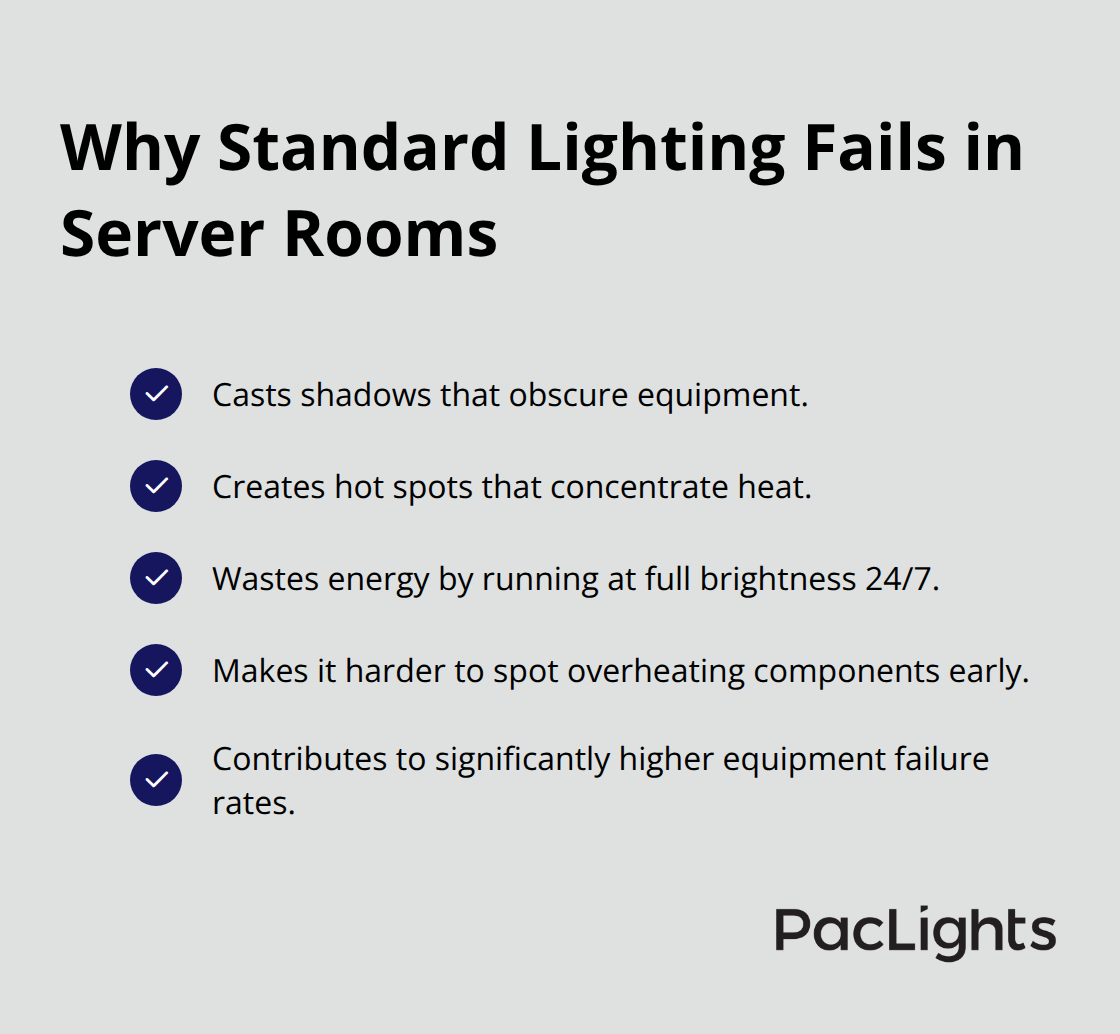
Poor lighting prevents technicians from identifying overheating components until damage occurs, which explains why data centers using conventional lighting report equipment failures 30-40% more frequently than facilities with precision rack illumination.
The visibility problem extends beyond convenience. When maintenance staff cannot see cable connections clearly, they make installation errors that compromise airflow patterns and thermal management. A single misplaced cable reduces cooling efficiency by up to 15% in a localized area, according to studies from the Uptime Institute, forcing HVAC systems to work harder and consume more electricity.
Energy Consumption and Lighting Efficiency
Data centers account for roughly 1-2% of global electricity use, with cooling and lighting representing significant portions of that load. Upgrading to high-bay LED fixtures with motion sensors cuts lighting energy consumption by 60-75% compared to traditional fluorescent systems. This shift matters because every watt saved in lighting reduces the cooling load that HVAC systems must handle.
PacLights offers high-bay and linear LED fixtures with optional motion sensors and daylight controls that optimize energy use in server environments. These solutions provide real-time visibility into infrastructure while reducing electricity bills substantially.
Equipment Lifespan and Thermal Management
Heat kills server components faster than any other factor. When technicians see temperature indicators, cable routing, and airflow patterns clearly, they catch thermal issues before escalation occurs. Proper illumination also enables faster troubleshooting during outages, reducing mean time to repair from hours to minutes. The ROI typically materializes within 18-24 months through energy savings alone, before accounting for prevented equipment failures and reduced downtime costs.
Networked lighting controls (such as those offered by PacLights) give operators real-time adjustments to match actual facility needs. This precision approach transforms how data centers balance performance, safety, and cost.
Lighting Solutions That Actually Work in Server Rooms
High-Bay and Linear LED Fixtures Eliminate Shadows
High-bay and linear LED fixtures form the foundation of effective rack illumination because they deliver uniform light across dense equipment without the shadows and hot spots that plague traditional fluorescent systems. Standard ceiling-mounted fixtures cast shadows directly over server racks, forcing technicians to use flashlights during maintenance work and creating safety hazards. High-bay LEDs mounted strategically above rack rows eliminate these shadows entirely, providing 500-1000 lux of consistent illumination across equipment faces.
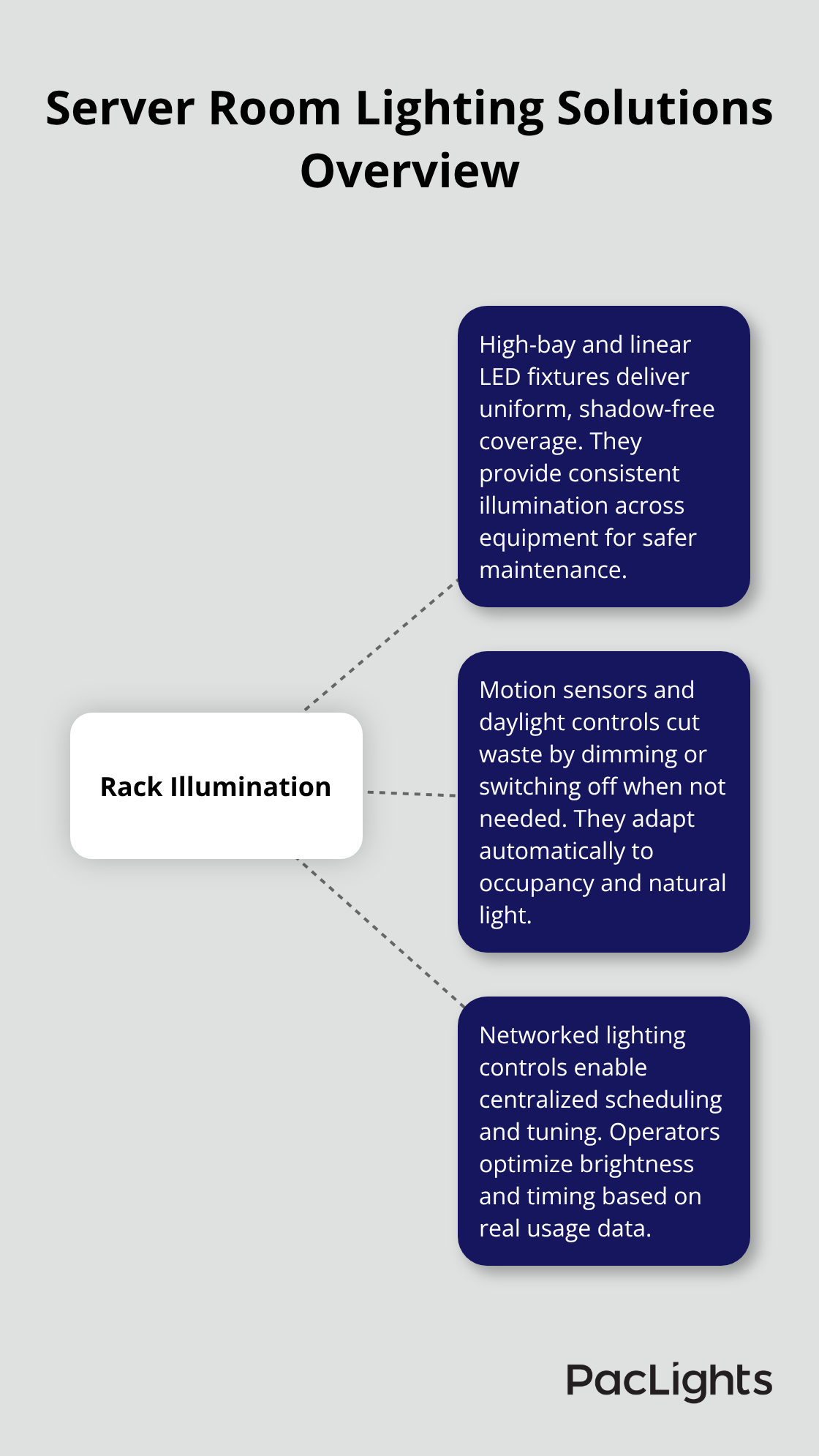
Linear LED strips installed horizontally between or alongside racks add targeted brightness exactly where technicians need visibility for cable management and component identification. The combination reduces eye strain during extended maintenance sessions and cuts installation errors that compromise airflow patterns.
Motion Sensors and Daylight Controls Cut Energy Waste
Motion sensors integrated into fixtures represent the most practical efficiency gain available-they reduce lighting runtime by 60-75% in facilities where technicians work intermittently rather than continuously. Daylight controls automatically dim fixtures when natural light enters through windows or skylights, preventing the wasteful practice of running full brightness during daylight hours.
A data center with motion sensors and daylight controls typically reduces lighting energy consumption by 40-50% compared to facilities running fixtures at constant brightness 24/7. These passive controls require no operator intervention and adapt automatically to changing conditions throughout the day.
Networked Lighting Controls Enable Dynamic Optimization
Networked lighting controls elevate precision rack illumination from static efficiency to dynamic optimization. These systems let operators adjust fixture brightness, color temperature, and scheduling through centralized software rather than manual switches or timers. Real-time adjustments mean facility managers can dim sections during low-activity periods, increase brightness during major maintenance windows, and respond instantly to equipment issues that require visual inspection.
This data-driven approach identifies which areas consume excessive energy, which fixtures require maintenance, and which zones could benefit from additional illumination. Facilities implementing networked controls report 15-25% additional energy savings beyond what motion sensors and daylight controls achieve alone, because operators can continuously refine lighting schedules based on actual usage patterns rather than assumptions.
PacLights offers advanced lighting controls that integrate with building management systems, providing operators with visibility into energy consumption patterns and fixture performance across the entire facility. With these systems in place, your facility moves from reactive maintenance to predictive optimization-the next step involves designing a layout that maximizes these technological advantages.
Designing an Effective Rack Lighting Layout
Identify Lighting Gaps Through Visual Inspection
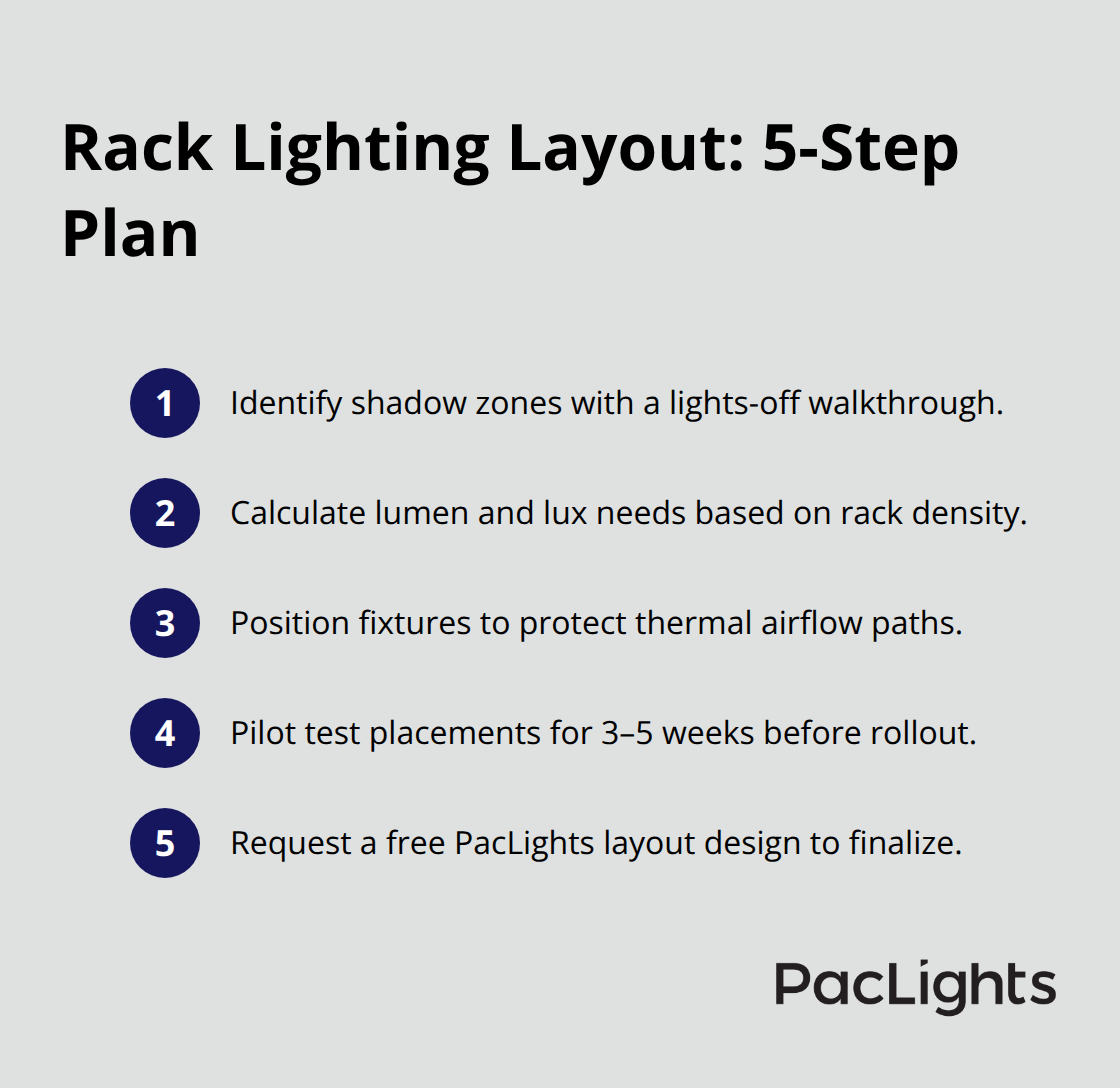
Walk through your server room with a flashlight during peak maintenance hours and turn off the overhead lights. Look for areas where technicians struggle to see cable connections, temperature indicators, and airflow patterns. These dark zones reveal your lighting gaps, and they cost money through installation errors and extended troubleshooting time. Mark these areas on a floor plan, then photograph them from multiple angles to document baseline conditions. This visual audit becomes your reference point for measuring improvement after implementation.
Most facilities discover that 40-60% of their server racks sit in partial shadow despite having ceiling fixtures overhead, simply because generic commercial lighting lacks the precision placement that rack illumination demands.
Calculate Lumen Requirements for Your Equipment Density
Server racks typically need 500-750 lux of illumination on equipment faces for safe maintenance work, according to ANSI/IESNA standards for industrial facilities. A single high-bay LED fixture rated at 10,000 lumens provides adequate coverage for two to three standard 42U racks when mounted 8-10 feet above equipment. However, rack density varies significantly across facilities. A data center with 15 racks per row needs different fixture spacing than one with 8 racks per row. Measure your row length and rack width, then divide by 2.5 to determine the number of fixtures needed. This formula assumes fixtures mounted centrally above each row with linear LED supplements between racks where shadows persist.
Position Fixtures to Protect Thermal Airflow
Mount fixtures directly above cold aisles where air returns to HVAC units, keeping fixtures clear of the hot air stream. Positioning high-bay fixtures over hot aisle rows restricts airflow and concentrates heat, defeating your cooling strategy. Linear LED strips belong between racks rather than directly above them, providing targeted illumination without thermal interference. Secure all fixtures and wiring away from equipment racks using overhead cable trays or wall-mounted conduit to prevent damage from maintenance activities and equipment movement.
Test Placement Before Full Deployment
Test fixture placement with temporary installation before committing to permanent mounting. A single misplaced fixture creates shadows that force technicians to use handheld lights, undermining your entire illumination strategy. Most facilities need 3-5 weeks of testing to finalize optimal placement, but this investment prevents costly mistakes during full deployment. PacLights offers free lighting layout designs that calculate exact fixture placement based on your facility dimensions and equipment configuration, eliminating guesswork from the planning phase.
Final Thoughts
Precision rack illumination strategies deliver measurable returns that extend far beyond reduced electricity bills. When your facility transitions from generic ceiling fixtures to high-bay LEDs with motion sensors and networked controls, technicians work faster and safer, equipment lasts longer because thermal issues get caught early, and your energy consumption drops by 60-75% compared to traditional fluorescent systems. Most data centers recover their lighting upgrade investment within 18-24 months through energy savings alone.
A facility with 50 server racks running conventional fluorescent fixtures spends roughly $8,000-12,000 annually on lighting electricity. Switching to high-bay LEDs with motion sensors cuts that to $3,000-4,000 per year, generating $5,000-8,000 in annual savings. Add prevented equipment failures and reduced downtime costs, and your ROI accelerates significantly.
Implementation starts with a realistic assessment of your current lighting gaps. Walk your server room during maintenance hours, identify shadow zones, and measure your rack density to determine how many fixtures you need and where they belong. Visit PacLights to request a free lighting layout design that calculates exact fixture placement based on your facility dimensions and projects your energy savings with precision.
Disclaimer: PacLights is not responsible for any actions taken based on the suggestions and information provided in this article, and readers should consult local building and electrical codes for proper guidance.