

Linear LED fixtures have transformed commercial and residential lighting with their versatility and energy efficiency. These sleek lighting solutions offer superior performance while reducing operational costs by up to 75% compared to traditional fluorescent systems.
We at PacLights see businesses and homeowners struggling with fixture selection daily. The right choice depends on your specific space requirements, mounting constraints, and performance expectations.
Which Linear LED Type Fits Your Project
Strip Lights Deliver Focused Task Illumination
Strip lights excel in applications where precise, focused illumination matters most. These fixtures produce 120-140 lumens per watt, which makes them ideal for under-cabinet installations, workbench areas, and retail display cases. Industrial facilities install 4-foot and 8-foot strip configurations that achieve 3,000-5,000 lumens per fixture.
The slim profile fits into tight spaces where traditional fixtures cannot operate. Professional kitchens depend on strip lights because they provide shadow-free illumination directly where food preparation takes place. Workers can see clearly without obstruction from overhead fixtures or cabinet shadows.

Wrap Lights Excel in Large Area Applications
Wrap-around fixtures provide 180-degree light distribution and cover significantly more floor area than strip alternatives. A single 4-foot wrap light illuminates approximately 100-150 square feet in warehouse settings, compared to 60-80 square feet from equivalent strip fixtures.
Manufacturing plants choose wrap lights for assembly lines because workers receive consistent illumination from multiple angles. This reduces eye strain during detailed tasks and improves productivity. These fixtures work exceptionally well in spaces with 12-20 foot ceiling heights where even light distribution across wide areas takes priority over precise task illumination.
Suspended Systems Transform Open Ceiling Environments
Suspended linear systems perform best in modern office buildings and retail spaces with exposed structural elements. These fixtures hang 6-18 inches below ceiling level and create dramatic visual impact while they provide both uplight and downlight capabilities.
Open-plan offices benefit from suspended systems because they define work zones without physical barriers. High-end retail stores use suspended fixtures to create layered effects that enhance merchandise presentation. Installation costs run 15-20% higher than surface-mounted options (but the architectural impact justifies the investment in spaces where aesthetics drive customer experience).
The choice between these three fixture types depends heavily on your specific space requirements and performance goals. However, proper selection also requires careful consideration of technical specifications and installation factors.
What Technical Specs Matter Most
Lumen Output Determines Your Coverage Area
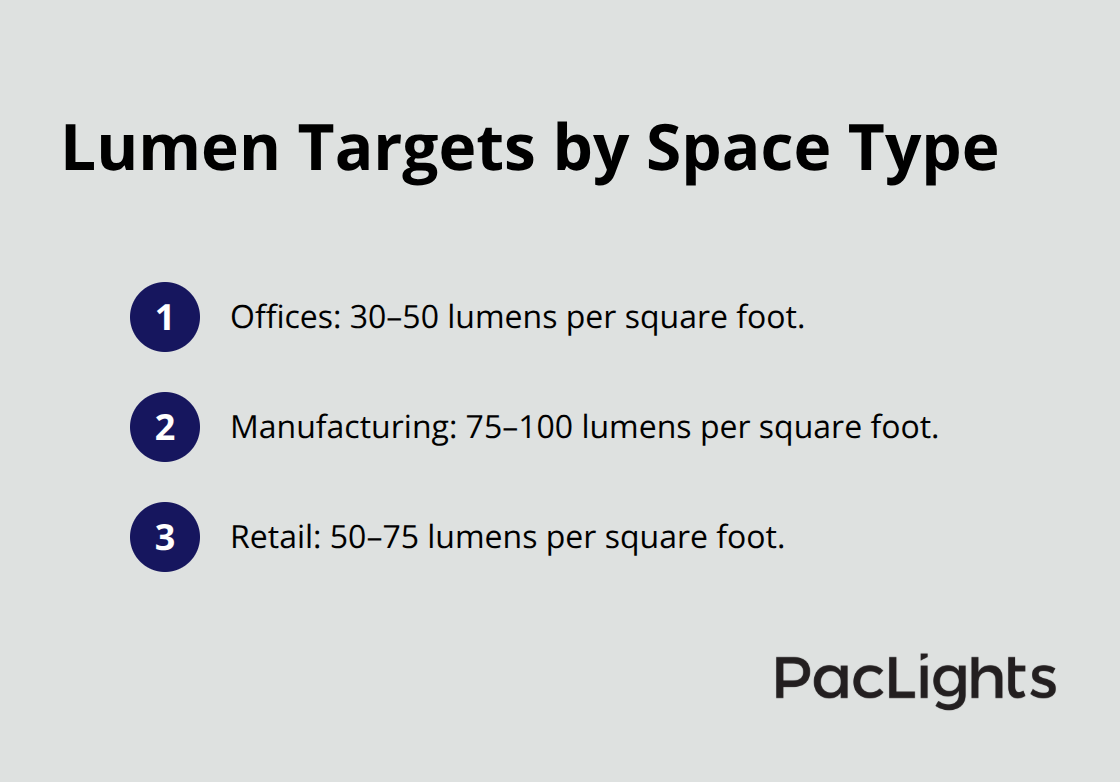
Professional spaces require specific lumen levels to function effectively. Office environments need 30-50 lumens per square foot for general work, while manufacturing facilities demand 75-100 lumens per square foot for detailed assembly tasks. A 4-foot linear LED fixture that produces 4,000 lumens covers approximately 100 square feet in offices but only 50 square feet in industrial settings. Retail spaces perform best with 50-75 lumens per square foot to showcase merchandise without harsh shadows.
Most commercial projects fail because they underestimate lumen requirements. Warehouses with 20-foot ceilings lose 40% of their light output due to distance, so fixtures must compensate with higher initial lumen production. The Department of Energy recommends that you calculate total lumens needed before you select individual fixtures rather than choose fixtures first.
Mounting Constraints Drive Your Installation Approach
Ceiling height dictates your installation strategy more than aesthetic preferences. Suspended fixtures work best with 10+ foot ceilings, while surface-mounted options suit 8-9 foot spaces. Recessed installation requires 6+ inches of plenum space and adds 25-30% to total project costs due to ceiling modifications.
Electrical infrastructure limits fixture placement regardless of your design goals. Existing junction boxes determine where fixtures can mount, and new electrical circuits cost $150-200 per linear foot in commercial buildings. Smart project plans identify electrical constraints before fixture selection to avoid costly modifications during installation.
Color Temperature Affects Productivity and Comfort
Workers perform 15-20% better under 4000K neutral white light compared to 3000K warm white in office environments (according to research studies). Manufacturing facilities benefit from 5000K daylight color temperatures that improve visual acuity during precision work. Retail stores use 3000K warm light in clothing areas but switch to 4000K in electronics sections where product details matter more.
Color Rendering Index above 80 becomes mandatory for spaces where color accuracy affects work quality. Print facilities and art studios require CRI ratings of 90+ to distinguish subtle color variations. General warehouse applications function adequately with CRI 70-80 fixtures that cost 20-25% less than high-CRI alternatives.
These technical specifications form the foundation of proper fixture selection, but modern linear LEDs offer advanced features that can significantly enhance performance and reduce operational costs.
Which Smart Features Cut Your Energy Bills Most
Occupancy Sensors Slash Operating Costs by Half
Motion sensors integrated into linear LED fixtures reduce energy consumption by 40-60% in commercial spaces according to Department of Energy studies. Warehouses achieve the highest savings because workers occupy specific zones for limited periods throughout shifts. Office buildings with occupancy sensors report average electricity cost reductions of $2,400 per year for every 10,000 square feet of space.
Dual-technology sensors combine passive infrared and ultrasonic detection to eliminate false triggers that plague single-sensor systems. These advanced sensors detect movement within 30 feet and maintain lights for 15-30 minutes after spaces become vacant.

Daylight Sensors Maximize Natural Light Benefits
Daylight sensors automatically adjust fixture output based on natural light levels that enter through windows and skylights. Manufacturing facilities near large windows reduce their energy consumption by 25-35% during daylight hours. Photocells integrated directly into fixtures respond faster than centralized systems and provide more precise control over individual zones.
These sensors monitor ambient light levels continuously and dim fixtures when sufficient natural light exists. Retail stores with large storefronts see immediate energy reductions when daylight sensors activate during peak sunlight hours.
Networked Controls Enable Building-Wide Optimization
Networked systems allow facility managers to control thousands of fixtures from centralized software platforms. DALI and 0-10V protocols enable precise brightness control while wireless systems eliminate expensive control wiring installation costs. Large retail chains report 15-20% additional energy savings when they implement networked controls compared to standalone fixture operation.
Smart building integration connects systems with HVAC and security platforms to optimize total building energy consumption. Facilities achieve compound savings when sensors trigger HVAC adjustments and security system responses based on actual occupancy patterns rather than predetermined schedules.
Emergency Battery Backup Integration
Emergency battery backup integration becomes mandatory in egress pathways and stairwells per building codes. Linear fixtures with integrated battery packs eliminate separate emergency systems and reduce installation complexity. Battery backup systems maintain 10% of normal light output for 90 minutes during power outages (which meets most commercial building requirements).
These integrated systems cost 30-40% less than separate emergency fixtures while they provide seamless operation during normal and emergency conditions. Facilities avoid the expense and maintenance complexity of dual fixture installations.
Final Thoughts
Strip lights deliver focused task illumination, wrap lights cover large zones efficiently, and suspended systems create architectural impact in open environments. Your fixture choice must align with specific lumen requirements, mounting limitations, and color temperature needs. Office spaces perform optimally with 4000K neutral white light, while retail environments benefit from warmer 3000K temperatures that enhance customer comfort.
Smart features like occupancy sensors and daylight harvesting reduce energy costs by 40-60%, which makes them worthwhile investments for most commercial applications. Emergency battery backup integration simplifies code compliance while it reduces installation complexity. Professional photometric layouts identify optimal fixture spacing and quantities before you commit to purchases.
We at PacLights help you select the right linear LED fixtures for your specific space requirements and budget constraints. Quality linear LED fixtures deliver 50,000+ hour lifespans and substantial energy savings that justify their initial investment through reduced maintenance and electricity costs over time. Professional installation and proper fixture selection avoid costly mistakes that can impact your project’s long-term performance.
Disclaimer: PacLights is not responsible for any actions taken based on the suggestions and information provided in this article, and readers should consult local building and electrical codes for proper guidance.