

Modular linear lighting transforms how we illuminate commercial and residential spaces. These flexible systems adapt to any layout while delivering consistent, professional-grade illumination.
We at PacLights see businesses struggling with rigid lighting solutions that can’t evolve with their needs. The right modular system solves this problem by offering unlimited configuration possibilities and seamless integration capabilities.
What Makes Modular Linear Lighting Different
Modular linear lighting operates on a fundamentally different principle than traditional fixed systems. Instead of single, rigid fixtures, these systems use individual light modules that connect through magnetic or clip-based mechanisms. Each module typically measures 2-4 feet in length and features built-in connectors that allow seamless connection without visible gaps. The Lighting Design Research Center’s 2024 report shows modular systems achieve 120-140 lumens per watt efficiency, significantly outperforming traditional linear fixtures at 90-100 lumens per watt.
Smart Connectivity Options
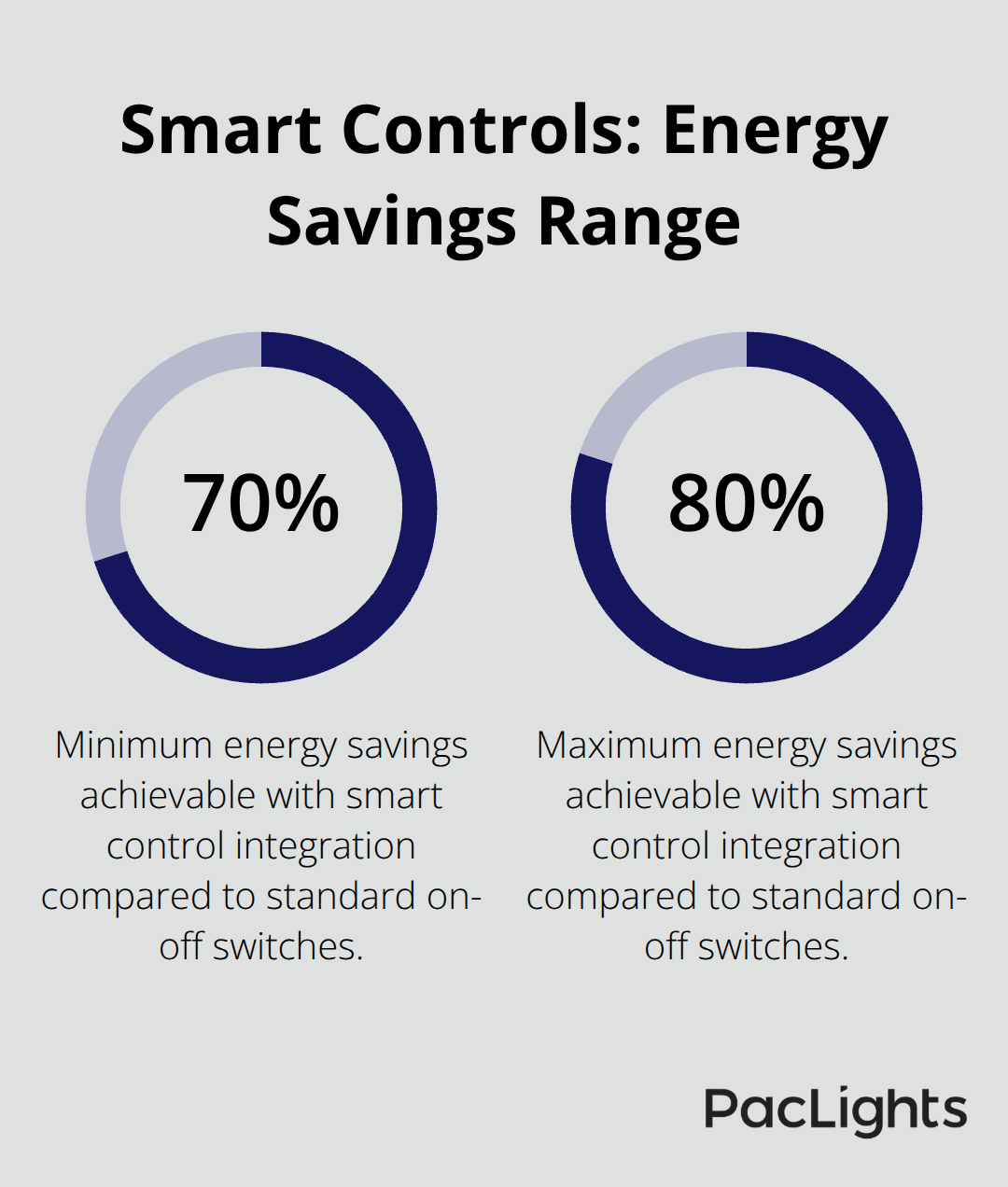
Modern modular systems support multiple control protocols (including DALI, Bluetooth, and Tuya Smart) for comprehensive management. These connections enable zone-based control, automated schedules, and real-time energy monitoring. Low-voltage DC operation at 48V improves safety during installation and maintenance while reducing electrical complexity. Smart control integration can deliver 70-80% energy savings compared to standard on-off switches, making the initial investment recover within 18-24 months for most commercial applications.
Performance Advantages
Modular systems score a perfect 10 for design flexibility compared to traditional linear lighting’s rating of 5, representing 100% improvement in adaptability. Installation time drops by up to 70% due to pre-fabricated connections and magnetic mounts. When modules fail, individual replacement takes minutes rather than hours, minimizing operational disruption. The modular approach allows precise light placement with consistent 300-500 lux illuminance levels across workspaces while maintaining UGR ratings below 19 for optimal visual comfort.
Energy Efficiency Benefits
This granular control eliminates the over-illumination common in fixed systems, reducing energy waste by 30-50% in typical installations. Each module operates independently, allowing users to activate only necessary sections during off-peak hours or low-occupancy periods. The high-quality aluminum construction enhances heat dissipation (extending LED lifespan beyond 50,000 hours) while maintaining consistent light output throughout the system’s operational life.
These technical advantages create the foundation for smart space planning, but selecting the right system requires careful consideration of your specific requirements and environmental factors.
What Specifications Match Your Project Needs
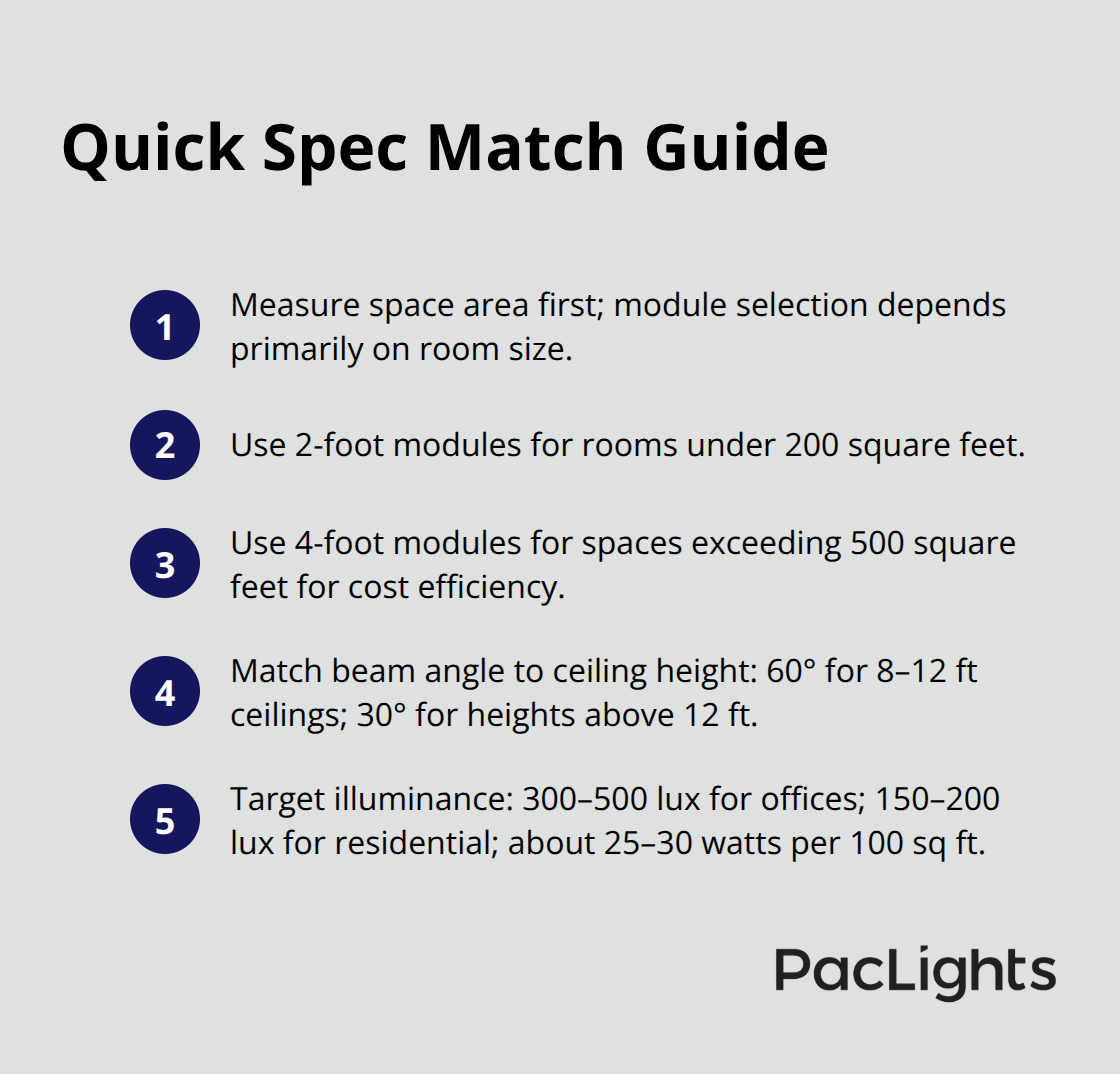
Space dimensions determine module selection more than any other factor. Rooms under 200 square feet perform best with 2-foot modules, while spaces exceeding 500 square feet require 4-foot modules for cost efficiency. Ceiling heights between 8-12 feet need modules with 60-degree beam angles, but heights above 12 feet demand focused 30-degree optics to maintain proper illuminance. The International Association of Lighting Designers recommends maintaining 300-500 lux for office environments and 150-200 lux for residential areas (which translates to approximately 25-30 watts per 100 square feet for LED modular systems).
Light Output Requirements
Color temperature selection depends entirely on function, not preference. Offices require 4000K to maintain alertness and reduce eye strain during computer work. Retail spaces perform better at 3000K to enhance product appeal and encourage longer browsing times. Residential applications work best at 2700K for relaxation and comfort. The Illuminating Engineering Society data shows that incorrect color temperature reduces productivity by 15-20% in work environments. Calculate total lumens by multiplying square footage by required lux levels, then divide by module efficiency ratings to determine the exact number of modules needed.
Control Integration Strategy
DALI protocol offers the most reliable performance for commercial installations with over 20 modules, providing individual addressing and feedback capabilities that Bluetooth systems cannot match. Tuya Smart works effectively for residential applications under 15 modules but lacks the precision control needed for professional environments. Motion sensors should activate zones within 0.5 seconds to prevent user frustration, while daylight harvesting requires sensors calibrated to maintain consistent illuminance regardless of natural light fluctuations. Smart controls typically add 20-30% to initial costs but generate 40-60% energy savings within the first year through automated scheduling and occupancy-based dimming.
Power and Voltage Considerations
Low-voltage DC systems at 48V provide safer installation conditions and reduce electrical complexity compared to traditional AC fixtures. These systems eliminate the need for complex ballasts and reduce heat generation (extending component lifespan beyond 50,000 hours). Power consumption calculations should account for driver efficiency ratings, which typically range from 85-95% in quality modular systems. Factor in 10-15% power overhead for future expansion when sizing electrical circuits and control systems.
Once you establish these technical specifications, proper installation techniques become the foundation for achieving optimal performance and longevity from your modular linear lighting investment.
How Do You Install Modular Linear Lighting Correctly
Proper module spacing requires mathematical precision, not guesswork. Mount modules 36-48 inches apart for uniform illumination in office environments, but reduce this to 24-30 inches in retail spaces where product visibility matters most. The National Electrical Manufacturers Association recommends maintaining centerline spacing at 1.2 times the mounting height for optimal light distribution.
Install modules 18-24 inches from walls to prevent harsh shadows and hotspots. Track mounting systems perform better than individual brackets because they distribute weight evenly and accommodate thermal expansion. Magnetic mounting reduces installation time by 60% compared to traditional screw-fixed systems while allowing quick repositioning during commissioning.
Creating Perfect Light Continuity
Seamless light lines demand modules with identical color temperatures within 100K tolerance and matching lumen output within 5%. The International Commission on Illumination data shows that variations beyond these thresholds create visible boundaries that destroy the continuous effect. Use end-to-end connectors with gasket seals to eliminate light gaps completely.
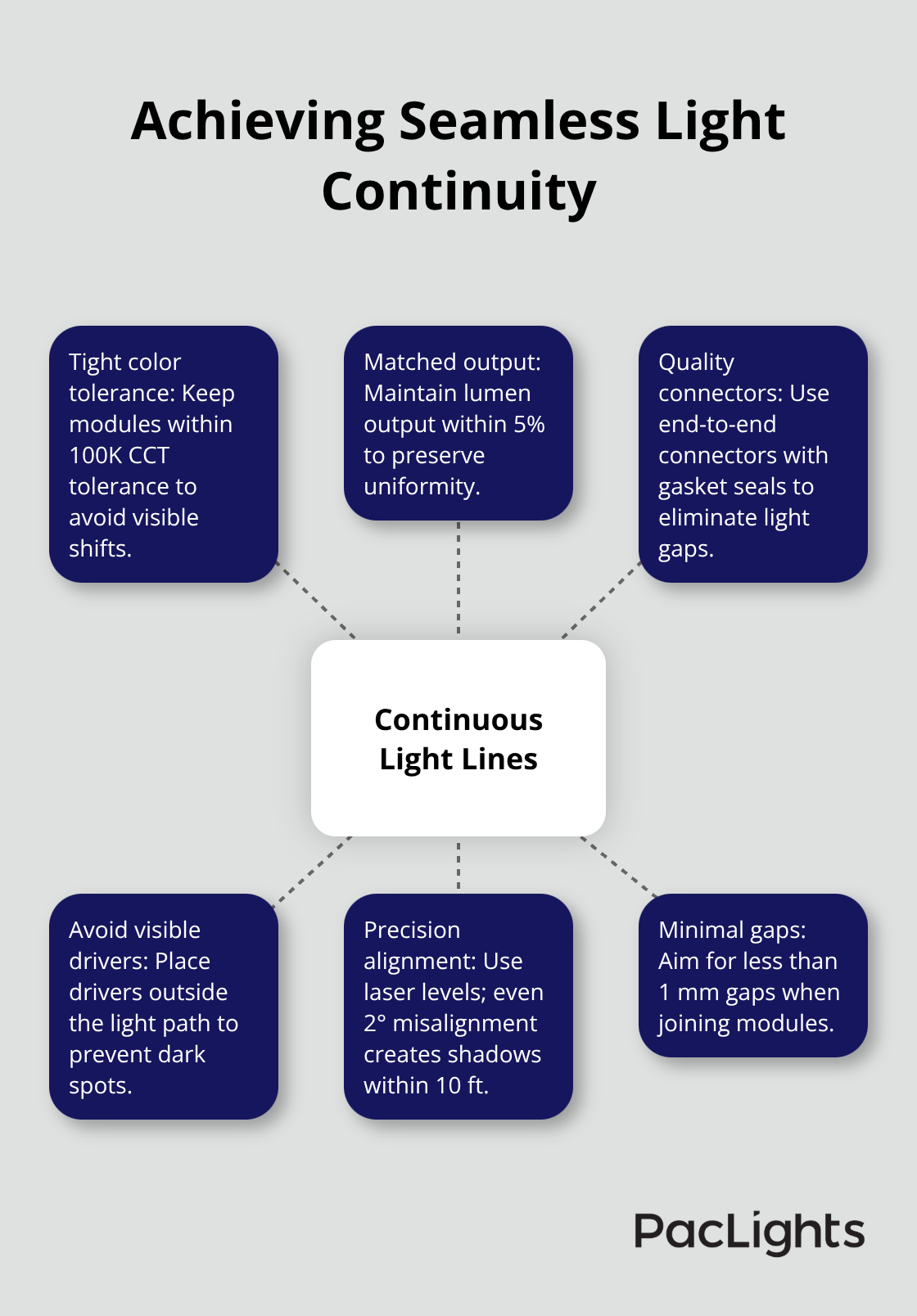
Position drivers outside the visible light path to prevent dark spots between modules. Align all modules with laser levels during installation because even 2-degree misalignment creates noticeable shadows at viewing distances under 10 feet. Quality modular systems maintain less than 1mm gaps between connected units when properly installed.
Electrical Integration Methods
Connect modular systems to dedicated 20-amp circuits to prevent voltage drop issues that reduce LED performance by 15-20%. Install dimming controls on separate neutral conductors to avoid interference with existing circuits. The Institute of Electrical and Electronics Engineers recommends shielded cables for DALI connections longer than 100 feet to prevent signal degradation.
Configure emergency lighting integration through relay modules that maintain 10% output during power failures (meeting safety code requirements). Smart sensors should connect directly to the control bus rather than through wall switches to maintain system intelligence and prevent manual overrides that compromise energy savings.
Final Thoughts
Modular linear lighting selection demands precise technical specifications matched with practical implementation needs. Space dimensions, light output requirements, and control system compatibility create the foundation for successful installations. The 120-140 lumens per watt efficiency and 70% installation time reduction make modular systems outperform traditional fixed options.
Long-term advantages extend far beyond initial cost savings. Individual module replacement reduces maintenance disruption while smart controls deliver 30-50% energy reduction through automated schedules. The perfect 10 flexibility rating allows systems to adapt with space requirements without complete replacement (traditional systems score only 5 for flexibility).
Implementation success requires proper planning and professional guidance. Calculate exact lumen requirements based on space function, select appropriate color temperatures for intended use, and integrate compatible control protocols from the start. We at PacLights offer comprehensive lighting solutions to help optimize your modular linear lighting investment with professional installation that meets safety code requirements.
Disclaimer: PacLights is not responsible for any actions taken based on the suggestions and information provided in this article, and readers should consult local building and electrical codes for proper guidance.