

Warehouse lighting retrofits represent one of the fastest ways to cut operating costs while boosting worker safety and productivity. Energy expenses consume 20-30% of most warehouse budgets, and outdated fixtures waste thousands annually.
At PacLights, we’ve seen firsthand how modern LED systems with smart controls transform warehouse operations. The right retrofit strategy delivers measurable savings within years, not decades.
The Real Financial Impact of Warehouse Lighting
Energy Waste Drains Your Budget
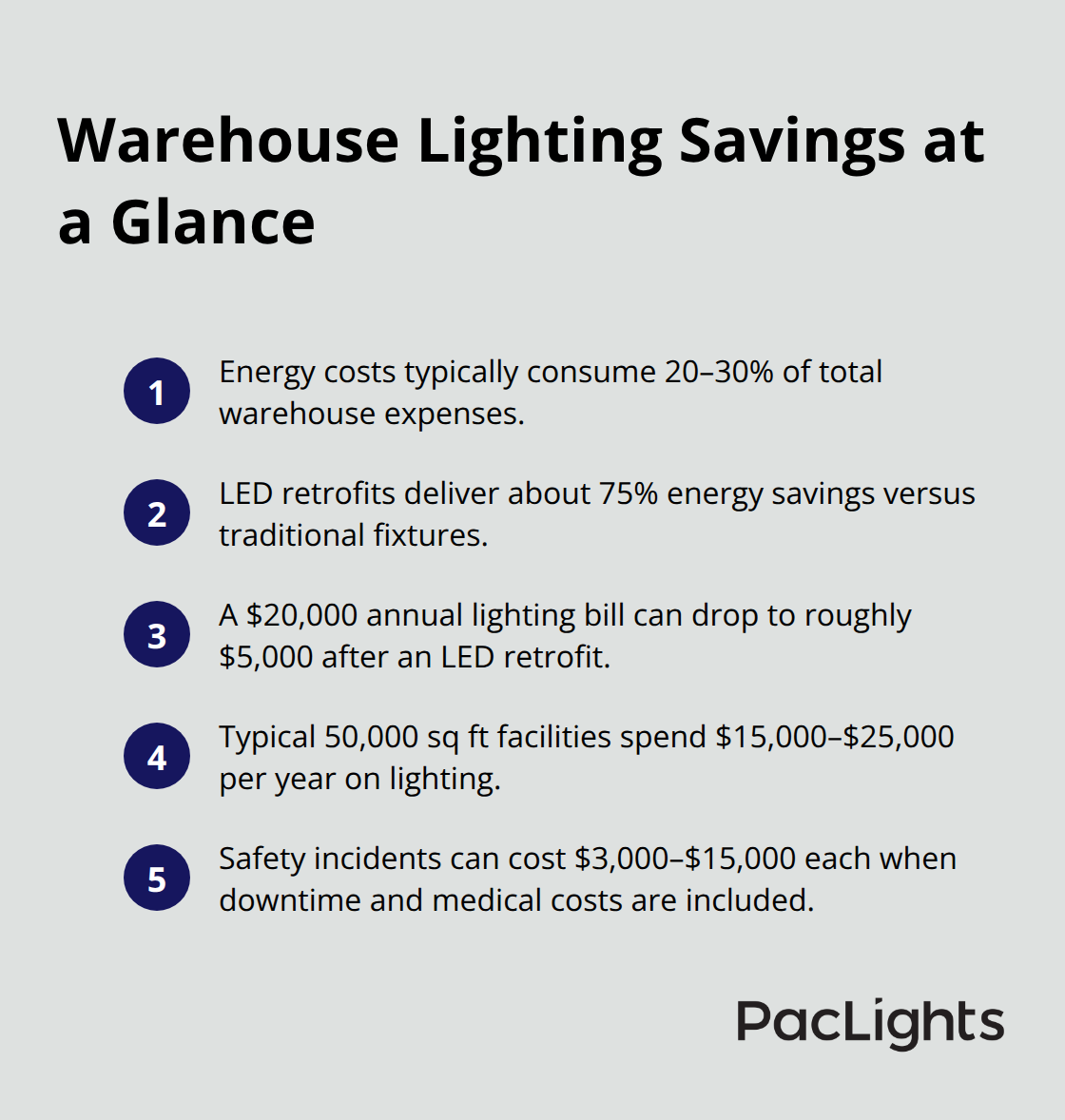
Warehouse managers often underestimate how much lighting drains their operating budget. Energy costs typically consume 20-30% of total warehouse expenses, and the majority of that waste comes from outdated fixtures that simply weren’t designed for modern efficiency. Traditional high-intensity discharge lamps and older fluorescent systems lose enormous amounts of energy as heat rather than light, forcing facilities to run air conditioning harder to compensate.
A facility operating 24/7 across 50,000 square feet might spend $15,000-$25,000 annually just on lighting alone. LED technology changes this equation dramatically by delivering 75% energy savings compared to traditional fixtures. That means a warehouse spending $20,000 yearly on lighting could reduce that to approximately $5,000 after a retrofit.
Hidden Operational Costs Add Up Fast
Poor lighting creates measurable operational problems that compound costs beyond energy bills. Workers in dimly lit warehouses make more picking errors, which increases labor costs and customer complaints. Warehouse accident rates spike in inadequate lighting conditions, leading to workers compensation claims, productivity losses, and potential OSHA violations.
Safety incidents in poorly lit facilities cost warehouses an average of $3,000-$15,000 per incident when accounting for downtime, medical expenses, and investigation costs. These hidden expenses often exceed energy savings alone, making the financial case for retrofits even stronger than energy calculations suggest.
ROI Timeline Proves the Investment Works
Most LED retrofit projects achieve full ROI within 3-5 years, with many facilities seeing payback in 2-3 years depending on current energy rates and retrofit scope. A 100,000-square-foot warehouse retrofitting high-bay LED fixtures with motion sensors and daylight harvesting controls typically invests $40,000-$80,000 upfront but recovers that investment through energy savings alone, without counting productivity gains or reduced accidents.
Motion sensors and daylight harvesting controls cut energy consumption by another 30-50% beyond LED efficiency, meaning a facility can achieve even faster payback. After ROI is achieved, the facility operates with essentially free lighting for the remaining 10-15 year lifespan of the LED fixtures. This economics-first reality reveals why warehouse operators who delay retrofits are essentially choosing to waste money year after year.
What Comes Next
The financial case for retrofits is clear, but success depends on selecting the right fixtures and controls for your specific warehouse layout and operations.
Fixtures and Controls That Actually Cut Costs
High-bay LED fixtures represent the most impactful upgrade for warehouse spaces, and the performance difference against older systems is stark. Traditional metal halide high bays consume 400-1000 watts per fixture while delivering inconsistent illumination with significant heat output that forces cooling systems to work harder. Modern LED high bays operate at 150-300 watts while producing superior brightness uniformity across the warehouse floor. A 50,000-square-foot facility replacing 100 metal halide fixtures with LED equivalents eliminates roughly 50,000-70,000 watts of continuous consumption, translating to approximately $5,000-$8,000 in annual energy savings at average industrial rates. The reduced heat output also decreases air conditioning demand, creating secondary savings that warehouse operators frequently overlook. Brightness consistency matters operationally too-workers experience fewer eye strain issues and make fewer picking errors in evenly lit spaces, which directly impacts labor productivity and error rates.
Motion Sensors and Daylight Harvesting Multiply Your Savings
Motion sensors and daylight harvesting controls cut energy consumption by another 30-50% beyond LED efficiency alone, making them essential for retrofits. Motion sensors dim or turn off fixtures in unoccupied zones, which proves particularly effective in warehouses with variable traffic patterns or shift-based operations. Daylight harvesting automatically reduces fixture output when natural light from skylights or windows provides sufficient illumination, a strategy especially valuable for facilities with significant roof exposure.
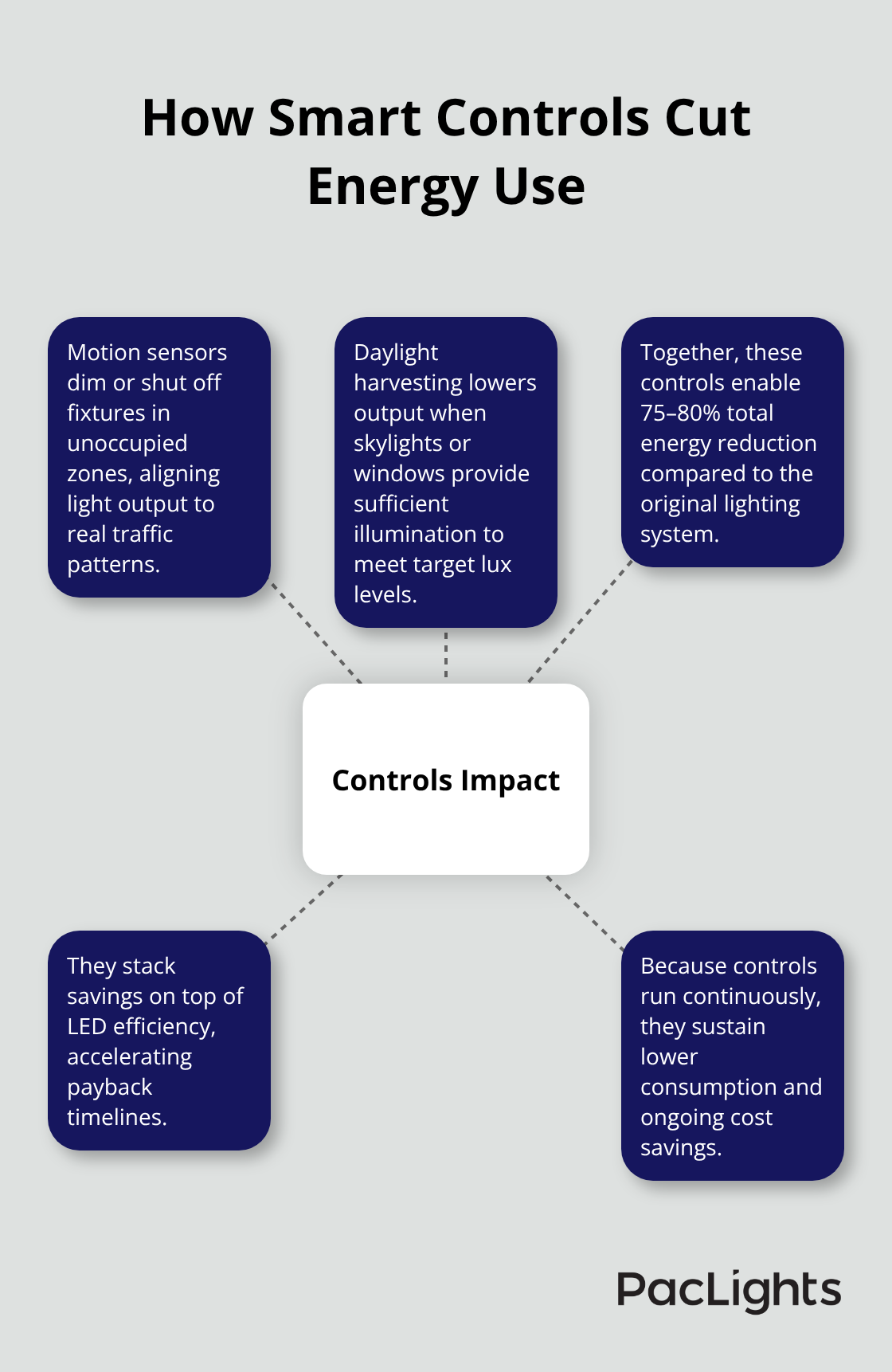
The two technologies work together to produce compounding effects-a warehouse can achieve 75-80% total energy reduction compared to the original system. These control systems pay for themselves rapidly because they operate continuously, unlike one-time efficiency gains from fixture upgrades alone.
Color Temperature Shapes Worker Performance
Upgrading to 5000K color temperature in warehouse spaces produces measurable impacts on worker focus and error rates that directly affect operational costs. Research from the American Society of Lighting Engineers shows that 5000K lighting (neutral daylight) improves visual acuity and alertness compared to warmer 3000K or cooler 6500K alternatives. Warehouses implementing 5000K retrofits report picking error reductions of 10-15% within the first month of operation, according to facility managers. Linear strip lights and flat panel fixtures deliver this color temperature consistently across work surfaces, eliminating dark spots and shadows that create safety hazards. These fixture types also distribute light more evenly than traditional high bays, reducing glare that causes worker fatigue during long shifts.
Selecting the Right Fixtures for Your Warehouse
The fixture type you select determines both immediate performance and long-term operational success. PacLights offers high bays, linear strip lights, and flat panel lights tailored to diverse warehouse needs, with optional motion and daylight controls to further optimize energy use. Flat panel fixtures work well for facilities with lower ceilings or spaces requiring consistent, shadow-free illumination. Linear strip lights suit areas with specific task requirements or where you need to retrofit existing infrastructure with minimal structural changes. High bays remain the standard for traditional warehouse heights and large open spaces where their concentrated output delivers superior coverage.
The right fixture selection sets the foundation for your retrofit, but implementation strategy determines whether you actually capture the savings these systems promise.
How to Plan and Execute Your Warehouse Retrofit
Start With a Professional Energy Audit
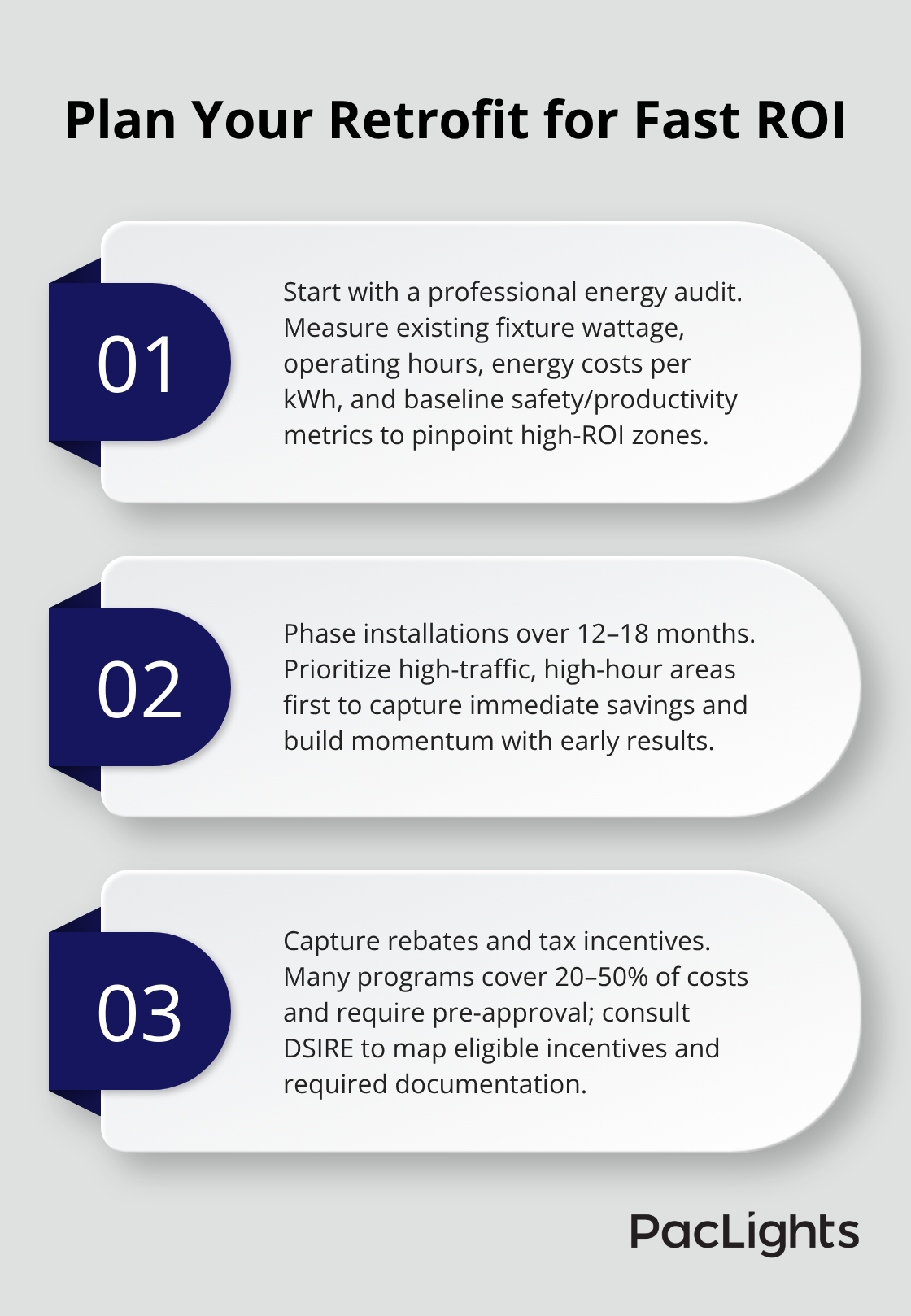
A professional lighting layout design and energy audit form the foundation of any successful retrofit, yet most warehouse managers skip this step to save money upfront. This approach costs thousands in wasted investments because fixture selection without proper site analysis leads to oversized systems that consume unnecessary energy or undersized systems that require expensive additions later. An energy audit identifies exactly where your facility wastes the most energy, quantifies current consumption patterns, and reveals which areas generate the highest ROI potential.
The audit should measure existing fixture wattage, operating hours, current energy costs per kilowatt-hour, and baseline productivity metrics like error rates or accident frequency. This data transforms retrofit decisions from guesswork into precision investments. You’ll know which zones deliver the fastest payback and which areas can wait for later phases.
Prioritize High-Impact Areas First
Phased installation across 12-18 months allows you to spread retrofit costs while capturing immediate savings from completed sections, a strategy far superior to attempting full-facility retrofits in a single project. Prioritize high-traffic zones and areas operating during peak hours first because these spaces generate the fastest payback and demonstrate results that justify continued investment.
A typical 100,000-square-foot warehouse might retrofit its receiving and shipping areas in month one, generating approximately $1,500-$2,000 in monthly energy savings that fund subsequent phases. These early wins create momentum and provide concrete evidence of the retrofit’s financial impact to stakeholders who control budget approvals for later phases.
Capture Available Rebates and Tax Incentives
Utility rebates and tax incentives vary significantly by region, with many programs offering 20-50% cost reductions on LED fixtures and controls. Most utility companies provide direct incentives for commercial lighting upgrades, and these programs can substantially reduce your out-of-pocket investment. Federal tax credits under the Energy Policy Act allow deductions for lighting system improvements, though specific eligibility depends on equipment specifications and installation documentation.
Capturing these incentives requires advance planning because many programs have application deadlines and require pre-approval before installation begins. You should identify available rebates during your energy audit phase rather than after spending money on equipment. The Database of State Incentives for Renewables and Efficiency tracks available programs by location, helping you map out which incentives apply to your facility and what documentation you’ll need to qualify.
Final Thoughts
Warehouse lighting retrofit ideas succeed when they combine immediate financial returns with operational improvements that compound over time. The data proves this consistently: retrofitting from outdated fixtures to modern LED systems with smart controls delivers 75% energy savings, reduces safety incidents, and achieves full ROI within 3-5 years. These results reflect what warehouse operators experience across facilities of all sizes, not theoretical projections.
The real advantage emerges when you treat your retrofit as a strategic investment rather than a cost-cutting exercise. A professional energy audit reveals exactly where your facility wastes money and which upgrades generate the fastest payback, while phased installation lets you capture immediate savings from completed sections and spread costs across multiple budget cycles. Motion sensors and daylight harvesting controls multiply your savings beyond LED efficiency alone, cutting energy consumption by another 30-50% through continuous optimization.
Outdated lighting systems drain thousands annually while creating safety risks and productivity losses that extend far beyond energy bills. Modern LED systems with networked controls eliminate this waste systematically, transforming your facility into an operation that runs more efficiently and safely. Visit PacLights to explore retrofit solutions tailored to your warehouse and receive a professional assessment that quantifies your savings potential.
Disclaimer: PacLights is not responsible for any actions taken based on the suggestions and information provided in this article, and readers should consult local building and electrical codes for proper guidance.