

Picking the right downlights for commercial spaces makes a real difference in how your facility looks and operates. Poor lighting choices waste energy, frustrate employees, and drive up utility bills month after month.
At PacLights, we’ve helped countless businesses find lighting solutions that actually work. This guide walks you through the types available, what to look for when selecting them, and how to get the most from your investment.
What Types of Downlights Work Best for Commercial Spaces
Recessed Downlights for Clean, Professional Spaces
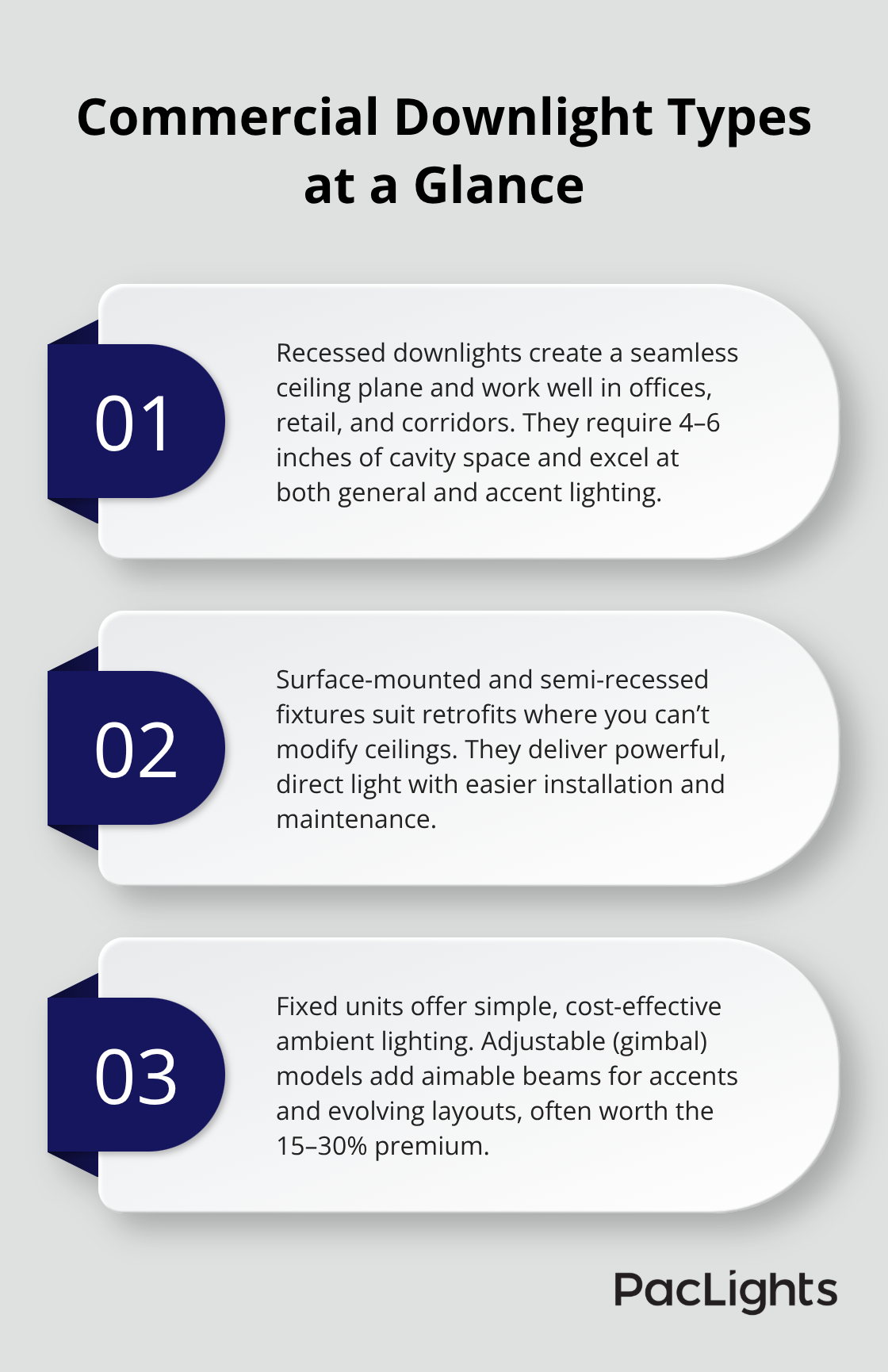
Recessed downlights sit flush with your ceiling and deliver clean, unobstructed light without consuming valuable space. They work exceptionally well in offices, retail environments, and corridors where aesthetics matter. The hidden fixture creates a seamless ceiling appearance, which most commercial clients prefer. Installation requires ceiling cavity space, typically 4 to 6 inches, so you need to plan ahead during renovation or new construction. Recessed units excel at accent lighting too-use them to highlight merchandise, artwork, or architectural features. For warehouses and industrial facilities where ceiling height isn’t a constraint, recessed downlights provide excellent general illumination with proper spacing.
Surface-Mounted and Semi-Recessed Options for Retrofits
Surface-mounted and semi-recessed options offer flexibility when ceiling space is limited or renovations aren’t feasible. Surface-mounted fixtures attach directly to the ceiling surface, making them ideal for retrofits and existing buildings where you can’t modify the structure. Semi-recessed units sit partially into the ceiling, balancing aesthetics with easier installation. These configurations work well in retail shops, showrooms, and commercial kitchens where you need powerful, direct light without major construction. They’re also simpler to maintain and replace than fully recessed units.
The trade-off is that surface-mounted fixtures are more visible, so choose designs that complement your space’s style.
Fixed Versus Adjustable Configurations
Fixed downlights deliver light in a single direction, making them perfect for general ambient lighting across large areas. They cost less upfront and require minimal maintenance since there are no moving parts. Adjustable or gimbal downlights let you aim the light beam where you actually need it, offering superior control for accent lighting and task-specific illumination. Retail environments benefit significantly from adjustable units-you can redirect light as store layouts change without replacing fixtures. The added cost for adjustable models typically ranges from 15 to 30 percent more than fixed options, but that flexibility often justifies the investment in spaces where lighting needs shift seasonally or frequently.
Lumen Output and Spacing Determine Performance
Downlight spacing directly impacts illumination quality and energy consumption. The general rule is to space recessed fixtures 1.5 times the ceiling height apart. A 9-foot ceiling means fixtures should be roughly 13.5 feet apart, though this varies based on lumen output and beam angle. Under-spacing creates hot spots and wastes energy; over-spacing leaves dark patches that frustrate employees and customers. Commercial spaces typically need 30 to 50 foot-candles of illumination, depending on the task. Office work requires around 30 to 50 foot-candles, while retail displays and inspection areas demand 50 to 100 foot-candles.
Getting Your Layout Right
Calculating exact spacing and lumen requirements for your specific facility eliminates guesswork and prevents costly mistakes. At PacLights, we offer free lighting layout designs that account for your ceiling height, room dimensions, and intended use. This approach helps you avoid both under-lit and over-lit areas that waste money. With the right configuration in place, you’re ready to evaluate the other factors that separate effective downlight systems from mediocre ones-brightness levels, energy efficiency, and color temperature all play significant roles in your final selection.
Brightness and Efficiency: What Actually Impacts Your Budget
Lumens Determine Energy Consumption and Operating Costs
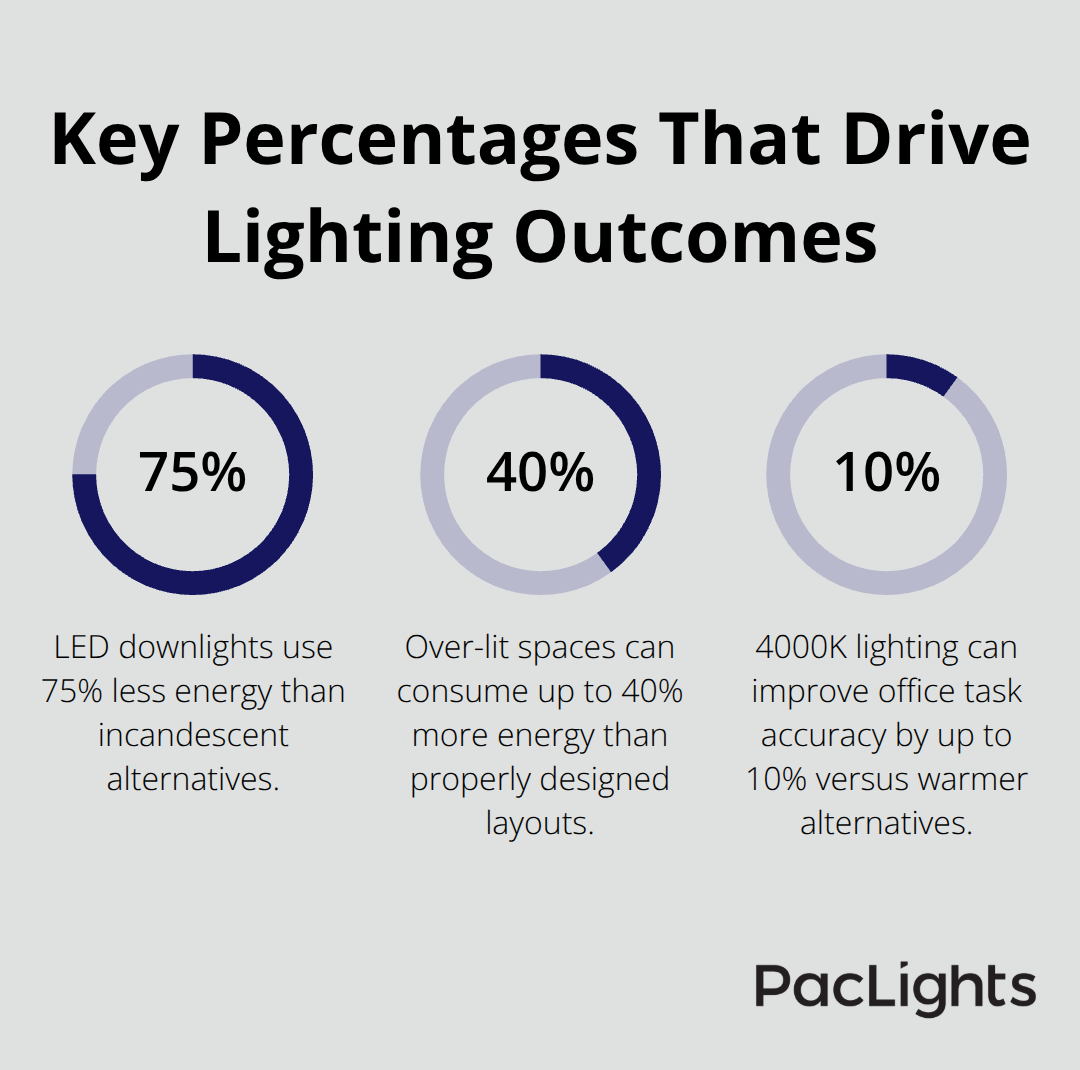
Brightness measured in lumens directly determines whether your facility operates efficiently or wastes thousands annually on unnecessary power consumption. Most commercial spaces need 300 to 500 lumens per downlight for general illumination, but this varies dramatically based on room function and ceiling height. A 10-foot ceiling in an office requires roughly 400 lumens per fixture, while a 12-foot warehouse ceiling might need 600 lumens to achieve the same foot-candle level on the floor. Most facility managers install fixtures with excessive lumen output, thinking brighter always means better. Over-lit spaces consume 20 to 40 percent more energy than properly designed layouts while creating glare and eye strain that reduces employee productivity.
LED Technology Cuts Operating Costs Dramatically
Energy Star data shows that LED downlights use 75 percent less energy than incandescent alternatives, and since commercial downlights typically run 8 to 12 hours daily, the difference compounds quickly. A 50-watt recessed downlight costs $6 monthly to operate, adding up to $72 yearly per fixture. Swap that for a 12-watt LED equivalent producing equivalent light output and you’re down to $17 yearly-a $55 annual savings per fixture. With 20 fixtures in a typical office, that’s $1,100 annually just in electricity costs, before accounting for reduced cooling loads from lower heat output.
These savings justify upgrading to LED fixtures even in facilities with relatively new lighting systems.
Color Temperature Shapes Perception and Performance
Warm white light at 2700K suits retail showrooms and hospitality environments, encouraging customers to linger and spend more time shopping. Neutral white at 4000K works best for offices and task-intensive areas like kitchens or inspection stations, where clarity and focus matter most. Cool white at 5000K or higher creates clinical, sterile environments that frustrate employees and should be avoided in commercial settings unless you’re lighting a laboratory or medical facility. Research from the American Society of Lighting Engineers confirms that 4000K lighting improves task accuracy by 5 to 10 percent compared to warmer alternatives in office environments.
Color Rendering Index Affects How Products and Spaces Appear
The color rendering index (CRI) rating-how accurately colors appear under artificial light-should be minimum 80 for retail spaces and 90 for applications where color matching matters. Cheap downlights with 70 CRI make merchandise look dull and unappealing, while 95 CRI fixtures bring products to life. When you evaluate downlight options, specify both color temperature and CRI upfront to avoid installing fixtures that undermine your facility’s purpose and waste the energy efficiency gains you’ve already achieved through proper lumen selection.
Matching Specifications to Your Facility’s Needs
The right brightness and efficiency combination requires you to assess your specific space requirements rather than apply generic standards across all areas. Task-intensive zones demand higher lumen output and neutral color temperatures, while customer-facing retail areas benefit from warmer tones that enhance product appeal. At PacLights, we offer free lighting layout designs and ROI assessments that account for your facility’s unique characteristics, helping you select fixtures that balance performance with operating costs. Once you’ve determined the right brightness levels and efficiency standards for your space, the next step involves understanding how to physically install and configure these fixtures for maximum performance.
Getting Maximum Performance From Your Downlight Investment
Correct Spacing Eliminates Wasted Energy and Poor Lighting
Proper spacing of downlights determines whether you achieve the efficiency gains and lighting quality you paid for. Incorrect spacing creates uneven illumination that forces employees to work under inadequate light or wastes energy over-lighting certain zones. The general rule of spacing fixtures 1.5 times the ceiling height applies only when you’ve calculated exact lumen requirements for your space. A 10-foot ceiling with 400-lumen fixtures should have units spaced roughly 15 feet apart, but this changes if you increase lumen output to 500 or reduce it to 300. Many facilities position fixtures too close together, thinking density improves uniformity. This approach wastes 15 to 25 percent of your energy budget while creating harsh shadows and glare. Start with a proper lighting layout that accounts for your specific ceiling height, room dimensions, and task requirements before installation begins.
Lighting Controls and Automation Amplify Performance
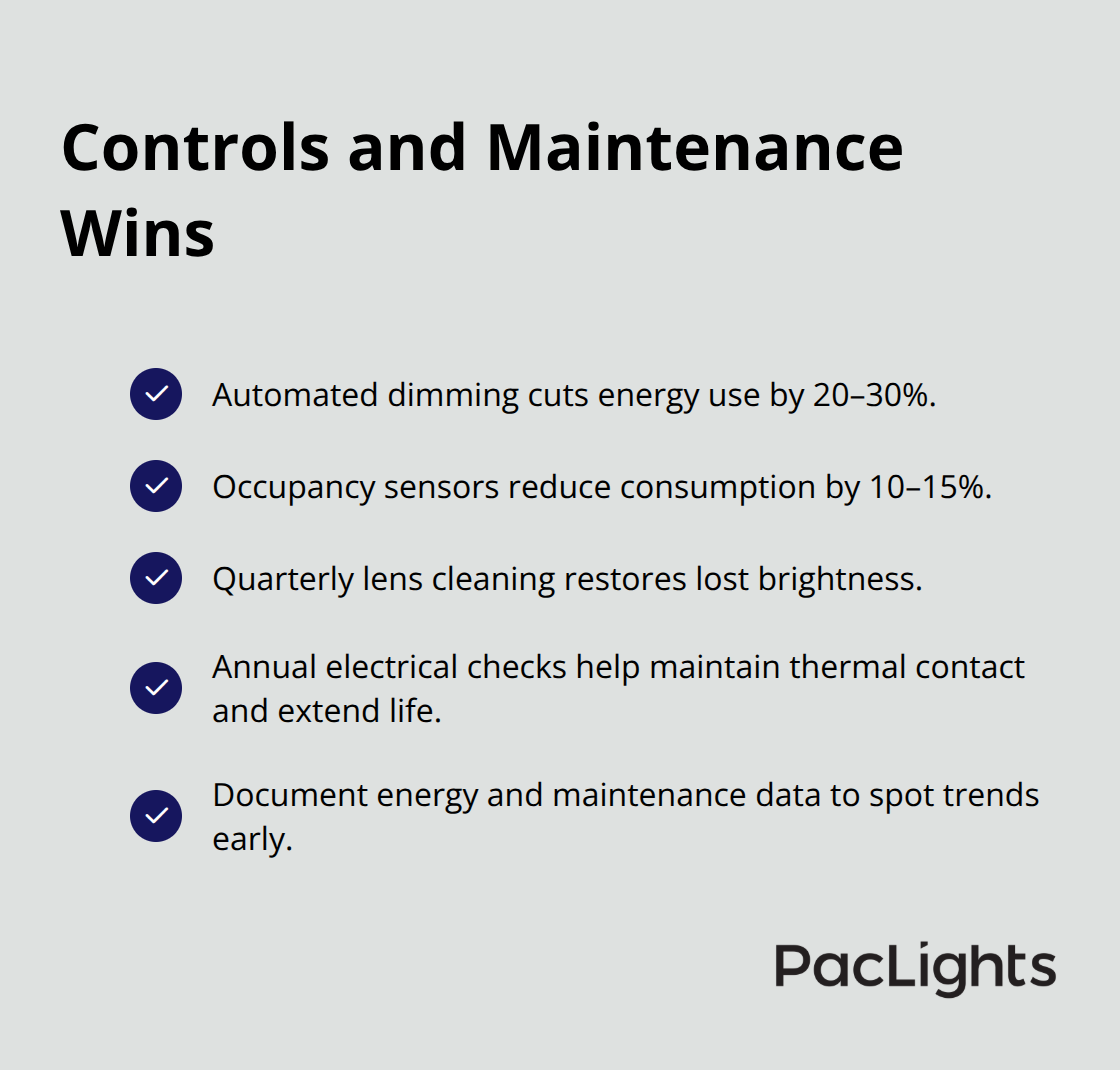
Once fixtures are positioned correctly, lighting controls and automation amplify performance far beyond what static fixtures alone can deliver. Automated dimming systems reduce energy consumption by 20 to 30 percent in spaces where daylight availability changes throughout the day. Occupancy sensors cut energy use by 10 to 15 percent in intermittently used areas like conference rooms or storage facilities. Advanced lighting controls (including networked systems) let you adjust brightness and color temperature remotely, eliminating the need to physically access fixtures to fine-tune performance.
These controls also provide data on energy consumption patterns, helping you identify problem areas and optimize fixture settings over time.
Maintenance Practices Extend Fixture Lifespan and Consistency
Maintenance practices directly impact how long your downlight investment lasts and how consistently fixtures perform. LED downlights typically last 50,000 hours or more, but dust accumulation on lenses reduces light output by 10 to 20 percent within two years if left uncleaned. Quarterly cleaning with a soft, dry cloth restores brightness without requiring fixture replacement. Check fixture connections annually to verify thermal contact between the LED module and heat sink remains tight, as loose connections accelerate component degradation. Facilities that implement quarterly cleaning and annual electrical checks extend fixture lifespan by 30 to 40 percent compared to those using no maintenance schedule. Document maintenance activities and energy consumption data so you can track performance trends and anticipate replacement needs before fixtures fail unexpectedly during critical business hours.
Final Thoughts
Selecting the right downlights for commercial spaces requires you to balance brightness levels matched to your facility’s function, energy efficiency that reduces operating costs, and correct installation that eliminates wasted light and power consumption. Lumen output determines your energy bill, color temperature shapes how employees and customers perceive your space, and spacing prevents both dark patches and wasteful over-lighting. These decisions compound over years of operation, making the difference between a facility that costs thousands annually in unnecessary electricity and one that performs efficiently without compromise.
Professional lighting design transforms these technical requirements into practical solutions tailored to your specific building. A properly designed layout accounts for your ceiling height, room dimensions, task requirements, and existing infrastructure, eliminating guesswork that leads to poor results. Automated controls and maintenance practices then amplify that initial investment, extending fixture lifespan while reducing energy consumption by 20 to 30 percent through dimming and occupancy sensors (facilities that implement this approach recover their upgrade costs within three to five years through energy savings alone).
We at PacLights help commercial and industrial facilities upgrade their lighting systems with energy-efficient fixtures and retrofit solutions. Contact us at paclights.com to discuss your facility’s specific lighting needs and receive a detailed assessment of your potential savings.
Disclaimer: PacLights is not responsible for any actions taken based on the suggestions and information provided in this article, and readers should consult local building and electrical codes for proper guidance.